Notice: تابع WP_Block_Type_Registry::register به طورنادرست فراخوانی شد. نامهای نوع بلوک نباید حروف بزرگ داشته باشند. لطفاً برای اطلاعات بیشتر، اشکال زدایی در وردپرس را مشاهده کنید. (این پیام در نگارش 5.0.0 افزوده شده است.) in /home/ethicsho/public_html/wp-includes/functions.php on line 5313
Warning: Use of undefined constant TDC_PATH_LEGACY - assumed 'TDC_PATH_LEGACY' (this will throw an Error in a future version of PHP) in /home/ethicsho/public_html/wp-content/plugins/td-composer/td-composer.php on line 109
Warning: Use of undefined constant TDSP_THEME_PATH - assumed 'TDSP_THEME_PATH' (this will throw an Error in a future version of PHP) in /home/ethicsho/public_html/wp-content/plugins/td-composer/td-composer.php on line 113 بایگانیهای 2886 - خانه اخلاق پژوهان جوان Notice: Trying to access array offset on value of type bool in /home/ethicsho/public_html/wp-content/plugins/wp-ulike/inc/general-functions.php on line 807
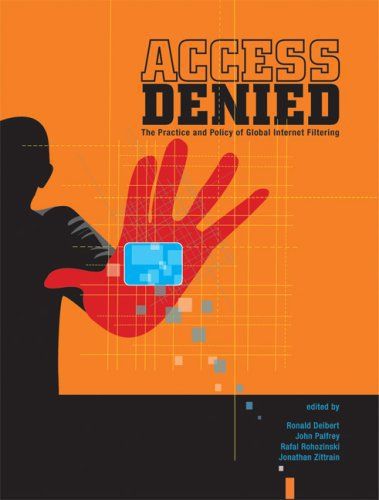
Many countries around the world block or filter Internet content, denying access to information—often about politics, but also relating to sexuality, culture, or religion—that they deem too sensitive for ordinary citizens. Access Denied documents and analyzes Internet filtering practices in over three dozen countries, offering the first rigorously conducted study of this accelerating trend.Internet filtering takes place in at least forty states worldwide including many countries in Asia and the Middle East and North Africa. Related Internet content control mechanisms are also in place in Canada, the United States and a cluster of countries in Europe. Drawing on a just-completed survey of global Internet filtering undertaken by the OpenNet Initiative (a collaboration of the Berkman Center for Internet and Society at Harvard Law School, the Citizen Lab at the University of Toronto, the Oxford Internet Institute at Oxford University, and the University of Cambridge) and relying on work by regional experts and an extensive network of researchers, Access Denied examines the political, legal, social, and cultural contexts of Internet filtering in these states from a variety of perspectives. Chapters discuss the mechanisms and politics of Internet filtering, the strengths and limitations of the technology that powers it, the relevance of international law, ethical considerations for corporations that supply states with the tools for blocking and filtering, and the implications of Internet filtering for activist communities that increasingly rely on Internet technologies for communicating their missions.Reports on Internet content regulation in forty different countries follow, with each country profile outlining the types of content blocked by category and documenting key findings.Contributors: Ross Anderson, Malcolm Birdling, Ronald Deibert, Robert Faris, Vesselina Haralampieva, Steven Murdoch, Helmi Noman, John Palfrey, Rafal Rohozinski, Mary Rundle, Nart Villeneuve, Stephanie Wang, and Jonathan Zittrain
Richard Sorabji presents a ground-breaking study of ancient Greek views of the emotions and their influence on subsequent theories and attitudes, pagan and Christian. The key questions are ones that concern everyone: what is emotion, and how does one cope with one’s own emotions and establish peace of mind? The central focus of the book is the Stoics, but Sorabji draws on a vast range of texts to give a rich historical survey of how Western thinking about this central aspect of human nature developed. The result is a magisterial work of scholarship which will be fascinating for anyone with an interest in the emotions from a historical or contemporary perspective.
Introduction.Part I: Philosophy of Language.1. On Sense and Reference. (Gottlob Frege).2. Thought. (Gottlob Frege).3. On Denoting. (Bertrand Russell).4. On Referring. (P. F. Strawson).5. Meaning. (H. P. Grice).6. Truth and Meaning. (Donald Davidson).7. Identity and Necessity. (Saul Kripke).8. Meaning and Reference. (Hilary Putnam).Further Reading in Philosophy of Language.Part II: Metaphysics.9. On the Relations of Universals and Particulars. (Bertrand Russell).10. From the Tractatus Logico-Philosophicus. (Ludwig Wittgenstein).11. Particular and General. (P. F. Strawson).12. On What There Is. (W. V. Quine).13. The Identity of Indiscernibles. (Max Black).Further Reading in Metaphysics.Part III: Epistemology.14. Four Forms of Skepticism. (G. E. Moore).15. From On Certainty. (Ludwig Wittgenstein).16. Knowledge by Acquaintance and Knowledge by Description. (Bertrand Russell).17. The Problem of the Criterion. (Roderick Chisholm).18. Is Knowledge Justified True Belief? (Edmund Gettier).19. Aspects of Scientific Explanation. (Carl Hempel).20. The New Riddle of Induction. (Nelson Goodman).21. Epistemology Naturalized. (W. V. Quine).Further Reading in Epistemology.Part IV: Philosophy of Mind.22. The Nature of Mind. (David Armstrong).23. The Nature of Mental States. (Hilary Putnam).24. Mental Events. (Donald Davidson).25. What is it Like to Be a Bat? (Thomas Nagel).26. Mad Pain and Martian Pain. (David Lewis).27. Can Computers Think? (John Searle).Further Reading in Philosophy of Mind.Part V: Freedom and Personal Identity.28. The Conceivability of Mechanism. (Norman Malcolm).29. Freedom and Resentment. (P. F. Strawson).30. Human Freedom and the Self. (Roderick Chisholm).31. The Self and the Future. (Bernard Williams).32. Action, Reasons, and Causes. (Donald Davidson).Further Reading in Freedom and Personal Identity.Part VI: Ethics.33. The Subject Matter of Ethics. (G. E. Moore).34. The Emotive Meaning of Ethical Terms. (C. L. Stevenson).35. Justice as Fairness. (John Rawls).36. Modern Moral Philosophy. (G. E. M. Anscombe).37. Morality as a System of Hypothetical Imperatives. (Philippa Foot).Further Reading in Ethics.Part VII: Methodology.38. The Notion of Analysis in Moore’s Philosophy. (C. H. Langford).39. Reply to Langford. (G. E. Moore).40. The Elimination of Metaphysics. (A. J. Ayer).41. Empiricism, Semantics, and Ontology. (Rudolf Carnap).42. A Plea for Excuses. (J. L. Austin).43. Two Dogmas of Empiricism. (W. V. Quine).44. In Defense of a Dogma. (H. P. Grice and P. F. Strawson.45. Philosophy and the Scientific Image of Man. (Wilfrid Sellars).46. From The Blue and the Brown Books. (Ludwig Wittgenstein).Further Reading in Methodology.Index.
The Book That Started A RevolutionSince its original publication in 1975, this groundbreaking work has awakened millions of concerned men and women to the shocking abuse of animals everywhere — inspiring a worldwide movement to eliminate much of the cruel and unnecessary laboratory animal experimentation of years past. In this newly revised and expanded edition, author Peter Singer exposes the chilling realities of today’s “factory forms” and product-testing procedures — offering sound, humane solutions to what has become a profound environmental and social as well as moral issue. An important and persuasive appeal to conscience, fairness, decency and justice, Animal Liberation is essential reading for the supporter and the skeptic alike.
More than any other field in education, the social and cultural foundations of education reflect many of the conflicts, tensions, and forces in American society. This is hardly surprising, since the area focuses on issues such as race, gender, socioeconomic class, the impact of technology on learning, what it means to be educated, and the role of teaching and learning in a societal context.The Encyclopedia of the Social and Cultural Foundations of Education provides a comprehensive introduction to the social and cultural foundations of education. With more than 400 entries, the three volumes of this indispensable resource offer a thorough and interdisciplinary view of the field for all those interested in issues involving schools and society.Key Features· Provides an interdisciplinary perspective from areas such as comparative education, educational anthropology, educational sociology, the history of education, and the philosophy of education· Presents essays on major movements in the field, including the Free School and Visual Instruction movements· Includes more than 130 biographical entries on important men and women in education· Offers interpretations of legal material including Brown v. Board of Education(1954) and the GI Bill of Rights· Explores theoretical debates fundamental to the field such as religion in the public school curriculum, rights of students and teachers, surveillance in schools, tracking and detracking, and many more · Contains a visual history of American education with nearly 350 images and an accompanying narrativeKey Themes· Arts, Media, and Technology· Curriculum· Economic Issues· Equality and Social Stratification· Evaluation, Testing, and Research Methods· History of Education· Law and Public Policy· Literacy· Multiculturalism and Special Populations· Organizations, Schools, and Institutions· Religion and Social Values· School Governance· Sexuality and Gender· Teachers· Theories, Models, and Philosophical Perspectives· A Visual History of American Education
ما از اخلاق چه انتظاری داریم؟ این سوال شاید تاحدودی برای عموم مردم و یا متخصصان این رشته قابل پاسخ باشد؛ اینکه خوب بودن را به ما بیاموزد و در تنظیم روابط فردی م...

جشن کتاب تهران به ایستگاه سی و یکم رسیده است. حال و احوال نشر کتاب خوب نیست و باید فرهنگدوستان را به خرید و هدیه دادن کتاب ترغیب نمود. خانه اخلاقپژوهان جوان ب...

بنیاد کتابهای اخلاق اسلامی عمدتا پالایش جان از آلودگیها و آراستن آن به زیباییها است. اندیشه محوری این قبیل کتابها آن است که انسان فعلی آنی نیست که باید باشد...

-
0 Comments