Notice: تابع WP_Block_Type_Registry::register به طورنادرست فراخوانی شد. نامهای نوع بلوک نباید حروف بزرگ داشته باشند. لطفاً برای اطلاعات بیشتر، اشکال زدایی در وردپرس را مشاهده کنید. (این پیام در نگارش 5.0.0 افزوده شده است.) in /home/ethicsho/public_html/wp-includes/functions.php on line 5313
Warning: Use of undefined constant TDC_PATH_LEGACY - assumed 'TDC_PATH_LEGACY' (this will throw an Error in a future version of PHP) in /home/ethicsho/public_html/wp-content/plugins/td-composer/td-composer.php on line 109
Warning: Use of undefined constant TDSP_THEME_PATH - assumed 'TDSP_THEME_PATH' (this will throw an Error in a future version of PHP) in /home/ethicsho/public_html/wp-content/plugins/td-composer/td-composer.php on line 113 بایگانیهای 2664 - خانه اخلاق پژوهان جوان Notice: Trying to access array offset on value of type bool in /home/ethicsho/public_html/wp-content/plugins/wp-ulike/inc/general-functions.php on line 807
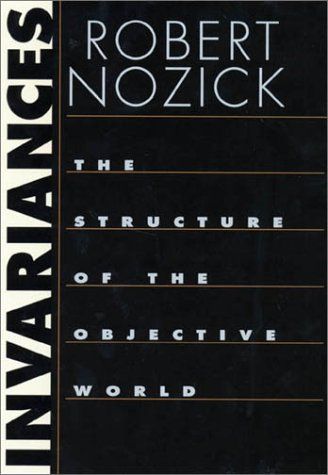
Excerpts from Robert Nozick’s “Invariances” Necessary truths are invariant across all possible worlds, contingent ones across only some. No wonder necessity lures philosophers. It is the flame, the philosopher the moth. Our intuitions that certain statements are necessary do not powerfully support this claim when natural selection would produce strong intuitions of their self-evidence, even were these statements (only) contingently true. Contemporary philosophers who give great weight to intuitions need to offer some account of why such intuitions are reliable and are to be trusted. Of course, if the purpose of such philosophy is merely to codify and systematize the intuitions that (for whatever reason) are held, then a philosophy built upon intuitions will need no further basis. And it will have no further validity. You might think that an insight into metaphysical impossibility could save the physicists much useless work by thereby excluding something as physically possible. Things seem to have worked in the opposite direction, though. Driven by a need to explain strange data, physicists formulate theories that countenance what previously was held to be metaphysically impossible. . . The physical tail wags the metaphysical dog. Why is there an objective world? Within evolutionary cosmology scientific laws might be viewed as the heritable structure of a universe, akin to what in biology would be an organism’s genetic endowment. . . Suppose that the reproductive process of a universe produces transformed offspring universes that differ from their parent. The greater the transformations that a law is invariant under, and the wider their number, the greater is that law’s heritability. The vast majority of the universes that exist through the processes of evolutionary cosmology, therefore, will exhibit laws that are invariant under a wide range of significant transformations. Such invariance, we have seen, is exactly what constitutes objectiveness. Evolutionary cosmology gives us objective worlds.
Charles Hirschkind’s unique study explores how a popular Islamic media form& -the cassette sermon& -has profoundly transformed the political geography of the Middle East over the last three decades. An essential aspect of what is now called the Islamic Revival, the cassette sermon has become omnipresent in most Middle Eastern cities, punctuating the daily routines of many men and women. Hirschkind shows how sermon tapes have provided one of the means by which Islamic ethical traditions have been recalibrated to a modern political and technological order& -to its noise and forms of pleasure and boredom, but also to its political incitements and call for citizen participation. Contrary to the belief that Islamic cassette sermons are a tool of militant indoctrination, Hirschkind argues that sermon tapes serve as an instrument of ethical self-improvement and as a vehicle for honing the sensibilities and affects of pious living. Focusing on Cairo’s popular neighborhoods, Hirschkind highlights the pivotal role these tapes now play in an expanding arena of Islamic argumentation and debate& -what he calls an “Islamic counterpublic.” This emerging arena connects Islamic traditions of ethical discipline to practices of deliberation about the common good, the duties of Muslims as national citizens, and the challenges faced by diverse Muslim communities around the globe. The Ethical Soundscapeis a brilliant analysis linking modern media practices of moral self-fashioning to the creation of increasingly powerful religious publics.
This unique introduction to comparative philosophy brings together Chinese, Indian, and Western philosophers of roughly the same sort, of comparable stature, on the same philosophical topics and issues. Discussions are arranged in traditional clusters — logic, epistemology, metaphysics, ethics, and social and political philosophy. Compares equals to equals — logicians with logicians, metaphysicians with metaphysicians, ethicists with ethicists — e.g., compares Indian, Chinese and Western empiricists, utilitarians, hedonists, egoists, atheists, theists, monists, pluralists, idealists, materialists, dualists, skeptics, relativists, political realists, etc. Treats the strictly philosophical arguments as roughly similar across cultures, but presents the larger cultural contexts in which they occur as considerably different. For anyone interested in comparative philosophy.
How can higher education today create a community of critical thinkers and searchers for truth that transcends the boundaries of class, gender, and nation? Martha C. Nussbaum, philosopher and classicist, argues that contemporary curricular reform is already producing such “citizens of the world” in its advocacy of diverse forms of cross-cultural studies. Her vigorous defense of “the new education” is rooted in Seneca’s ideal of the citizen who scrutinizes tradition critically and who respects the ability to reason wherever it is found–in rich or poor, native or foreigner, female or male.Drawing on Socrates and the Stoics, Nussbaum establishes three core values of liberal education–critical self-examination, the ideal of the world citizen, and the development of the narrative imagination. Then, taking us into classrooms and campuses across the nation, including prominent research universities, small independent colleges, and religious institutions, she shows how these values are (and in some instances are not) being embodied in particular courses. She defends such burgeoning subject areas as gender, minority, and gay studies against charges of moral relativism and low standards, and underscores their dynamic and fundamental contribution to critical reasoning and world citizenship.For Nussbaum, liberal education is alive and well on American campuses in the late twentieth century. It is not only viable, promising, and constructive, but it is essential to a democratic society. Taking up the challenge of conservative critics of academe, she argues persuasively that sustained reform in the aim and content of liberal education is the most vital and invigorating force in higher education today.
ما از اخلاق چه انتظاری داریم؟ این سوال شاید تاحدودی برای عموم مردم و یا متخصصان این رشته قابل پاسخ باشد؛ اینکه خوب بودن را به ما بیاموزد و در تنظیم روابط فردی م...

جشن کتاب تهران به ایستگاه سی و یکم رسیده است. حال و احوال نشر کتاب خوب نیست و باید فرهنگدوستان را به خرید و هدیه دادن کتاب ترغیب نمود. خانه اخلاقپژوهان جوان ب...

بنیاد کتابهای اخلاق اسلامی عمدتا پالایش جان از آلودگیها و آراستن آن به زیباییها است. اندیشه محوری این قبیل کتابها آن است که انسان فعلی آنی نیست که باید باشد...

-
0 Comments