Notice: تابع WP_Block_Type_Registry::register به طورنادرست فراخوانی شد. نامهای نوع بلوک نباید حروف بزرگ داشته باشند. لطفاً برای اطلاعات بیشتر، اشکال زدایی در وردپرس را مشاهده کنید. (این پیام در نگارش 5.0.0 افزوده شده است.) in /home/ethicsho/public_html/wp-includes/functions.php on line 5313
Warning: Use of undefined constant TDC_PATH_LEGACY - assumed 'TDC_PATH_LEGACY' (this will throw an Error in a future version of PHP) in /home/ethicsho/public_html/wp-content/plugins/td-composer/td-composer.php on line 109
Warning: Use of undefined constant TDSP_THEME_PATH - assumed 'TDSP_THEME_PATH' (this will throw an Error in a future version of PHP) in /home/ethicsho/public_html/wp-content/plugins/td-composer/td-composer.php on line 113 بایگانیهای 2467 - خانه اخلاق پژوهان جوان Notice: Trying to access array offset on value of type bool in /home/ethicsho/public_html/wp-content/plugins/wp-ulike/inc/general-functions.php on line 807
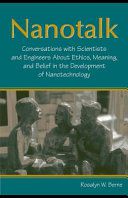
No one really knows where nanotechnology is leading, what its pursuit will mean, and how it may affect human and other forms of life. Nevertheless, its research and development are moving briskly into that unknown. It has been suggested that rapid movement towards ‘who knows where’ is endemic to all technological development; that its researchers pursue it for curiosity and enjoyment, without knowing the consequences, believing that their efforts will be beneficial. Further, that the enthusiasm for development comes with no malicious intent but rather from simple ignorance. Contrary to that commonly held perception about the collective pursuit of technological development, there are individual research scientists and engineers who are quite willing to reflect on the meaning of their work in nanotechnology.Nanotalk is a book of conversations and explorations with thirty five such nano-research scientists and engineers who share their ideas, experiences, perceptions, and beliefs about their work, humanity, nature, change, and the future of the world with nanotechnology. Precisely because of the unknowable nature of nanotechnology research and development, conscientious foresight and ethical reflection are warranted every step of the way. Not only do nanotechnology research and development represent enormous financial commitments, but they also require a profound leap of faith regarding its possible outcomes. Using these conversations as the basis of reflection and deliberation, the author explores the possible significance of nanotechnology to humanity and how it might be pursued conscientiously and ethically.
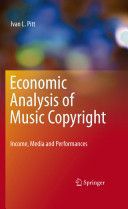
“Chris Anderson’s initial L̀ong Tail’ analysis was released in 2004 just as the wave of mergers and acquisitions was sweeping the music publishing and radio industries. Music industry executives began looking for Anderson’s L̀ong Tail’ effect and with it the implied redistribution of royalty income from popular songs to long dormant and forgotten works in their catalogs. These music publishers had hoped to further maximize the value of their copyright assets (lyrics and melody) in their existing music catalogs as the sale of compact disks diminished, and consumers switched their purchasing and listening habits to new digital formats in music technology such as the iPod.” “This book deals with the measurement of skewness, heavy tails and asymmetry in performance royalty income data in the music industry from an Economics of Art and Culture perspective. The book is divided into two parts. The first part is a general introduction to the many supply and demand economic factors that are related to music performance royalty payments. The second part is an applied econometrics section that provides modeling and in-depth analysis of income data from a songwriter, music publisher and blanket licensing perspective. The book will appeal to researchers and students in cultural economics, media and statistics as well as general readers and professionals in the music publishing industry.” “As a Senior Economist for the American Society of Composers, Authors, and Publishers (ASCAP) using both internal and licensed external proprietary data, the author found that the so-called s̀uperstar effects’ are still present in performance royalty income. Success is still concentrated on a relatively few copyright holders or members who can be grouped into h̀eavy tails’ of the empirical income distribution in a departure from Anderson’s L̀ong Tail’ analysis.”.
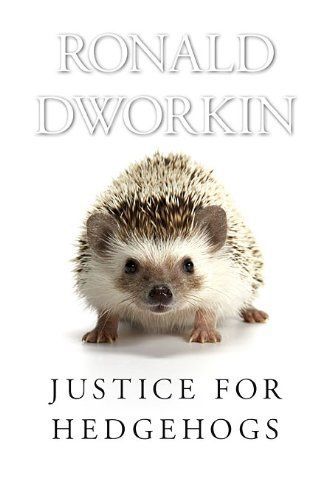
The fox knows many things, the Greeks said, but the hedgehog knows one big thing. In his most comprehensive work the author argues that value in all its forms is one big thing: that what truth is, life means, morality requires, and justice demands are different aspects of the same large question. He develops original theories on a great variety of issues very rarely considered in the same book: moral skepticism, literary, artistic, and historical interpretation, free will, ancient moral theory, being good and living well, liberty, equality, and law among many other topics. What we think about any one of these must stand up, eventually, to any argument we find compelling about the rest. Skepticism in all its forms, philosophical, cynical, or post-modern, threatens that unity. The Galilean revolution once made the theological world of value safe for science. But the new republic gradually became a new empire: the modern philosophers inflated the methods of physics into a totalitarian theory of everything. They invaded and occupied all the honorifics, reality, truth, fact, ground, meaning, knowledge, and being, and dictated the terms on which other bodies of thought might aspire to them, and skepticism has been the inevitable result. The author feels we need a new revolution, and that we must make the world of science safe for value.
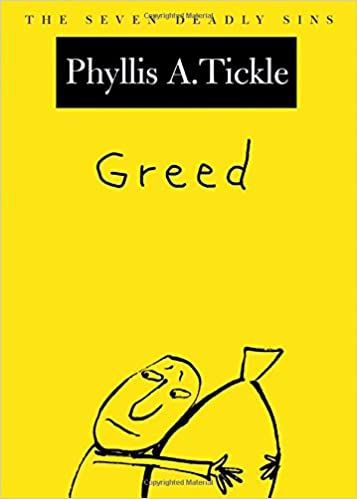
Grasping. Avarice. Covetousness. Miserliness. Insatiable cupidity. Overreaching ambition. Desire spun out of control. The deadly sin of Greed goes by many names, appears in many guises, and wreaks havoc on individuals and nations alike. In this lively and generous book, Phyllis A. Tickle argues that Greed is “the Matriarch of the Deadly Clan,” the ultimate source of Pride, Envy, Sloth, Gluttony, Lust, and Anger. She shows that the major faiths, from Hinduism and Taoism to Buddhism and Christianity regard Greed as the greatest calamity humans can indulge in, engendering further sins and eviscerating all virtues. As the Sikh holy book Adi Granth asks: “Where there is greed, what love can there be?” Tickle takes a long view of Greed, from St. Paul to the present, focusing particularly on changing imaginative representations of Greed in Western literature and art. Looking at such works as the Psychomachia, or “Soul Battle” of the fifth-century poet Aurelius Clemens Prudentius, the paintings of Peter Bruegel and Hieronymous Bosch, the 1987 film Wall Street, and the contemporary Italian artist Mario Donizetti, Tickle shows how our perceptions have evolved from the medieval understanding of Greed as a spiritual enemy to a nineteenth-century sociological construct to an early twentieth-century psychological deficiency, and finally to a new view, powerfully articulated in Donizetti’s mystical paintings, of Greed as both tragic and beautiful. Engaging, witty, brilliantly insightful, Greed explores the full range of this deadly sin’s subtle, chameleon-like qualities, and the enormous destructive power it wields, evidenced all too clearly in the world today.
ما از اخلاق چه انتظاری داریم؟ این سوال شاید تاحدودی برای عموم مردم و یا متخصصان این رشته قابل پاسخ باشد؛ اینکه خوب بودن را به ما بیاموزد و در تنظیم روابط فردی م...

جشن کتاب تهران به ایستگاه سی و یکم رسیده است. حال و احوال نشر کتاب خوب نیست و باید فرهنگدوستان را به خرید و هدیه دادن کتاب ترغیب نمود. خانه اخلاقپژوهان جوان ب...

بنیاد کتابهای اخلاق اسلامی عمدتا پالایش جان از آلودگیها و آراستن آن به زیباییها است. اندیشه محوری این قبیل کتابها آن است که انسان فعلی آنی نیست که باید باشد...

-
0 Comments