Notice: تابع WP_Block_Type_Registry::register به طورنادرست فراخوانی شد. نامهای نوع بلوک نباید حروف بزرگ داشته باشند. لطفاً برای اطلاعات بیشتر، اشکال زدایی در وردپرس را مشاهده کنید. (این پیام در نگارش 5.0.0 افزوده شده است.) in /home/ethicsho/public_html/wp-includes/functions.php on line 5313
Warning: Use of undefined constant TDC_PATH_LEGACY - assumed 'TDC_PATH_LEGACY' (this will throw an Error in a future version of PHP) in /home/ethicsho/public_html/wp-content/plugins/td-composer/td-composer.php on line 109
Warning: Use of undefined constant TDSP_THEME_PATH - assumed 'TDSP_THEME_PATH' (this will throw an Error in a future version of PHP) in /home/ethicsho/public_html/wp-content/plugins/td-composer/td-composer.php on line 113 بایگانیهای 2273 - خانه اخلاق پژوهان جوان Notice: Trying to access array offset on value of type bool in /home/ethicsho/public_html/wp-content/plugins/wp-ulike/inc/general-functions.php on line 807
The first edition of Caroline Whitbeck’s Ethics in Engineering Practice and Research focused on the difficult ethical problems engineers encounter in their practice and in research. In many ways, these problems are like design problems: they are complex, often ill defined; resolving them involves an iterative process of analysis and synthesis; and there can be more than one acceptable solution. In the second edition of this text, Dr. Whitbeck goes above and beyond by featuring more real-life problems, stating recent scenarios, and laying the foundation of ethical concepts and reasoning. This book offers a real-world, problem-centered approach to engineering ethics, using a rich collection of open-ended case studies to develop skill in recognizing and addressing ethical issues.
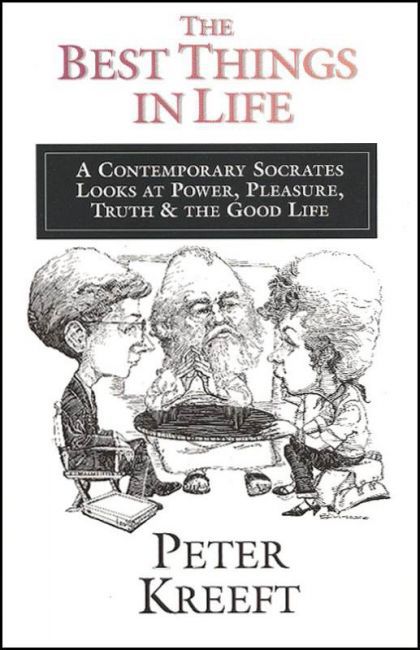
What are the best things in life? Questions like that may boggle your mind. But they don’t boggle Socrates. The indomitable old Greek brings his unending questions to Desperate State University. With him come the same mind-opening and spirit-stretching challenge that disrupted ancient Athens. What is the purpose of education? Why do we make love?What good is money? Can computers think like people? Is there a difference between Capitalism and Communism? What is the greatest good? Is belief in God like belief in Santa Claus?
In twelve short, Socratic dialogues Peter Kreeft explodes contemporary values like success, power and pleasure. And he bursts the modern bubbles of agnosticism and subjectivism. He leaves you richer, wiser and more able to discern what the best things in life actually are.
Purchase of this book includes free trial access to www.million-books.com where you can read more than a million books for free. This is an OCR edition with typos. Excerpt from book: when completely formed. Many of our most important perceptions through the eye are universally acknowledged to be acquired. But they are as general as the original perceptions of that organ; they arise as independently of our will, and human nature would be quite as imperfect without them. An adult who did not immediately see the different distances of objects from his eye, would be thought by every one to be as great a deviation from the ordinary state of man as if he were incapable of distinguishing the brightest sunshine from the darkest midnight. Acquired perceptions and sentiments may therefore be termed natural, as much as those which are more com- monly so called, if they be as rarely found wanting. Ethical theories can never be satisfactorily discussed by those who do not constantly bear in mind, that the question concerning the existence of a moral faculty in man which immediately approves or disapproves without reference to any further object, is perfectly distinct, on the one hand, from that which inquires into the qualities thus approved or disapproved; and on the other, from an inquiry whether that faculty be derived from other parts of our mental frame, or be itself one of the ultimate constituent principles of human nature. SECTION II. Retrospect of Ancient Ethics. Inquiries concerning the nature of mind, the first principles of knowledge, the origin and government of the world, appear to have been among the earliest objects which employed the understanding of civilized men. Fragments of such speculation are handed down fromthe legendary age of Greek philosophy. In the remaining monuments of that more ancient form of civilization which sprung up in Asia, we see clearly that the Bra- minical philosophers, in times perhaps before the dawn of western history, …
This timely reader in moral philosophy addresses a controversy that strongly affected recent European reflections on the relevance of ethics for theories of democratic institutions and democratic legitimacy. The debate centers around the idea of a communicative ethics as articulated by Jurgen Habermas and Karl-Otto Apel, and it is representative both of recent attempts to bridge the gap between Continental and Anglo-American philosophy and of the turn to language that has characterized much of recent philosophy.The Communicative Ethics Controversy illustrates philosophical dialogue in action, moving from theses to counterarguments to rejoinders. Theoretical statements by Habermas, Apel, and two of their leading students, Dietrich Bohler and Robert Alexy, are followed by a series of five arguments by their leading critics, who represent viewpoints ranging from Kantian idealism to Wittgensteinian ordinary-language theory. Fred Dallmayr’s introduction and Seyla Benhabib’s incisive conclusion place the debate in perspective, bringing it up to date and relating it to the Anglo-American context.Seyla Benhabib is Associate Professor of Philosophy and Women’s Studies at the State University of New York, Stony Brook. Fred Dallmayr is Packey Dee Professor of Government at the University of Notre Dame.Contributors: Robert Alexy. Karl-Otto Apel. Seyla Benhabib. Dietrich Bohler. Jurgen Habermas. Otfried Hoffe. KarlHeinz Ilting. Hermann Lubbe. Herbert Schnadelbach. Albrecht Wellmer.
ما از اخلاق چه انتظاری داریم؟ این سوال شاید تاحدودی برای عموم مردم و یا متخصصان این رشته قابل پاسخ باشد؛ اینکه خوب بودن را به ما بیاموزد و در تنظیم روابط فردی م...

جشن کتاب تهران به ایستگاه سی و یکم رسیده است. حال و احوال نشر کتاب خوب نیست و باید فرهنگدوستان را به خرید و هدیه دادن کتاب ترغیب نمود. خانه اخلاقپژوهان جوان ب...

بنیاد کتابهای اخلاق اسلامی عمدتا پالایش جان از آلودگیها و آراستن آن به زیباییها است. اندیشه محوری این قبیل کتابها آن است که انسان فعلی آنی نیست که باید باشد...

-
0 Comments