Notice: تابع WP_Block_Type_Registry::register به طورنادرست فراخوانی شد. نامهای نوع بلوک نباید حروف بزرگ داشته باشند. لطفاً برای اطلاعات بیشتر، اشکال زدایی در وردپرس را مشاهده کنید. (این پیام در نگارش 5.0.0 افزوده شده است.) in /home/ethicsho/public_html/wp-includes/functions.php on line 5313
Warning: Use of undefined constant TDC_PATH_LEGACY - assumed 'TDC_PATH_LEGACY' (this will throw an Error in a future version of PHP) in /home/ethicsho/public_html/wp-content/plugins/td-composer/td-composer.php on line 109
Warning: Use of undefined constant TDSP_THEME_PATH - assumed 'TDSP_THEME_PATH' (this will throw an Error in a future version of PHP) in /home/ethicsho/public_html/wp-content/plugins/td-composer/td-composer.php on line 113 بایگانیهای 2090 - خانه اخلاق پژوهان جوان Notice: Trying to access array offset on value of type bool in /home/ethicsho/public_html/wp-content/plugins/wp-ulike/inc/general-functions.php on line 807
This is the first English translation of all of Kant’s writings on moral and political philosophy collected in a single volume. No other collection competes with the comprehensiveness of this one. As well as Kant’s most famous moral and political writings, the Groundwork to the Metaphysics of Morals, the Critique of Practical Reason, the Metaphysics of Morals, and Toward Perpetual Peace, the volume includes shorter essays and reviews, some of which have never been translated before. There is also an English-German and German-English glossary of key terms.
R. Jay Wallace argues in this book that moral accountability hinges on questions of fairness: When is it fair to hold people morally responsible for what they do? Would it be fair to do so even in a deterministic world? To answer these questions, we need to understand what we are doing when we hold people morally responsible, a stance that Wallace connects with a central class of moral sentiments, those of resentment, indignation, and guilt. To hold someone responsible, he argues, is to be subject to these reactive emotions in one’s dealings with that person. Developing this theme with unusual sophistication, he offers a new interpretation of the reactive emotions and traces their role in our practices of blame and moral sanction. With this account in place, Wallace advances a powerful and sustained argument against the common view that accountability requires freedom of will. Instead, he maintains, the fairness of holding people responsible depends on their rational competence: the power to grasp moral reasons and to control their behavior accordingly. He shows how these forms of rational competence are compatible with determinism. At the same time, giving serious consideration to incompatibilist concerns, Wallace develops a compelling diagnosis of the common assumption that freedom is necessary for responsibility. Rigorously argued, eminently readable, this book touches on issues of broad concern to philosophers, legal theorists, political scientists, and anyone with an interest in the nature and limits of responsibility.
This first book of its kind for the medical profession brings the real-world translation of ethics to the care of patients, conduct of protocols, and training of professionals. An interactive, case-oriented approach to mental health ethics, Professionalism and Ethics: Q & A Self-Study Guide for Mental Health Professionals consists of questions and answers developed by the authors and fourteen contributors from backgrounds as diverse as family medicine, research ethics, social psychology, and public health. They draw on personal experience in the care of people with mental illness, in mental health research, and in clinical training to generate scenarios that pose ethical questions. Some questions are narrow and to the point, such as responding to a suspicion of child abuse; others require a more nuanced approach, such as dealing with conflict of interest posed by a pharmaceutical company. They then resolve these questions in alignment with an understanding of ethical principles, the standards of their fields, the law, and the expectations of mental health professionals. The brief case descriptions that frame each ethical question echo the real-life complexities of clinical practice and are presented in single-answer, multiple-choice format modeled after key medical licensure and specialty certification organizations. Following an overview of ethics and professionalism, questions cover four broad areas: core concepts, clinical care, medical research, and interactions with colleagues and trainees. Explanations following the questions offer background information about relevant ethical concepts and related legal and clinical considerations. A subsequent section features another set of questions for self-assessment, followed by answers with citations to appropriate references. The book’s overall approach is geared to underscore the following areas of concern: • Essential ethical skills, such as understanding how personal values affect patient care, recognizing high-risk situations in which ethical problems arise, and building ethical safeguards• Core ethical principles, including nonmaleficence, beneficence, autonomy, respect, justice, veracity, fidelity, and privacy• Key clinical ethics issues, including maintaining therapeutic boundaries, patient non-abandonment, informed consent and treatment refusal, alternative decision making and advance directives, confidentiality, reporting colleague misconduct, and caring for difficult patients. Trainees and experienced clinicians alike will be richly rewarded by considering the dilemmas posed here. Developed with an extensive review process, reference verifications, and iterative crosschecks, this book facilitates professionalism as a core competency in medicine as it instills the need for ongoing consideration of ethical behaviors and principles in the daily practice of psychiatry.
Adam Smith (1723-90) is celebrated all over the world as the author ofThe Wealth of Nationsand the founder of modern economics. A few of his ideas–that of the “invisible hand” of the market and that “It is not from the benevolence of the butcher, the brewer, or the baker that we expect our dinner, but from their regard to their own interest” have become iconic. Yet Smith saw himself primarily as a philosopher rather than an economist and would never have predicted that the ideas for which he is now best known were his most important. This book shows the extent to whichThe Wealth of Nationsand Smith’s other great work,The Theory of Moral Sentiments,were part of a larger scheme to establish a grand “Science of Man,” one of the most ambitious projects of the European Enlightenment, which was to encompass law, history, and aesthetics as well as economics and ethics, and which was only half complete on Smith’s death in 1790. Nick Phillipson reconstructs Smith’s intellectual ancestry and shows what Smith took from, and what he gave to, in the rapidly changing intellectual and commercial cultures of Glasgow and Edinburgh as they entered the great years of the Scottish Enlightenment. Above all he explains how far Smith’s ideas developed in dialogue with those of his closest friend, the other titan of the age, David Hume.
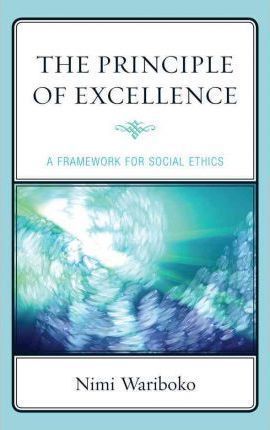
In The Principle of Excellence, Nimi Wariboko deconstructs the traditional, depoliticized meaning of virtue, providing a thorough reading of the debates, conceptual struggles, and ambiguities used by virtue ethicists to produce today’s conception of excellence. He presents a new meaning of excellence, explaining the ways communities can use excellence as the organizing principle for their political and economic development, and exploring how large-scale modern societies can be better administered in environments characterized by contingency and possibilities.
ما از اخلاق چه انتظاری داریم؟ این سوال شاید تاحدودی برای عموم مردم و یا متخصصان این رشته قابل پاسخ باشد؛ اینکه خوب بودن را به ما بیاموزد و در تنظیم روابط فردی م...

جشن کتاب تهران به ایستگاه سی و یکم رسیده است. حال و احوال نشر کتاب خوب نیست و باید فرهنگدوستان را به خرید و هدیه دادن کتاب ترغیب نمود. خانه اخلاقپژوهان جوان ب...

بنیاد کتابهای اخلاق اسلامی عمدتا پالایش جان از آلودگیها و آراستن آن به زیباییها است. اندیشه محوری این قبیل کتابها آن است که انسان فعلی آنی نیست که باید باشد...

-
0 Comments