Notice: تابع WP_Block_Type_Registry::register به طورنادرست فراخوانی شد. نامهای نوع بلوک نباید حروف بزرگ داشته باشند. لطفاً برای اطلاعات بیشتر، اشکال زدایی در وردپرس را مشاهده کنید. (این پیام در نگارش 5.0.0 افزوده شده است.) in /home/ethicsho/public_html/wp-includes/functions.php on line 5313
Warning: Use of undefined constant TDC_PATH_LEGACY - assumed 'TDC_PATH_LEGACY' (this will throw an Error in a future version of PHP) in /home/ethicsho/public_html/wp-content/plugins/td-composer/td-composer.php on line 109
Warning: Use of undefined constant TDSP_THEME_PATH - assumed 'TDSP_THEME_PATH' (this will throw an Error in a future version of PHP) in /home/ethicsho/public_html/wp-content/plugins/td-composer/td-composer.php on line 113 بایگانیهای 1508 - خانه اخلاق پژوهان جوان Notice: Trying to access array offset on value of type bool in /home/ethicsho/public_html/wp-content/plugins/wp-ulike/inc/general-functions.php on line 807
China has the highest levels of copyright piracy and trademark counterfeiting in the world, even though it also provides the highest per capita volume of enforcement. In this original study of intellectual property rights (IPR) in relation to state capacity, Dimitrov analyzes this puzzle by offering the first systematic analysis of all IPR enforcement avenues in China, across all IPR subtypes. He shows that the extremely high volume of enforcement provided for copyrights and trademarks is unfortunately of a low quality, and as such serves only to perpetuate IPR violations. In the area of patents, however, he finds a low volume of high-quality enforcement. In light of these findings, the book develops a theory of state capacity that conceptualizes the Chinese state as simultaneously weak and strong. It also demonstrates that fully rationalized enforcement of domestic and foreign IPR is emerging unevenly and, somewhat counter-intuitively, chiefly in those IPR subtypes that are least subject to domestic or foreign pressure. The book draws on extensive fieldwork in China and five other countries, as well as on 10 unique IPR enforcement datasets that exploit previously unexplored sources, including case files of private investigation firms.
Religion is a dominant force in the lives of many Americans. It animates, challenges, directs and shapes, as well, the legal, political, and scientific agendas of the new Age of Biotechnology. In a very real way, religion, biomedical technology and law are – epistemologically – different. Yet, they are equal vectors of force in defining reality and approaching an understanding of it. Indeed, all three share a synergetic relationship, for they seek to understand and improve the human condition. This book strikes a rich balance between thorough analysis (in the body), anchored in sound references to religion, law and medical scientific analysis, and a strong scholarly direction in the end notes. It presents new insights into the decision-making processes of the new Age of Biotechnology and shows how religion, law and medical science interact in shaping, directing and informing the political processes. This volume will be of interest to both scholars and practitioners in the fields of religion and theology, philosophy, ethics, (family) law, science, medicine, political science and public policy, and gender studies. It will serve as a reference source and can be used in graduate and undergraduate courses in law, medicine and religion.
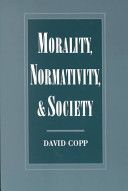
Moral claims not only assume to be true, but they also guide our choices. This fascinating book presents a new theory of normative judgment, the “standard-based theory,” which offers a schematic account of the truth conditions of normative propositions of all kinds, including moral propositions and propositions about reasons. Here, David Copp argues that because any society needs a social moral code in order to enable its members to live together successfully, and because it would be rational for a society to choose such a system, certain moral codes–and the standards they include–are justified. In this work, Copp raises a number of important issues in moral theory, as well as in metaphysics and the philosophy of language.
ما از اخلاق چه انتظاری داریم؟ این سوال شاید تاحدودی برای عموم مردم و یا متخصصان این رشته قابل پاسخ باشد؛ اینکه خوب بودن را به ما بیاموزد و در تنظیم روابط فردی م...

جشن کتاب تهران به ایستگاه سی و یکم رسیده است. حال و احوال نشر کتاب خوب نیست و باید فرهنگدوستان را به خرید و هدیه دادن کتاب ترغیب نمود. خانه اخلاقپژوهان جوان ب...

بنیاد کتابهای اخلاق اسلامی عمدتا پالایش جان از آلودگیها و آراستن آن به زیباییها است. اندیشه محوری این قبیل کتابها آن است که انسان فعلی آنی نیست که باید باشد...

-
0 Comments