Notice: تابع WP_Block_Type_Registry::register به طورنادرست فراخوانی شد. نامهای نوع بلوک نباید حروف بزرگ داشته باشند. لطفاً برای اطلاعات بیشتر، اشکال زدایی در وردپرس را مشاهده کنید. (این پیام در نگارش 5.0.0 افزوده شده است.) in /home/ethicsho/public_html/wp-includes/functions.php on line 5313
Warning: Use of undefined constant TDC_PATH_LEGACY - assumed 'TDC_PATH_LEGACY' (this will throw an Error in a future version of PHP) in /home/ethicsho/public_html/wp-content/plugins/td-composer/td-composer.php on line 109
Warning: Use of undefined constant TDSP_THEME_PATH - assumed 'TDSP_THEME_PATH' (this will throw an Error in a future version of PHP) in /home/ethicsho/public_html/wp-content/plugins/td-composer/td-composer.php on line 113 بایگانیهای 1275 - خانه اخلاق پژوهان جوان Notice: Trying to access array offset on value of type bool in /home/ethicsho/public_html/wp-content/plugins/wp-ulike/inc/general-functions.php on line 807
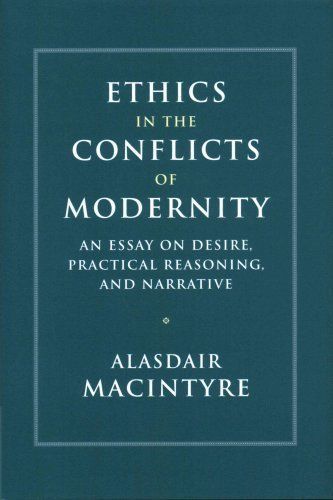
“This essay is divided into five chapters. In the first the questions initially posed about our desires and how we should think about them are questions that plain non philosophical persons often find themselves asking. When however they carry their attempt to answer these questions a little further, they find that they have, perhaps inadvertently, become philosophers, and that they need some at least of the conceptual and argumentative resources which professional philosophers provide. So their enquiry, like this one, becomes philosophical. But philosophy in our culture has become an almost exclusively specialized academic discipline whose practitioners for the most part address only each other rather than the educated lay person. Moreover those same practitioners have for the last fifty years been harassed by the academic system into publishing more and more as a condition for academic survival, so that on most topics of philosophical interest there is by now an increasingly large, an often unmanageable large body of literature that has to be read as a prologue before adding to it one more item. Readers should be warned that my references to this literature are selective and few. Had I conscientiously attempted not only to find my way through all the relevant published writing in the philosophy of mind and in ethics, but then also explained how I had come to terms with the claims advanced by its authors, I would have had to write at impossible length and in a format that would have made this essay inaccessible to the lay reader for whom it is written”–
John Pollock aims to construct a theory of rational decision making for real agents–not ideal agents. Real agents have limited cognitive powers, but traditional theories of rationality have applied only to idealized agents that lack such constraints. Pollock argues that theories of ideal rationality are largely irrelevant to the decision making of real agents. Thinking about Acting aims to provide a theory of “real rationality.”
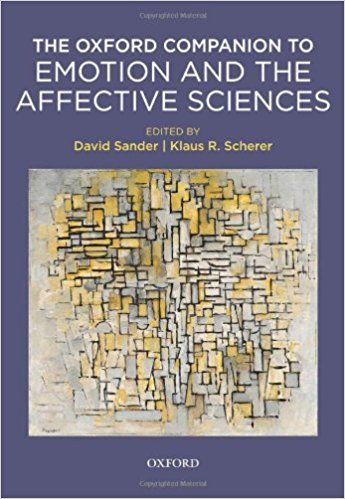
Few areas have witnessed the type of growth we have seen in the affective sciences in the past decades. Across psychology, philosophy, economics, and neuroscience, there has been an explosion of interest in the topic of emotion and affect. Comprehensive, authoritative, up-to-date, and easy-to-use, the new Oxford Companion to Emotion and the Affective Sciences is an indispensable resource for all who wish to find out about theories, concepts, methods, and research findings in this rapidly growing interdisciplinary field – one that brings together, amongst others, psychologists, neuroscientists, social scientists, philosophers, and historians. Organized by alphabetical entries, and presenting brief definitions, conciseoverviews, and encyclopaedic articles (all with extensive references to relevant publications), this Companion lends itself to casual browsing by non-specialists interested in the fascinating phenomena of emotions, moods, affect disorders, and personality as well as to focused search for pertinent information bystudents and established scholars in the field.Not only does the book provide entries on affective phenomena, but also on their neural underpinnings, their cognitive antecedents and the associated responses in physiological systems, facial, vocal, and bodily expressions, and action tendencies. Numerous entries also consider the role of emotion in society and social behavior, as well as in cognitive processes such as those critical for perception, attention, memory, judgement and decision-making.The volume has been edited by a group of internationally leading authorities in the respective disciplines consisting of two editors (David Sander and Klaus Scherer) as well as group of 11 associate editors (John T. Cacioppo, Tim Dalgleish, Robert Dantzer, Richard J. Davidson, Ronald B. de Sousa, Phoebe C. Ellsworth, Nico Frijda, George Loewenstein, Paula M. Niedenthal, Peter Salovey, and Richard A. Shweder). The members of the editorial board have commissioned and reviewed contributions frommajor experts on specific topics.In addition to comprehensive coverage of technical terms and fundamental issues, the volume also highlights current debates that inform the ongoing research process. In addition, the Companion contains a wealth of material on the role of emotion in applied domains such as economic behaviour, music and arts, work and organizational behaviour, family interactions and group dynamics, religion, law and justice, and societal change.Highly accessible and wide-ranging, this book is a vital resource for scientists, students, and professionals eager to obtain a rapid, conclusive overview on central terms and topics and anyone wanting to learn more about the mechanisms underlying the emotions dominating many aspects of our lives.
This book is an expanded and revised edition of the author’s critically acclaimed volume Nuts and Bolts for the Social Sciences. In twenty-six succinct chapters, Jon Elster provides an account of the nature of explanation in the social sciences. He offers an overview of key explanatory mechanisms in the social sciences, relying on hundreds of examples and drawing on a large variety of sources-psychology, behavioral economics, biology, political science, historical writings, philosophy and fiction. Written in accessible and jargon-free language, Elster aims at accuracy and clarity while eschewing formal models.
ما از اخلاق چه انتظاری داریم؟ این سوال شاید تاحدودی برای عموم مردم و یا متخصصان این رشته قابل پاسخ باشد؛ اینکه خوب بودن را به ما بیاموزد و در تنظیم روابط فردی م...

جشن کتاب تهران به ایستگاه سی و یکم رسیده است. حال و احوال نشر کتاب خوب نیست و باید فرهنگدوستان را به خرید و هدیه دادن کتاب ترغیب نمود. خانه اخلاقپژوهان جوان ب...

بنیاد کتابهای اخلاق اسلامی عمدتا پالایش جان از آلودگیها و آراستن آن به زیباییها است. اندیشه محوری این قبیل کتابها آن است که انسان فعلی آنی نیست که باید باشد...

-
0 Comments