Notice: تابع WP_Block_Type_Registry::register به طورنادرست فراخوانی شد. نامهای نوع بلوک نباید حروف بزرگ داشته باشند. لطفاً برای اطلاعات بیشتر، اشکال زدایی در وردپرس را مشاهده کنید. (این پیام در نگارش 5.0.0 افزوده شده است.) in /home/ethicsho/public_html/wp-includes/functions.php on line 5313
Warning: Use of undefined constant TDC_PATH_LEGACY - assumed 'TDC_PATH_LEGACY' (this will throw an Error in a future version of PHP) in /home/ethicsho/public_html/wp-content/plugins/td-composer/td-composer.php on line 109
Warning: Use of undefined constant TDSP_THEME_PATH - assumed 'TDSP_THEME_PATH' (this will throw an Error in a future version of PHP) in /home/ethicsho/public_html/wp-content/plugins/td-composer/td-composer.php on line 113 بایگانیهای 956.7044/31 - خانه اخلاق پژوهان جوان Notice: Trying to access array offset on value of type bool in /home/ethicsho/public_html/wp-content/plugins/wp-ulike/inc/general-functions.php on line 807
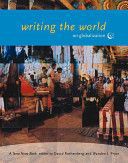
This collection of essays, memoirs, poems, stories, and artwork looks at globalization as a worldwide exchange of art and ideas. Writing the World focuses on the cultural realities of globalism—the opportunities it provides to learn from other cultures. This knowledge, argue David Rothenberg and Wandee Pryor in their introduction, can be power: “When all of us learn enough about our differences to respect the diversity that exists, we will be unable to pretend we are the same. We will never accept the old innocence and ignorance bred by oppression and exploitation.” For the contributors to Writing the World, to dream of the global village is to see the world not as a vast market but as a place of shared values and linked wonder.”It is time to listen to the many literate voices the world speaks,” say Rothenberg and Pryor. The voices of Writing the World range from Arundhati Roy on the “colonization of knowledge” in her essay “The Ladies Have Feelings, So… Shall We Leave It to the Experts?” to Naomi Klein’s meditation on fences, ownership, and property. They include Bill McKibben on women farmers in Bangladesh, Hannes Westberg’s account of being shot by Swedish police at a demonstration, James Barilla on invading and indigenous plant species in “The Aliens in the Garden,” and many other vivid, compelling, and provocative writings that celebrate—and illustrate—”the poetry of cultural contact.” Artists and photographers whose work appears in the book include Adam Clayman, Jenny Matthews, Richard Robinson, and Arpita Singh.
It is hard to overestimate the importance of the work of Augustine of Hippo, both in his own period and in the subsequent history of Western philosophy. Until the thirteenth century, when he may have had a competitor in Thomas Aquinas, he was the most important philosopher of the medieval period. Many of his views, including his theory of the just war, his account of time and eternity, his understanding of the will, his attempted resolution of the problem of evil, and his approach to the relation of faith and reason, have continued to be influential up to the present time. In this volume of specially-commissioned essays, sixteen scholars provide a wide-ranging and stimulating contribution to our understanding of Augustine, covering all the major areas of his philosophy and theology.
The concept of altruism, or disinterested concern for another’s welfare, has been discussed by everyone from theologians to psychologists to biologists. In this book, evolutionary, neurological, developmental, psychological, social, cultural, and religious aspects of altruistic behavior are examined. It is a collaborative examination of one of humanity’s essential and defining characteristics by renowned researchers from various disciplines. Their integrative dialogue illustrates that altruistic behavior is a significant mode of expression that can be studied by various scholarly methods and understood from a variety of perspectives in both the humanities and the sciences. Altruism and Altruistic Love establishes a framework for scholarship on altruism by presenting definitions, a historical overview, a review of contemporary research, and debates in various disciplines, as well as a discussion of directions for future work.
Here is the concluding volume of Sir Anthony Kenny’s monumental four-volume history of philosophy, the first major single-author narrative history to appear for several decades. Here Kenny tells the fascinating story of the development of philosophy in the modern world, from the early nineteenth century to the end of the millennium. Alongside (and intertwined with) extraordinary scientific advances, cultural changes, and political upheavals, the last two centuries have seen some of the most intriguing and original developments in philosophical thinking, which have transformed our understanding of ourselves and our world. In the first part of the book, Kenny offers a lively narrative introducing the major thinkers in their historical context. Among those we meet are the great figures of continental European philosophy, from Schopenhauer, Kierkegaard, and Nietzsche to Heidegger, Sartre, and Derrida; the Pragmatists such as C.S. Pierce and William James, who first developed a distinctively American philosophical tradition; Marx, Darwin, and Freud, the non-philosophers whose influence on philosophy was immense; and Wittgenstein and Russell, friends and colleagues who set the agenda for analytic philosophy in the twentieth century. Kenny then proceeds to guide the reader lucidly through the nine main areas of philosophical work in the period, offering a serious engagement with ideas and arguments about logic, language, epistemology, metaphysics, ethics, aesthetics, politics, and the existence of God. Graced with many beautiful illustrations, Philosophy in the Modern World concludes Kenny’s stimulating history of the intellectual development of Western civilization, allowing readers to trace the birth and growth of philosophy from antiquity to the present day.
ما از اخلاق چه انتظاری داریم؟ این سوال شاید تاحدودی برای عموم مردم و یا متخصصان این رشته قابل پاسخ باشد؛ اینکه خوب بودن را به ما بیاموزد و در تنظیم روابط فردی م...

جشن کتاب تهران به ایستگاه سی و یکم رسیده است. حال و احوال نشر کتاب خوب نیست و باید فرهنگدوستان را به خرید و هدیه دادن کتاب ترغیب نمود. خانه اخلاقپژوهان جوان ب...

بنیاد کتابهای اخلاق اسلامی عمدتا پالایش جان از آلودگیها و آراستن آن به زیباییها است. اندیشه محوری این قبیل کتابها آن است که انسان فعلی آنی نیست که باید باشد...

-
0 Comments