Notice: تابع WP_Block_Type_Registry::register به طورنادرست فراخوانی شد. نامهای نوع بلوک نباید حروف بزرگ داشته باشند. لطفاً برای اطلاعات بیشتر، اشکال زدایی در وردپرس را مشاهده کنید. (این پیام در نگارش 5.0.0 افزوده شده است.) in /home/ethicsho/public_html/wp-includes/functions.php on line 5313
Warning: Use of undefined constant TDC_PATH_LEGACY - assumed 'TDC_PATH_LEGACY' (this will throw an Error in a future version of PHP) in /home/ethicsho/public_html/wp-content/plugins/td-composer/td-composer.php on line 109
Warning: Use of undefined constant TDSP_THEME_PATH - assumed 'TDSP_THEME_PATH' (this will throw an Error in a future version of PHP) in /home/ethicsho/public_html/wp-content/plugins/td-composer/td-composer.php on line 113 بایگانیهای 822.3093561 - خانه اخلاق پژوهان جوان Notice: Trying to access array offset on value of type bool in /home/ethicsho/public_html/wp-content/plugins/wp-ulike/inc/general-functions.php on line 807
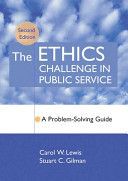
Since it was first published in 1991, The Ethics Challenge in Public Service has become a classic text used by public managers and in public management programs across the country. This second edition is filled with practical tools and techniques for making ethical choices in the ambiguous, pressured world of public service. It explores the day-to-day ethical dilemmas managers face in their work, including what to do when rules recommend one action and compassion another, and whether it is ethical to dissent from agency policy. This essential text explores managers’ accountability to different stakeholders and how to balance the often competing responsibilities.
Nearly a century before the advent of “multiculturalism,” Jane Addams put forward her conception of the moral significance of diversity. Each member of a democracy, Addams believed, is under a moral obligation to seek out diverse experiences, making a daily effort to confront others’ perspectives. Morality must be seen as a social rather than an individual endeavour, and democracy as a way of life rather than merely a basis for laws. Failing this, both democracy and ethics remain sterile, empty concepts.In this, Addams’ earliest book on ethics – presented here with a substantial introduction by Charlene Haddock Seigfried – she reflects on the factors that hinder the ability of all members of society to determine their own well-being. Observing relationships between charitable workers and their clients, between factory owners and their employers, and between household employers and their servants, she identifies sources of friction and shows how conceiving of democracy as a social obligation can lead to new, mutually beneficial lines of conduct.She also considers the proper education of workers, struggles between parents and their adult daughters over conflicting family and social claims, and the merging of politics with the daily lives of constituents. “The sphere of morals is the sphere of action”, Addams proclaims. It is not enough to believe passively in the innate dignity of all human beings. Rather, one must work daily to root out racial, gender, class, and other prejudices from personal relationships.
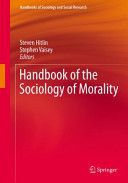
Human beings necessarily understand their social worlds in moral terms, orienting their lives, relationships, and activities around socially-produced notions of right and wrong.Morality is sociologically understood as more than simply helping or harming others; it encompasses any way that individuals form understandings of what behaviors are better than others, what goals are most laudable, and what “proper” people believe, feel, and do. Morality involves the explicit and implicit sets of rules and shared understandings that keep human social groups intact. Morality includes both the “shoulds” and “should nots” of human activity, its proactive and inhibitive elements.At one time, sociologists were centrally concerned with morality, issues like social cohesion, values, the goals and norms that structure society, and the ways individuals get socialized to reproduce those concerns. In the last half-century, however, explicit interest in these topics has waned, and modern sociology has become uninterested in these matters and morality has become marginalized within the discipline.But a resurgence in the topic is happening in related disciplines – psychology, neurology, philosophy, and anthropology – and in the wider national discourse. Sociology has much to offer, but is not fully engaged in this conversation. Many scholars work on areas that would fall under the umbrella of a sociology of morality but do not self-identify in such a manner, nor orient their efforts toward conceptualizing what we know, and should know, along these dimensions.The Handbook of the Sociology of Morality fills a niche within sociology making explicit the shared concerns of scholars across the disciplines as they relate to an often-overlooked dimension of human social life. It is unique in social science as it would be the first systematic compilation of the wider social structural, cultural, cross-national, organizational, and interactional dimension of human moral (understood broadly) thought, feeling, and behavior.
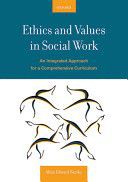
In a unique and student-friendly package, Ethics and Values in Social Work offers a series of learning modules that will ensure graduates receive a comprehensive ethics and values education. Designed to be easily incorporated into any curriculum, each module helps students integrate the knowledge, skills, self-awareness, and critical thinking abilities required for dealing with ethical issues. From applying basic ethical standards of practice to managing complex ethical dilemmas, this textbook equips readers with a range of tools and strategies for responding to ethical questions and concerns. Traditional ethics textbooks provide students with a model for ethical decision making. This breakthrough textbook goes beyond ethical decision making by providing students with a strategic framework for managing ethical issues that includes guidelines for engaging others in ethical discussions and using conflict resolution theory to promote collaborative solutions. Some textbooks introduce students to ethical theories, such as deontology, teleology, and virtue ethics. This textbook goes beyond describing these theories by providing students with opportunities to apply, compare, and contrast these approaches as they relate to various contexts of social work practice. A wealth of case scenarios, discussion questions, and role-play exercises make this an engaging, thought-provoking teaching and learning tool. At a basic level, this textbook teaches students the essential principles and standards that define ethical practice. At a more profound level, Ethics and Values in Social Work inspires students to reach for the highest values of profession: service, dignity and worth of the person, human relationships, integrity, competence, social justice, human rights, and scientific inquiry. Format and contents help social work programs meet and exceed CSWE accreditation standards, providing a clear structure for integrating ethics and values content throughout foundation and advanced courses The six-stage framework for managing ethical issues provides a range of tools and strategies for identifying, analyzing, and responding to ethical problems, dilemmas, and breaches A developmental approach to learning ethics supports students in engaging in higher levels of understanding, abstraction, application, and synthesis of ethics material Experiential exercises prepare students for managing the ethical and values issues that may arise in field placements Fun, engaging activities encourage students to reflect, question, and apply theory to practice Thought-provoking and reality-based case examples illustrate thorny ethical issues that professionals may encounter, ranging from end-of-life decision making to boundary crossings to rationing resources during a national crisis
Everywhere people share certain moral principles–it is bad to steal, to kill, to lie–and yet we often subvert these rules. As Robert Hinde points out in this provocative book, the politician will vote with his party instead of his conscience, a lawyer will argue a point that he or she personally abhors. And this constant bending the rules ultimately endangers our world. Hinde, an eminent Cambridge biologist and psychologist, here presents a new approach to morality–combining insights from evolutionary science with observations on how people actually behave. Featuring contributions by Nobel Peace Laureate Sir Joseph Rotblat, the book illuminates how rule-bending–hardening in-group boundaries, putting duty over other moral obligations, and much more–occurs within personal relationships, law, science, medicine, politics, business, and war. Hinde argues that many of the world’s problems are related to the disregard of moral rules–for instance, racism, religious intolerance, excessive consumerism, and global warming. With growing reliance on nuclear weapons, we are heading for a world ruled by threat and fear, instead of one ruled by law and mutual understanding. We need a new understanding of morality, its nature, sources, and importance for communal living. This book helps to provide that understanding.
ما از اخلاق چه انتظاری داریم؟ این سوال شاید تاحدودی برای عموم مردم و یا متخصصان این رشته قابل پاسخ باشد؛ اینکه خوب بودن را به ما بیاموزد و در تنظیم روابط فردی م...

جشن کتاب تهران به ایستگاه سی و یکم رسیده است. حال و احوال نشر کتاب خوب نیست و باید فرهنگدوستان را به خرید و هدیه دادن کتاب ترغیب نمود. خانه اخلاقپژوهان جوان ب...

بنیاد کتابهای اخلاق اسلامی عمدتا پالایش جان از آلودگیها و آراستن آن به زیباییها است. اندیشه محوری این قبیل کتابها آن است که انسان فعلی آنی نیست که باید باشد...

-
0 Comments