Notice: تابع WP_Block_Type_Registry::register به طورنادرست فراخوانی شد. نامهای نوع بلوک نباید حروف بزرگ داشته باشند. لطفاً برای اطلاعات بیشتر، اشکال زدایی در وردپرس را مشاهده کنید. (این پیام در نگارش 5.0.0 افزوده شده است.) in /home/ethicsho/public_html/wp-includes/functions.php on line 5313
Warning: Use of undefined constant TDC_PATH_LEGACY - assumed 'TDC_PATH_LEGACY' (this will throw an Error in a future version of PHP) in /home/ethicsho/public_html/wp-content/plugins/td-composer/td-composer.php on line 109
Warning: Use of undefined constant TDSP_THEME_PATH - assumed 'TDSP_THEME_PATH' (this will throw an Error in a future version of PHP) in /home/ethicsho/public_html/wp-content/plugins/td-composer/td-composer.php on line 113 بایگانیهای 618.92/0042 - خانه اخلاق پژوهان جوان Notice: Trying to access array offset on value of type bool in /home/ethicsho/public_html/wp-content/plugins/wp-ulike/inc/general-functions.php on line 807
Conceived originally as a serious presentation of the development of philosophy for Catholic seminary students, Frederick Copleston’s nine-volumeA History Of Philosophyhas journeyed far beyond the modest purpose of its author to universal acclaim as the best history of philosophy in English. Copleston, an Oxford Jesuit of immense erudition who once tangled with A.J. Ayer in a fabled debate about the existence of God and the possibility of metaphysics, knew that seminary students were fed a woefully inadequate diet of theses and proofs, and that their familiarity with most of history’s great thinkers was reduced to simplistic caricatures. Copleston set out to redress the wrong by writing a complete history of Western Philosophy, one crackling with incident and intellectual excitement – and one that gives full place to each thinker, presenting his thought in a beautifully rounded manner and showing his links to those who went before and to those who came after him.
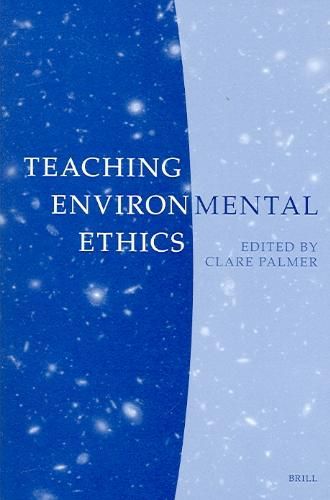
This collection explores a variety of questions, both of a theoretical and practical nature, raised by teaching environmental ethics. Questions considered move from asking whether teaching environmental ethics should include environmental advocacy, to practical issues about texts, syllabi and teaching techniques.
This book is about the gap between the moral demand on us and our natural capacities to meet it. John Hare starts with Kants statement of the moral demand and his acknowledgement of this gap. Hare then analyses Kants use of the resources of the Christian tradition to make sense of this gap,especially the notions of revelation, providence, and Gods grace. Kant reflects the traditional way of making sense of this gap, which is to invoke Gods assistance in bridging it. Hare goes on to examine various contemporary philosophers who do not use these resources. He considers three mainstrategies: exaggerating our natural capacities, diminishing the moral demand, and finding some naturalistic substitute for Gods assistance. He argues that these strategies do not work, and that we are therefore left with the gap and with the problem that it is unreasonable to demand of ourselves astandard which we cannot reach. In the final section of the book, Hare looks in more detail at the Christian doctrines of atonement, justification, and sanctification. He discusses Kierkegaards account of the relation between the ethical life and the Christian life, and ends by considering humanforgiveness, and the ways in which Gods forgiveness is both like and unlike our forgiveness of each other. The book is intended for those interested in both ethical theory and Christian theology.
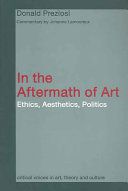
By juxtaposing issues and problems, Donald Preziosi’s latest collection of essays, In the Aftermath of Art, opens up multiple interpretive possibilities by bringing to the surface hidden resonances in the implications of each text. In re-reading his own writings, Preziosi opens up alternatives to contemporary discourses on art history and visual culture. A critical commentary by critic, historian, and theorist Johanne Lamoureux complements the author’s own introduction, mirroring the multiple interpretations within the essays themselves.
ما از اخلاق چه انتظاری داریم؟ این سوال شاید تاحدودی برای عموم مردم و یا متخصصان این رشته قابل پاسخ باشد؛ اینکه خوب بودن را به ما بیاموزد و در تنظیم روابط فردی م...

جشن کتاب تهران به ایستگاه سی و یکم رسیده است. حال و احوال نشر کتاب خوب نیست و باید فرهنگدوستان را به خرید و هدیه دادن کتاب ترغیب نمود. خانه اخلاقپژوهان جوان ب...

بنیاد کتابهای اخلاق اسلامی عمدتا پالایش جان از آلودگیها و آراستن آن به زیباییها است. اندیشه محوری این قبیل کتابها آن است که انسان فعلی آنی نیست که باید باشد...

-
0 Comments