Notice: تابع WP_Block_Type_Registry::register به طورنادرست فراخوانی شد. نامهای نوع بلوک نباید حروف بزرگ داشته باشند. لطفاً برای اطلاعات بیشتر، اشکال زدایی در وردپرس را مشاهده کنید. (این پیام در نگارش 5.0.0 افزوده شده است.) in /home/ethicsho/public_html/wp-includes/functions.php on line 5313
Warning: Use of undefined constant TDC_PATH_LEGACY - assumed 'TDC_PATH_LEGACY' (this will throw an Error in a future version of PHP) in /home/ethicsho/public_html/wp-content/plugins/td-composer/td-composer.php on line 109
Warning: Use of undefined constant TDSP_THEME_PATH - assumed 'TDSP_THEME_PATH' (this will throw an Error in a future version of PHP) in /home/ethicsho/public_html/wp-content/plugins/td-composer/td-composer.php on line 113 بایگانیهای 333.7 - خانه اخلاق پژوهان جوان Notice: Trying to access array offset on value of type bool in /home/ethicsho/public_html/wp-content/plugins/wp-ulike/inc/general-functions.php on line 807
Literature often deals with moral issues. It focuses on human dilemmas and awakens our imagination to new possibilities. It compels us to rethink and revise our everyday assumptions, enabling us to consider ethical questions in creative ways. The Moral Life: An Introductory Reader in Ethics and Literature brings together an extensive and varied collection of 87 classical and contemporary readings on ethical theory and practice. The book is divided into four sections covering the nature of morality, moral theories, moral issues, and applied ethics. Integrating literature with philosophy in an innovative way, editor Louis Pojman uses literary works to enliven and make concrete the ethical theory or applied issues addressed in each chapter. Literary works by Hugo, Hawthorne, Melville, Tolstoy, Ibsen, Huxley, Orwell, Camus, LeGuin, Styron, and many others lead students into philosophical concepts and issues such as relativism, utilitarianism, virtue ethics, the meaning of life, freedom, sex, love and marriage, and environmental ethics. Once introduced, these topics are developed further through readings by philosophers including Aristotle, Sartre, Bernard Williams, Jane English, and Thomas E. Hill, Jr. This unique anthology emphasizes the personal dimension of ethics, which is often ignored or minimized in ethics texts. Featuring insightful part and chapter introductions as well as biographical sketches, abstracts, and study questions for each reading selection, The Moral Life is ideal for introductory ethics courses. It also provides an engaging gateway into personal and social ethics for the general reader.
In this important new book, Michael J. Perry examines three of the most disputed constitutional issues of our time: capital punishment, state laws banning abortion, and state policies denying the benefit of law to same-sex unions. The author, a leading constitutional scholar, explains that if a majority of the justices of the Supreme Court believes that a law violates the Constitution, it does not necessarily follow that the Court should rule that the law is unconstitutional. In cases in which it is argued that a law violates the Constitution, the Supreme Court must decide which of two importantly different questions it should address: (1) Is the challenged law unconstitutional? (2) Is the lawmakers’ judgment that the challenged law is constitutional a reasonable judgment? (One can answer both questions in the affirmative.) By focusing on the death penalty, abortion, and same-sex unions, Perry provides illuminating new perspectives not only on moral controversies that implicate one or more constitutionally entrenched human rights, but also on the fundamental question of the Supreme Court’s proper role in adjudicating such controversies.
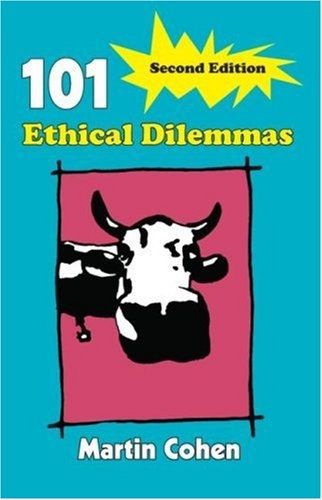
Will meat eaters get into heaven? Do trees have rights? Is it ever right to design a baby? What would you do? Would you always do the right thing? IS there a right thing? In this second edition of his thought-provoking and highly engaging introduction to ethics, Martin Cohen brings us eleven brand new ethical dilemmas including: The Dodgy Donor Clinic The Famous Footbridge Dilemma The Human Canonball. From overcrowded lifeboats to the censor’s pen, Martin Cohen’s stimulating and amusing dilemmas reveal the subtleties, complexities and contradictions that make up the rich tapestry of ethics. From DIY babies and breeding experiments to ‘Twinkies courtroom drama’ and Newgate Prison, there is a dilemma for everyone. Dilemmas from the worlds of medical, business, legal and war ethics; dilemmas in the shape of beautiful and ugly sisters, frogs, kings, ancient volcanic islands and suspiciously exotic villages. This book may not help you become a good person, but atleast you will have had a good think about it.
This is a major new study of Kants ethics that will transform the way students and scholars approach the subject in future. Allen Wood argues that Kants ethical vision is grounded in the idea of the dignity of the rational nature of every human being. Undergoing both natural competitiveness and social antagonism the human species, according to Kant, develops the rational capacity to struggle against its impulses towards a human community in which the ends of all are to harmonize and coincide. The distinctive features of the book are twofold. First, it focuses for the first time on the central role played in Kants ethical theory by the value of rational nature as an end itself. Second, it shows the importance of Kants systematic theory of human nature and history, and its implications for the structure, formulation, and application of Kants moral principles. This comprehensive study will be of critical importance to students of moral philosophy, the history of ideas, political theory, and religious studies.
ما از اخلاق چه انتظاری داریم؟ این سوال شاید تاحدودی برای عموم مردم و یا متخصصان این رشته قابل پاسخ باشد؛ اینکه خوب بودن را به ما بیاموزد و در تنظیم روابط فردی م...

جشن کتاب تهران به ایستگاه سی و یکم رسیده است. حال و احوال نشر کتاب خوب نیست و باید فرهنگدوستان را به خرید و هدیه دادن کتاب ترغیب نمود. خانه اخلاقپژوهان جوان ب...

بنیاد کتابهای اخلاق اسلامی عمدتا پالایش جان از آلودگیها و آراستن آن به زیباییها است. اندیشه محوری این قبیل کتابها آن است که انسان فعلی آنی نیست که باید باشد...

-
0 Comments