Notice: تابع WP_Block_Type_Registry::register به طورنادرست فراخوانی شد. نامهای نوع بلوک نباید حروف بزرگ داشته باشند. لطفاً برای اطلاعات بیشتر، اشکال زدایی در وردپرس را مشاهده کنید. (این پیام در نگارش 5.0.0 افزوده شده است.) in /home/ethicsho/public_html/wp-includes/functions.php on line 5313
Warning: Use of undefined constant TDC_PATH_LEGACY - assumed 'TDC_PATH_LEGACY' (this will throw an Error in a future version of PHP) in /home/ethicsho/public_html/wp-content/plugins/td-composer/td-composer.php on line 109
Warning: Use of undefined constant TDSP_THEME_PATH - assumed 'TDSP_THEME_PATH' (this will throw an Error in a future version of PHP) in /home/ethicsho/public_html/wp-content/plugins/td-composer/td-composer.php on line 113 بایگانیهای 323.44/2/09 - خانه اخلاق پژوهان جوان Notice: Trying to access array offset on value of type bool in /home/ethicsho/public_html/wp-content/plugins/wp-ulike/inc/general-functions.php on line 807
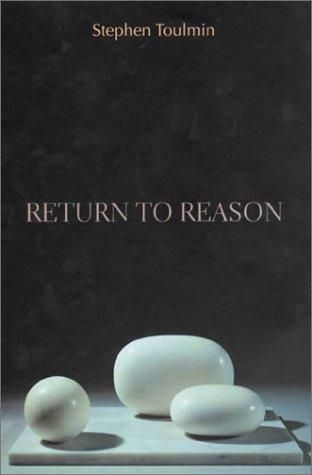
The turmoil and brutality of the twentieth century have made it increasingly difficult to maintain faith in the ability of reason to fashion a stable and peaceful world. After the ravages of global conflict and a Cold War that divided the world’s loyalties, how are we to master our doubts and face the twenty-first century with hope?In Return to Reason, Stephen Toulmin argues that the potential for reason to improve our lives has been hampered by a serious imbalance in our pursuit of knowledge. The centuries-old dominance of rationality, a mathematical mode of reasoning modeled on theory and universal certainties, has diminished the value of reasonableness, a system of humane judgments based on personal experience and practice. To this day, academic disciplines such as economics and professions such as law and medicine often value expert knowledge and abstract models above the testimony of diverse cultures and the practical experience of individuals.Now, at the beginning of a new century, Toulmin sums up a lifetime of distinguished work and issues a powerful call to redress the balance between rationality and reasonableness. His vision does not reject the valuable fruits of science and technology, but requires awareness of the human consequences of our discoveries. Toulmin argues for the need to confront the challenge of an uncertain and unpredictable world, not with inflexible ideologies and abstract theories, but by returning to a more humane and compassionate form of reason, one that accepts the diversity and complexity that is human nature as an essential beginning for all intellectual inquiry.
In this book, Weikart helps unlock the mystery of Hitler’s evil by vividly demonstrating the surprising conclusion that Hitler’s immorality flowed from a coherent ethic. Hitler was inspired by evolutionary ethics to pursue the utopian project of biologically improving the human race. This ethic underlay or influenced almost every major feature of Nazi policy: eugenics (i.e., measures to improve human heredity, including compulsory sterilization), euthanasia, racism, population expansion, offensive warfare, and racial extermination.
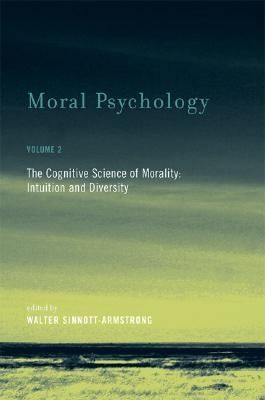
For much of the twentieth century, philosophy and science went their separate ways. In moral philosophy, fear of the so-called naturalistic fallacy kept moral philosophers from incorporating developments in biology and psychology. Since the 1990s, however, many philosophers have drawn on recent advances in cognitive psychology, brain science, and evolutionary psychology to inform their work. This collaborative trend is especially strong in moral philosophy, and these three volumes bring together some of the most innovative work by both philosophers and psychologists in this emerging interdisciplinary field.Contributors to Volume 2:Fredrik Bjorklund (University of Lund), James Blair (National Institute of Mental Health), Paul Bloomfield (University of Connecticut), Fiery Cushman (Harvard University), Justin D’Arms (Ohio State University), John Deigh (University of Texas at Austin), John Doris (Washington University), Julia Driver (Dartmouth College), Ben Fraser (Australian National University Research School of Social Science), Gerd Gigerenzer (Max Plank Institute), Michael Gill (University of Arizona), Jonathan Haidt (University of Virginia) Marc Hauser (Harvard University), Daniel Jacobson (Bowling Green State University), Joshua Knobe (University of North Carolina at Chapel Hill), Brian Leiter (University of Texas at Austin), Don Loeb (University of Vermont), Ron Mallon (University of Utah), Darcia Narvaez (University of Notre Dame), Shaun Nichols (University of Arizona), Alexandra Plakias (University of Michigan), Jesse Prinz (University of North Carolina at Chapel Hill), Geoffrey Sayre-McCord (University of North Carolina, Chapel Hill), Russ Shafer-Landau (University of Wisconsin), Walter Sinnott-Armstrong (Dartmouth College), Cass Sunstein (University of Chicago), William Tolhurst (University of Northern Illinois), Liane Young (Harvard University).
In this book, Yaqub describes a simple conception of truth and shows that it yields a semantical theory that accommodates the whole range of our seemingly conflicting intuitions about truth. This conception takes the Tarskian biconditionals (such as “The sentence ‘Johannes loved Clara’ is true if and only if Johannes loved Clara”) as correctly and completely defining the notion of truth. The semantical theory, which is called the revision theory, that emerges from this conception paints a metaphysical picture of truth as a property whose applicability is given by a revision process rather than by a fixed extension. The main advantage of this revision process is its ability to explain why truth seems in many cases almost redundant, in others substantial, and yet in others paradoxical (as in the famous Liar). Yaqub offers a comprehensive defense of the revision theory of truth by developing consistent and adequate formal semantics for languages in which all sorts of problematic sentences (Liar and company) can be constructed. Yaqub concludes by introducing a logic of truth that further demonstrates the adequacy of the revision theory.
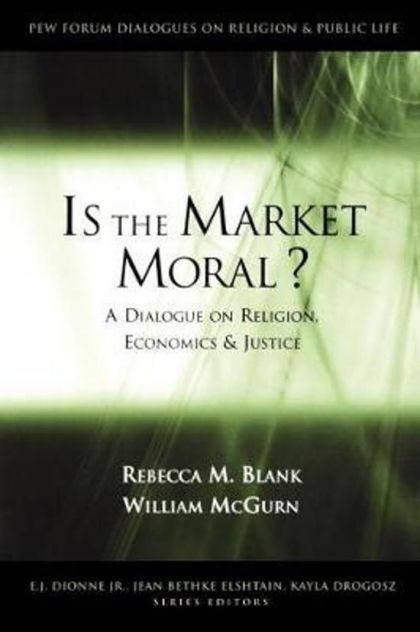
In the great tradition of moral argument about the nature of the economic market, Rebecca Blank and William McGurn join to debate the fundamental questionsequality and efficiency, productivity and social justice, individual achievement and personal rights in the workplace, the costs and benefits of corporate and entrepreneurial capitalism. And they do so grounded in both economic sophistication and religious commitment.Rebecca Blank is an economist by training and describes herself as culturally Protestant in the habits of mind and heart. She has also chaired the committee that wrote the statement on Christian faith and economic life adopted by the United Church of Christ. Addressing market failure, for her, requires that sometimes “freedom to choose” give way to other human values.William McGurn, a journalist and a Roman Catholic, uses his expertise in economics to reflect on the teachings of the church concerning the morality of the market. For McGurn, humans reach their fullest potential when they are free from the constraints of others. He writes that “our quarrel is not so much with Adam Smith or Milton Friedman but with the Providence that so clearly designed man to be his most prosperous at his most free.”This book grapples with the new imperatives of a global economy while working in the classic tradition of political economy which always treated seriously the questions of morality, justice, productivity, and freedom.
ما از اخلاق چه انتظاری داریم؟ این سوال شاید تاحدودی برای عموم مردم و یا متخصصان این رشته قابل پاسخ باشد؛ اینکه خوب بودن را به ما بیاموزد و در تنظیم روابط فردی م...

جشن کتاب تهران به ایستگاه سی و یکم رسیده است. حال و احوال نشر کتاب خوب نیست و باید فرهنگدوستان را به خرید و هدیه دادن کتاب ترغیب نمود. خانه اخلاقپژوهان جوان ب...

بنیاد کتابهای اخلاق اسلامی عمدتا پالایش جان از آلودگیها و آراستن آن به زیباییها است. اندیشه محوری این قبیل کتابها آن است که انسان فعلی آنی نیست که باید باشد...

-
0 Comments