Notice: تابع WP_Block_Type_Registry::register به طورنادرست فراخوانی شد. نامهای نوع بلوک نباید حروف بزرگ داشته باشند. لطفاً برای اطلاعات بیشتر، اشکال زدایی در وردپرس را مشاهده کنید. (این پیام در نگارش 5.0.0 افزوده شده است.) in /home/ethicsho/public_html/wp-includes/functions.php on line 5313
Warning: Use of undefined constant TDC_PATH_LEGACY - assumed 'TDC_PATH_LEGACY' (this will throw an Error in a future version of PHP) in /home/ethicsho/public_html/wp-content/plugins/td-composer/td-composer.php on line 109
Warning: Use of undefined constant TDSP_THEME_PATH - assumed 'TDSP_THEME_PATH' (this will throw an Error in a future version of PHP) in /home/ethicsho/public_html/wp-content/plugins/td-composer/td-composer.php on line 113 بایگانیهای 170.95 - خانه اخلاق پژوهان جوان Notice: Trying to access array offset on value of type bool in /home/ethicsho/public_html/wp-content/plugins/wp-ulike/inc/general-functions.php on line 807
How should a prize be awarded after a horse race? Should it go to the best rider, the best person, or the one who finishes first? To what extent are bystanders blameworthy when they do nothing to prevent harm? Are there any objective standards of moral responsibility with which to address such perennial questions? In this fluidly written and lively book, Daniel Robinson takes on the prodigious task of setting forth the contours of praise and blame. He does so by mounting an important and provocative new defense of a radical theory of moral realism and offering a critical appraisal of prevailing alternatives such as determinism and behaviorism and of their conceptual shortcomings. The version of moral realism that arises from Robinson’s penetrating inquiry–an inquiry steeped in Aristotelian ethics but deeply informed by modern scientific knowledge of human cognition–is independent of cognition and emotion. At the same time, Robinson carefully explores how such human attributes succeed or fail in comprehending real moral properties. Through brilliant analyses of constitutional and moral luck, of biosocial and genetic versions of psychological determinism, and of relativistic-anthropological accounts of variations in moral precepts, he concludes that none of these conceptions accounts either for the nature of moral properties or the basis upon which they could be known. Ultimately, the theory that Robinson develops preserves moral properties even while acknowledging the conditions that undermine the powers of human will.
Few phenomena are as formative of our experience of the visual world as displays of suffering. But what does it mean to have an ethical experience of disturbing or traumatizing images? What kind of ethical proposition does an image of pain mobilize? How may the spectator learn from and make use of the painful image as a source of ethical reflection? Engaging with a wide range of visual media–from painting, theatre, and sculpture, to photography, film, and video–this interdisciplinary collection of essays by leading and emerging scholars of visual culture offers a reappraisal of the increasingly complex relationship between images of pain and the ethics of viewing. Ethics and Images of Pain reconsiders the persistent and ever pertinent nexus of aesthetics and ethics, the role of painful images as generators of unpredictable forms of affect, the moral transformation of spectatorship, the ambivalence of the witness and the representation of afflication as a fundamental form of our shared scopic experience. The instructive and illuminating essays in the collection introduce a phenomenological context in which to make sense of our current ecology of excruciating images, one that accentuates notions of responsibility, empathy, and imagination. Contributors trace the images of pain across a miscellany of case studies, and amongst the topics addressed are: the work of artists as disparate as Doris Salcedo, Anselm Kiefer and Bendik Riis; photographs from Abu Ghraib and Rwanda; Hollywood war films and animated documentaries; performances of self-immolations and incidents of police brutality captured on mobile phones.
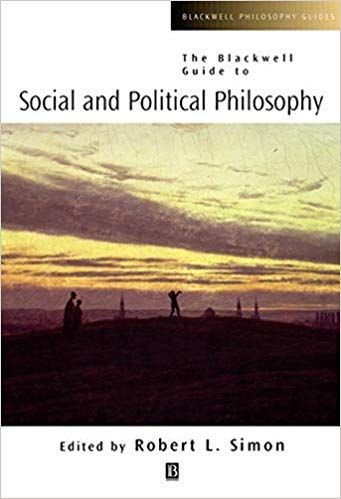
“The Blackwell Guide to Social and Political Philosophy” brings together a collection of newly commissioned essays which examine fundamental issues in social and political theory. Written by leading social and political philosophers, each essay provides a history of the issue at hand and a judicious assessment of the main arguments that have been brought to bear upon that issue.The collection deals with traditional topics in social and political philosophy, such as liberty, authority, justice, and equality as well as with issues raised by diversity and pluralism within the democratic state. The contributors offer a sustained dialogue on the merits of liberal political theory and on the views of some of its critics. Each essay begins with an accessible introduction but develops into a philosophically acute evaluation of the issue in question.The compilation is ideal as a self-standing text for an introductory or intermediate course in social and political philosophy.
ما از اخلاق چه انتظاری داریم؟ این سوال شاید تاحدودی برای عموم مردم و یا متخصصان این رشته قابل پاسخ باشد؛ اینکه خوب بودن را به ما بیاموزد و در تنظیم روابط فردی م...

جشن کتاب تهران به ایستگاه سی و یکم رسیده است. حال و احوال نشر کتاب خوب نیست و باید فرهنگدوستان را به خرید و هدیه دادن کتاب ترغیب نمود. خانه اخلاقپژوهان جوان ب...

بنیاد کتابهای اخلاق اسلامی عمدتا پالایش جان از آلودگیها و آراستن آن به زیباییها است. اندیشه محوری این قبیل کتابها آن است که انسان فعلی آنی نیست که باید باشد...

-
0 Comments