Notice: تابع WP_Block_Type_Registry::register به طورنادرست فراخوانی شد. نامهای نوع بلوک نباید حروف بزرگ داشته باشند. لطفاً برای اطلاعات بیشتر، اشکال زدایی در وردپرس را مشاهده کنید. (این پیام در نگارش 5.0.0 افزوده شده است.) in /home/ethicsho/public_html/wp-includes/functions.php on line 5313
Warning: Use of undefined constant TDC_PATH_LEGACY - assumed 'TDC_PATH_LEGACY' (this will throw an Error in a future version of PHP) in /home/ethicsho/public_html/wp-content/plugins/td-composer/td-composer.php on line 109
Warning: Use of undefined constant TDSP_THEME_PATH - assumed 'TDSP_THEME_PATH' (this will throw an Error in a future version of PHP) in /home/ethicsho/public_html/wp-content/plugins/td-composer/td-composer.php on line 113 بایگانیهای 144.0903 - خانه اخلاق پژوهان جوان Notice: Trying to access array offset on value of type bool in /home/ethicsho/public_html/wp-content/plugins/wp-ulike/inc/general-functions.php on line 807
The Cambridge Companion to the Scottish Enlightenment offers a philosophical perspective on an eighteenth-century movement that has been profoundly influential on western culture. A distinguished team of contributors examines the writings of David Hume, Adam Smith, Thomas Reid, Adam Ferguson, Colin Maclaurin and other Scottish thinkers, in fields including philosophy, natural theology, economics, anthropology, natural science and law. In addition, the contributors relate the Scottish Enlightenment to its historical context and assess its impact and legacy in Europe, America and beyond. The result is a comprehensive and accessible volume that illuminates the richness, the intellectual variety and the underlying unity of this important movement. It will be of interest to a wide range of readers in philosophy, theology, literature and the history of ideas.
Sam Harris’s first book,The End of Faith,ignited a worldwide debate about the validity of religion. In the aftermath, Harris discovered that most peoplefrom religious fundamentalists to nonbelieving scientistsagree on one point: science has nothing to say on the subject of human values. Indeed, our failure to address questions of meaning and morality through science has now become the most common justification for religious faith. It is also the primary reason why so many secularists and religious moderates feel obligated to “respect” the hardened superstitions of their more devout neighbors.In this explosive new book, Sam Harris tears down the wall between scientific facts and human values, arguing that most people are simply mistaken about the relationship between morality and the rest of human knowledge. Harris urges us to think about morality in terms of human and animal well-being, viewing the experiences of conscious creatures as peaks and valleys on a “moral landscape.” Because there are definite facts to be known about where we fall on this landscape, Harris foresees a time when science will no longer limit itself to merely describing what people do in the name of “morality”; in principle, science should be able to tell us what weoughtto do to live the best lives possible. Bringing a fresh perspective to age-old questions of right and wrong and good and evil, Harris demonstrates that we already know enough about the human brain and its relationship to events in the world to say that there are right and wrong answers to the most pressing questions of human life. Because such answers exist, moral relativism is simply falseand comes at increasing cost to humanity. And the intrusions of religion into the sphere of human values can be finally repelled: for just as there is no such thing as Christian physics or Muslim algebra, there can be no Christian or Muslim morality.Using his expertise in philosophy and neuroscience, along with his experience on the front lines of our “culture wars,” Harris delivers a game-changing book about the future of science and about the real basis of human cooperation.
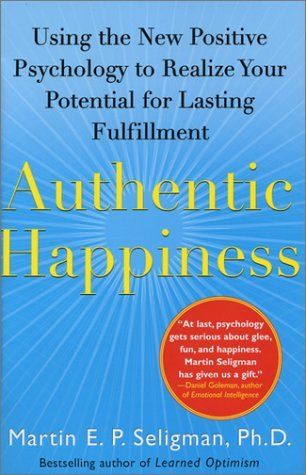
In this national bestseller — Martin Seligman’s most stimulating, persuasive book to date — the acclaimed author of Learned Optimism introduces yet another revolutionary idea. Drawing on groundbreaking scientific research, Seligman shows how Positive Psychology is shifting the profession’s paradigm away from its narrow-minded focus on pathology, victimology, and mental illness to positive emotion and mental health. Happiness, studies show, is not the result of good genes or luck. It can be cultivated by identifying and nurturing traits that we already possess — including kindness, originality, humor, optimism, and generosity.Seligman provides the tools you need in order to ascertain your most positive traits or strengths. Then he explains how, by frequently calling upon these “signature strengths” in all the crucial realms of life — health, relationships, career — you will not only develop natural buffers against misfortune and negative emotion, but also achieve new and sustainable levels of authentic contentment, gratification, and meaning.
How do our feelings for others shape our attitudes and conduct towards them? Is morality primarily a matter of rational choice, or instinctual feeling? Joseph Duke Filonowicz takes the reader on an engaging, informative tour of some of the main issues in philosophical ethics, explaining and defending the ideas of the early-modern British sentimentalists. These philosophers – Shaftesbury, Hutcheson, Hume, and Smith – argued that it is our feelings, and not our ‘reason’, which ultimately determine how we judge what is good or bad, right or wrong, and how we choose to act towards our fellow human beings. Filonowicz draws on contemporary sociology and evolutionary biology as well as present-day moral theory to examine and defend the sentimentalist view and to challenge the rationalistic character of contemporary ethics. His book will appeal to readers interested in both history of philosophy and current ethical debates.
ما از اخلاق چه انتظاری داریم؟ این سوال شاید تاحدودی برای عموم مردم و یا متخصصان این رشته قابل پاسخ باشد؛ اینکه خوب بودن را به ما بیاموزد و در تنظیم روابط فردی م...

جشن کتاب تهران به ایستگاه سی و یکم رسیده است. حال و احوال نشر کتاب خوب نیست و باید فرهنگدوستان را به خرید و هدیه دادن کتاب ترغیب نمود. خانه اخلاقپژوهان جوان ب...

بنیاد کتابهای اخلاق اسلامی عمدتا پالایش جان از آلودگیها و آراستن آن به زیباییها است. اندیشه محوری این قبیل کتابها آن است که انسان فعلی آنی نیست که باید باشد...

-
0 Comments