Happiness, Death, and the Remainder of Life
by Jonathan Lear
2000
2724
150.195
0-674-00329-2
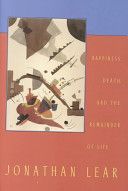
Separated by millennia, Aristotle and Sigmund Freud gave us disparate but compelling pictures of the human condition. But if, with Jonathan Lear, we scrutinize these thinkers’ attempts to explain human behavior in terms of a higher principle–whether happiness or death–the pictures fall apart. Aristotle attempted to ground ethical life in human striving for happiness, yet he didn’t understand what happiness is any better than we do. Happiness became an enigmatic, always unattainable, means of seducing humankind into living an ethical life. Freud fared no better when he tried to ground human striving, aggression, and destructiveness in the death drive, like Aristotle attributing purpose where none exists. Neither overarching principle can guide or govern “the remainder of life,” in which our inherently disruptive unconscious moves in breaks and swerves to affect who and how we are. Lear exposes this tendency to self-disruption for what it is: an opening, an opportunity for new possibilities. His insights have profound consequences not only for analysis but for our understanding of civilization and its discontent.
Warning: Invalid argument supplied for foreach() in /home/ethicsho/public_html/wp-content/themes/Hedayat/woocommerce/single-product.php on line 641





Notice: تابع id به طورنادرست فراخوانی شد. خاصیت های محصول نباید به صورت مستقیم مشاهده شود. Backtrace: require('wp-blog-header.php'), require_once('wp-includes/template-loader.php'), include('/themes/Hedayat/woocommerce/single-product.php'), WC_Abstract_Legacy_Product->__get, wc_doing_it_wrong لطفاً برای اطلاعات بیشتر، اشکال زدایی در وردپرس را مشاهده کنید. (این پیام در نگارش 3.0 افزوده شده است.) in /home/ethicsho/public_html/wp-includes/functions.php on line 5313