ethical know how
by Francisco Varela
1999
3147
170
9780804730334
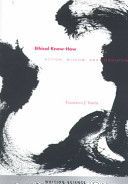
How can science be brought to connect with experience? This book addresses two of the most challenging problems facing contemporary neurobiology and cognitive science: first, understanding how we unconsciously execute habitual actions as a result of neurological and cognitive processes that are not formal actions of conscious judgment but part of a habitual nexus of systematic self-organization; second, creating an ethics adequate to our present awareness that there is no such thing as a transcendental self, a stable subject, or a soul.In earlier modes of cognitive science, cognition was conceptualized according to a model of representation and abstract reasoning. In the realm of ethics, this corresponded to the philosophical tenet that to do what is ethical is to do what corresponds to an abstract set of rules. By contrast to this computationalism, the author places central emphasis on what he terms “enaction”—cognition as the ability to negotiate embodied, everyday living in a world that is inseparable from our sensory-motor capacities.Apart from his researches in cognitive science, the bodies of thought that enable Varela to make this link are phenomenology and two representatives of what he calls the “wisdom traditions”: Confucian ethics and Buddhist epistemology. From the Confucian tradition, he draws upon the Mencius to propose an ethics of praxis, one in which ethical action is conceived as a project of being rather than as a system of judgment, less a matter of rules that are universally applicable than a goal of expertise, sagehood.The Buddhist contribution to his project encompasses “the embodiment of the void” and the “pragmatics of a virtual self.” How does a belief system that does not posit a unitary self or subject conceive the living of an “I”? In summation, the author proposes an ethics founded on “savoir faire” that is a practice of transformation based on a constant recognition of the “virtual” nature of ourselves in the actual operations of our mental lives.
Warning: Invalid argument supplied for foreach() in /home/ethicsho/public_html/wp-content/themes/Hedayat/woocommerce/single-product.php on line 641




Notice: تابع id به طورنادرست فراخوانی شد. خاصیت های محصول نباید به صورت مستقیم مشاهده شود. Backtrace: require('wp-blog-header.php'), require_once('wp-includes/template-loader.php'), include('/themes/Hedayat/woocommerce/single-product.php'), WC_Abstract_Legacy_Product->__get, wc_doing_it_wrong لطفاً برای اطلاعات بیشتر، اشکال زدایی در وردپرس را مشاهده کنید. (این پیام در نگارش 3.0 افزوده شده است.) in /home/ethicsho/public_html/wp-includes/functions.php on line 5313