Notice: تابع WP_Block_Type_Registry::register به طورنادرست فراخوانی شد. نامهای نوع بلوک نباید حروف بزرگ داشته باشند. لطفاً برای اطلاعات بیشتر، اشکال زدایی در وردپرس را مشاهده کنید. (این پیام در نگارش 5.0.0 افزوده شده است.) in /home/ethicsho/public_html/wp-includes/functions.php on line 5313
Warning: Use of undefined constant TDC_PATH_LEGACY - assumed 'TDC_PATH_LEGACY' (this will throw an Error in a future version of PHP) in /home/ethicsho/public_html/wp-content/plugins/td-composer/td-composer.php on line 109
Warning: Use of undefined constant TDSP_THEME_PATH - assumed 'TDSP_THEME_PATH' (this will throw an Error in a future version of PHP) in /home/ethicsho/public_html/wp-content/plugins/td-composer/td-composer.php on line 113 بایگانیهای Ronald D. Francis - خانه اخلاق پژوهان جوان Notice: Trying to access array offset on value of type bool in /home/ethicsho/public_html/wp-content/plugins/wp-ulike/inc/general-functions.php on line 807
The Moral Philosophers adopts a historical approach to moral philosophy, taking in chronological sequence some of the major ethical philosophers of the past. Richard Norman introduces the thought of each figure as a coherent and comprehensive ethical theory, exploring their richness andcomplexity. Each theory is critically examined and presented as an attempt to surmount some of the deficiencies of its predecessor; and through this critical process the book moves towards some concluding suggestions about the content of an acceptable ethical theory. This new edition includes four new chapters: one on Nietzsche, and three which provide substantially extended coverage of twentieth-century moral philosophy, including discussions of contemporary utilitarianism, rights-based ethical theories, contractarian ethics and virtue ethics, and recentdebates between realism and anti-realism in ethics. The Moral Philosophers is designed for undergraduate students and the general reader, and is written in clear and non-technical language. It is intended for use as a basic text in an introductory course on ethics, with detailed recommended reading sections at the beginning of each chapter.
The Phenomenology of Spirit was Hegel’s grandest experiment, changing our vision of the world and the very nature of philosophical enterprise. In this book, Solomon captures the bold and exhilarating spirit, presenting the Phenomenology as a thoroughly personal as well as philosophical work. He begins with a historical introduction, which lays the groundwork for a section-by-section analysis of the Phenomenology. Both the initiated and readers unacquainted with the intricacies of German idealism will find this to be an accessible and exciting introduction to this great philosopher’s monumental work.
This revised edition of IEthics and StatecraftR has been reorganized to better situate chapters that play to one another thematically, on peacemaking, the ethics and statecraft of war, and the statecraft of major international reform, and two new chapters, on Theodore Roosevelt and the Vietnam War, respectively, have been added to this classic work. The contributions remain centrally concerned with moral reasoning about important decisions taken by key statesmen in times of war, peace, and transformation, arguing that national leaders-including realists-have always concerned themselves with normative constraints on power, both their own and that of others. This revised edition of IEthics and StatecraftR has been reorganized to better situate chapters that play to one another thematically, on peacemaking, the ethics and statecraft of war, and the statecraft of major international reform, and two new chapters, on Theodore Roosevelt and the Vietnam War, respectively, have been added to this classic work. The contributions remain centrally concerned with moral reasoning about important decisions taken by key statesmen in times of war, peace, and transformation, arguing that national leaders-including realists-have always concerned themselves with normative constraints on power, both their own and that of others. This book posits that the problems of ethics in international relations are always conditioned by uncertainty, actors’ inexact knowledge of real-world conditions, and morally ambiguous outcomes. Contrary to the course assumptions of much IR theory, individual leaders remain the major conduit by which ethical concerns are deployed or ignored in the foreign policy of states. To ignore moral norms, which already govern international relations, is to ignore a key dimension of the subject; such an oversight will necessarily lead to a shallow analysis and a basic misunderstanding of how and why states behave as they do.
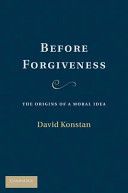
“In this book, David Konstan argues that the modern concept of interpersonal forgiveness, in the full sense of the term, did not exist in ancient Greece and Rome. Even more startlingly, it is not fully present in the Hebrew Bible, nor again in the New Testament, or in the early Jewish and Christian commentaries on the Holy Scriptures. It would still be centuries– many centuries– before the idea of interpersonal forgiveness, with its accompanying ideas of apology, remorse, and a change of heart on thepart of the wrongdoer, would emerge. For all its vast importance today in religion, law, politics, and psychotherapy, interpersonal forgiveness is creation of the 18th and 19th centuries, when the Christian concept of divine forgiveness was finally secularized. Forgiveness was God’s province, and it took a revolution in thought to bring it to earth and make it a human trait”–
ما از اخلاق چه انتظاری داریم؟ این سوال شاید تاحدودی برای عموم مردم و یا متخصصان این رشته قابل پاسخ باشد؛ اینکه خوب بودن را به ما بیاموزد و در تنظیم روابط فردی م...

جشن کتاب تهران به ایستگاه سی و یکم رسیده است. حال و احوال نشر کتاب خوب نیست و باید فرهنگدوستان را به خرید و هدیه دادن کتاب ترغیب نمود. خانه اخلاقپژوهان جوان ب...

بنیاد کتابهای اخلاق اسلامی عمدتا پالایش جان از آلودگیها و آراستن آن به زیباییها است. اندیشه محوری این قبیل کتابها آن است که انسان فعلی آنی نیست که باید باشد...

-
0 Comments