Notice: تابع WP_Block_Type_Registry::register به طورنادرست فراخوانی شد. نامهای نوع بلوک نباید حروف بزرگ داشته باشند. لطفاً برای اطلاعات بیشتر، اشکال زدایی در وردپرس را مشاهده کنید. (این پیام در نگارش 5.0.0 افزوده شده است.) in /home/ethicsho/public_html/wp-includes/functions.php on line 5313
Warning: Use of undefined constant TDC_PATH_LEGACY - assumed 'TDC_PATH_LEGACY' (this will throw an Error in a future version of PHP) in /home/ethicsho/public_html/wp-content/plugins/td-composer/td-composer.php on line 109
Warning: Use of undefined constant TDSP_THEME_PATH - assumed 'TDSP_THEME_PATH' (this will throw an Error in a future version of PHP) in /home/ethicsho/public_html/wp-content/plugins/td-composer/td-composer.php on line 113 بایگانیهای Richard Parry - خانه اخلاق پژوهان جوان Notice: Trying to access array offset on value of type bool in /home/ethicsho/public_html/wp-content/plugins/wp-ulike/inc/general-functions.php on line 807
This book establishes the necessary integration of theological knowledge with theological ethics. It does this as a response to the postmodern critique of Christianity, as exemplified in Rorty and Lyotard. They argue that any claim to know God is necessarily tyrannical. Contemporary responses to such postmodern thinking often fail to address adequately the ethical critique that is made. This book redresses that balance by suggesting that our knowedge of God and love of the Other are so intimately connected that we cannot have one without the other. In the absence of love, then, we simply do not know God. Justin Thacker proposes that an effective theological response to postmodernity must address both knowledge and ethics in an integrated fashion as presented in this book.
In this major new book, Matthew Kramer seeks to establish two main conclusions. On the one hand, moral requirements and other elements of ethics are strongly objective in a number of senses that that Kramer elaborates. On the other hand, the objectivity of ethics is itself an ethical matter that rests primarily on ethical considerations. Moral realism ? the doctrine that morality is indeed objective in the various respects which Kramer expounds ? is a moral doctrine. This volume therefore fights battles on two complicatedly criss-crossing fronts. Many philosophers who deny the objectivity of ethics have sought to base their arguments on non-ethical considerations. They take themselves to be impugning the intellectual solidity of ethical claims and values without advancing any such claims or endorsing any such values in the course of their reflections. Quite a few champions of ethical objectivity have responded in kind by seeking to adduce alternative non-ethical considerations. Kramer, while aiming to dispel doubts about ethical objectivity, goes against both the doubters and their realist opponents by insisting that the key questions concerning ethical objectivity are not only about the domain of ethics but also within it. Distinguished by its originality, ambition and quality of scholarship, “Moral Realism as a Moral Doctrine” will be of interest to a wide range of readers in metaethics and moral philosophy more broadly.
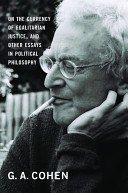
G. A. Cohen was one of the most gifted, influential, and progressive voices in contemporary political philosophy. At the time of his death in 2009, he had plans to bring together a number of his most significant papers. This is the first of three volumes to realize those plans. Drawing on three decades of work, it contains previously uncollected articles that have shaped many of the central debates in political philosophy, as well as papers published here for the first time. In these pieces, Cohen asks what egalitarians have most reason to equalize, he considers the relationship between freedom and property, and he reflects upon ideal theory and political practice.Included here are classic essays such as “Equality of What?” and “Capitalism, Freedom, and the Proletariat,” along with more recent contributions such as “Fairness and Legitimacy in Justice,” “Freedom and Money,” and the previously unpublished “How to Do Political Philosophy.” On ample display throughout are the clarity, rigor, conviction, and wit for which Cohen was renowned. Together, these essays demonstrate how his work provides a powerful account of liberty and equality to the left of Ronald Dworkin, John Rawls, Amartya Sen, and Isaiah Berlin.
If philosophy has any business in the world, it is the clarification of our thinking and the clearing away of ideas that cloud the mind. In this book, one of the world’s preeminent philosophers takes issue with an idea that has found an all-too-prominent place in popular culture and philosophical thought: the idea that while factual claims can be rationally established or refuted, claims about value are wholly subjective, not capable of being rationally argued for or against. Although it is on occasion important and useful to distinguish between factual claims and value judgments, the distinction becomes, Hilary Putnam argues, positively harmful when identified with a dichotomy between the objective and the purely “subjective.”Putnam explores the arguments that led so much of the analytic philosophy of language, metaphysics, and epistemology to become openly hostile to the idea that talk of value and human flourishing can be right or wrong, rational or irrational; and by which, following philosophy, social sciences such as economics have fallen victim to the bankrupt metaphysics of Logical Positivism. Tracing the problem back to Hume’s conception of a “matter of fact” as well as to Kant’s distinction between “analytic” and “synthetic” judgments, Putnam identifies a path forward in the work of Amartya Sen. Lively, concise, and wise, his book prepares the way for a renewed mutual fruition of philosophy and the social sciences.
ما از اخلاق چه انتظاری داریم؟ این سوال شاید تاحدودی برای عموم مردم و یا متخصصان این رشته قابل پاسخ باشد؛ اینکه خوب بودن را به ما بیاموزد و در تنظیم روابط فردی م...

جشن کتاب تهران به ایستگاه سی و یکم رسیده است. حال و احوال نشر کتاب خوب نیست و باید فرهنگدوستان را به خرید و هدیه دادن کتاب ترغیب نمود. خانه اخلاقپژوهان جوان ب...

بنیاد کتابهای اخلاق اسلامی عمدتا پالایش جان از آلودگیها و آراستن آن به زیباییها است. اندیشه محوری این قبیل کتابها آن است که انسان فعلی آنی نیست که باید باشد...

-
0 Comments