Notice: تابع WP_Block_Type_Registry::register به طورنادرست فراخوانی شد. نامهای نوع بلوک نباید حروف بزرگ داشته باشند. لطفاً برای اطلاعات بیشتر، اشکال زدایی در وردپرس را مشاهده کنید. (این پیام در نگارش 5.0.0 افزوده شده است.) in /home/ethicsho/public_html/wp-includes/functions.php on line 5313
Warning: Use of undefined constant TDC_PATH_LEGACY - assumed 'TDC_PATH_LEGACY' (this will throw an Error in a future version of PHP) in /home/ethicsho/public_html/wp-content/plugins/td-composer/td-composer.php on line 109
Warning: Use of undefined constant TDSP_THEME_PATH - assumed 'TDSP_THEME_PATH' (this will throw an Error in a future version of PHP) in /home/ethicsho/public_html/wp-content/plugins/td-composer/td-composer.php on line 113 بایگانیهای Richard Amesbury - خانه اخلاق پژوهان جوان Notice: Trying to access array offset on value of type bool in /home/ethicsho/public_html/wp-content/plugins/wp-ulike/inc/general-functions.php on line 807
Taking Wittgenstein at His Word is an experiment in reading organized around a central question: What kind of interpretation of Wittgenstein’s later philosophy emerges if we adhere strictly to his claims that he is not in the business of presenting and defending philosophical theses and that his only aim is to expose persistent conceptual misunderstandings that lead to deep philosophical perplexities? Robert Fogelin draws out the therapeutic aspects of Wittgenstein’s later work by closely examining his account of rule-following and how he applies the idea in the philosophy of mathematics.The first of the book’s two parts focuses on rule-following, Wittgenstein’s “paradox of interpretation,” and his naturalistic response to this paradox, all of which are persistent and crucial features of his later philosophy. Fogelin offers a corrective to the frequent misunderstanding that the paradox of interpretation is a paradox about meaning, and he emphasizes the importance of Wittgenstein’s often undervalued appeals to natural responses. The second half of the book examines how Wittgenstein applies his reflections on rule-following to the status of mathematical propositions, proofs, and objects, leading to remarkable, demystifying results.Taking Wittgenstein at His Word shows that what Wittgenstein claims to be doing and what he actually does are much closer than is often recognized. In doing so, the book underscores fundamental–but frequently underappreciated–insights about Wittgenstein’s later philosophy.
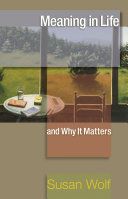
Most people, including philosophers, tend to classify human motives as falling into one of two categories: the egoistic or the altruistic, the self-interested or the moral. According to Susan Wolf, however, much of what motivates us does not comfortably fit into this scheme. Often we act neither for our own sake nor out of duty or an impersonal concern for the world. Rather, we act out of love for objects that we rightly perceive as worthy of love–and it is these actions that give meaning to our lives. Wolf makes a compelling case that, along with happiness and morality, this kind of meaningfulness constitutes a distinctive dimension of a good life. Written in a lively and engaging style, and full of provocative examples, Meaning in Life and Why It Matters is a profound and original reflection on a subject of permanent human concern.
The author offers an emotional account of her amazing journey from a 15-year-old living on the streets and eating garbage to her acceptance into Harvard, a feat that prompted a Lifetime movie and a successful motivational-speaking career.
Purchase of this book includes free trial access to www.million-books.com where you can read more than a million books for free. This is an OCR edition with typos. Excerpt from book: CHAPTER III. ON QUALITY OF PLEASURE. I Alluded in the last chapter to the two great unsettled questions, to what degree happiness is different for different people, and how far it is in each man’s own power for himself. Both these questions concern the subject of this chapter. If happiness is different for different people, how far ought it to be so ? And how far can we raise the character of our happiness ? There is perhaps a disposition in our age to accept A morality jTi i iT ofhappi- a morality of happiness as better, more like what we ness, espe- expect morality to be, than one of rule: such a hoi,,1 morality may take the form of a utilitarianism recog- rj;e nizing different kinds of pleasures, some worthier and is more c- more to be striven after than others. Religion too than’a mo- has not unfrequently shown itself more in harmony i1ety of with the moral philosophy which speaks much of happiness than with that which speaks much of law. And though it is true that when religion has spoken the language of bare utilitarianism, as in Paley, it has not much commended itself to real human feeling: still when it is presented to us not only as conformable to our desire, but also as what is to regulate our desire, uniting with its promises to make us happy a call upon us for effort after a worthy happiness, and elevation of our idea of happiness (as we are told on the one hand that the ways of religion are pleasantness and her paths peace, while on the other hand we pray that we may love that which God commands and desire that he promises); the morality which is thus proposed to us has charms in our view which do not belong to a morality of rule. But this But then it is to be observed that this more at- worthiness tractive form of utilitarianism involves …
ما از اخلاق چه انتظاری داریم؟ این سوال شاید تاحدودی برای عموم مردم و یا متخصصان این رشته قابل پاسخ باشد؛ اینکه خوب بودن را به ما بیاموزد و در تنظیم روابط فردی م...

جشن کتاب تهران به ایستگاه سی و یکم رسیده است. حال و احوال نشر کتاب خوب نیست و باید فرهنگدوستان را به خرید و هدیه دادن کتاب ترغیب نمود. خانه اخلاقپژوهان جوان ب...

بنیاد کتابهای اخلاق اسلامی عمدتا پالایش جان از آلودگیها و آراستن آن به زیباییها است. اندیشه محوری این قبیل کتابها آن است که انسان فعلی آنی نیست که باید باشد...

-
0 Comments