Notice: تابع WP_Block_Type_Registry::register به طورنادرست فراخوانی شد. نامهای نوع بلوک نباید حروف بزرگ داشته باشند. لطفاً برای اطلاعات بیشتر، اشکال زدایی در وردپرس را مشاهده کنید. (این پیام در نگارش 5.0.0 افزوده شده است.) in /home/ethicsho/public_html/wp-includes/functions.php on line 5313
Warning: Use of undefined constant TDC_PATH_LEGACY - assumed 'TDC_PATH_LEGACY' (this will throw an Error in a future version of PHP) in /home/ethicsho/public_html/wp-content/plugins/td-composer/td-composer.php on line 109
Warning: Use of undefined constant TDSP_THEME_PATH - assumed 'TDSP_THEME_PATH' (this will throw an Error in a future version of PHP) in /home/ethicsho/public_html/wp-content/plugins/td-composer/td-composer.php on line 113 بایگانیهای Mira Teresa Sundara Rajan - خانه اخلاق پژوهان جوان Notice: Trying to access array offset on value of type bool in /home/ethicsho/public_html/wp-content/plugins/wp-ulike/inc/general-functions.php on line 807
This book is about the gap between the moral demand on us and our natural capacities to meet it. John Hare starts with Kants statement of the moral demand and his acknowledgement of this gap. Hare then analyses Kants use of the resources of the Christian tradition to make sense of this gap,especially the notions of revelation, providence, and Gods grace. Kant reflects the traditional way of making sense of this gap, which is to invoke Gods assistance in bridging it. Hare goes on to examine various contemporary philosophers who do not use these resources. He considers three mainstrategies: exaggerating our natural capacities, diminishing the moral demand, and finding some naturalistic substitute for Gods assistance. He argues that these strategies do not work, and that we are therefore left with the gap and with the problem that it is unreasonable to demand of ourselves astandard which we cannot reach. In the final section of the book, Hare looks in more detail at the Christian doctrines of atonement, justification, and sanctification. He discusses Kierkegaards account of the relation between the ethical life and the Christian life, and ends by considering humanforgiveness, and the ways in which Gods forgiveness is both like and unlike our forgiveness of each other. The book is intended for those interested in both ethical theory and Christian theology.
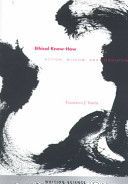
How can science be brought to connect with experience? This book addresses two of the most challenging problems facing contemporary neurobiology and cognitive science: first, understanding how we unconsciously execute habitual actions as a result of neurological and cognitive processes that are not formal actions of conscious judgment but part of a habitual nexus of systematic self-organization; second, creating an ethics adequate to our present awareness that there is no such thing as a transcendental self, a stable subject, or a soul.In earlier modes of cognitive science, cognition was conceptualized according to a model of representation and abstract reasoning. In the realm of ethics, this corresponded to the philosophical tenet that to do what is ethical is to do what corresponds to an abstract set of rules. By contrast to this computationalism, the author places central emphasis on what he terms “enaction”—cognition as the ability to negotiate embodied, everyday living in a world that is inseparable from our sensory-motor capacities.Apart from his researches in cognitive science, the bodies of thought that enable Varela to make this link are phenomenology and two representatives of what he calls the “wisdom traditions”: Confucian ethics and Buddhist epistemology. From the Confucian tradition, he draws upon the Mencius to propose an ethics of praxis, one in which ethical action is conceived as a project of being rather than as a system of judgment, less a matter of rules that are universally applicable than a goal of expertise, sagehood.The Buddhist contribution to his project encompasses “the embodiment of the void” and the “pragmatics of a virtual self.” How does a belief system that does not posit a unitary self or subject conceive the living of an “I”? In summation, the author proposes an ethics founded on “savoir faire” that is a practice of transformation based on a constant recognition of the “virtual” nature of ourselves in the actual operations of our mental lives.
Bernard Rollin historically and conceptually examines the ideology that denies the relevance of ethics to science. Providing an introduction to basic ethical concepts, he discusses a variety of ethical issues relevant to science and how they are ignored, to the detriment of both science and society. These issues include research on human subjects, animal research, genetic engineering, biotechnology, cloning, xenotransplantation, and stem cell research. Rollin also explores the ideological agnosticism that scientists have displayed regarding subjective experience in humans and animals, and its pernicious effect on pain management.
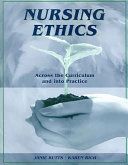
Spanning the nursing curriculum, Nursing Ethics: Across the Curriculum and Into Practice is derived from theoretical foundations, clinical evidence and case study. Based on the concept that compassionate relationships between nurses and patients form a vital element of humanistic nursing, this text provides foundational knowledge about ethics and decision-making strategies to prepare nurses for the moral issues they experience daily. Nursing Ethics includes decision-making approaches and models, rationale for decisions, and management of care for various topics. Instructor’s Resources Now Available! (Click on Supplements on the left-hand-menu to view.)
ما از اخلاق چه انتظاری داریم؟ این سوال شاید تاحدودی برای عموم مردم و یا متخصصان این رشته قابل پاسخ باشد؛ اینکه خوب بودن را به ما بیاموزد و در تنظیم روابط فردی م...

جشن کتاب تهران به ایستگاه سی و یکم رسیده است. حال و احوال نشر کتاب خوب نیست و باید فرهنگدوستان را به خرید و هدیه دادن کتاب ترغیب نمود. خانه اخلاقپژوهان جوان ب...

بنیاد کتابهای اخلاق اسلامی عمدتا پالایش جان از آلودگیها و آراستن آن به زیباییها است. اندیشه محوری این قبیل کتابها آن است که انسان فعلی آنی نیست که باید باشد...

-
0 Comments