Notice: تابع WP_Block_Type_Registry::register به طورنادرست فراخوانی شد. نامهای نوع بلوک نباید حروف بزرگ داشته باشند. لطفاً برای اطلاعات بیشتر، اشکال زدایی در وردپرس را مشاهده کنید. (این پیام در نگارش 5.0.0 افزوده شده است.) in /home/ethicsho/public_html/wp-includes/functions.php on line 5313
Warning: Use of undefined constant TDC_PATH_LEGACY - assumed 'TDC_PATH_LEGACY' (this will throw an Error in a future version of PHP) in /home/ethicsho/public_html/wp-content/plugins/td-composer/td-composer.php on line 109
Warning: Use of undefined constant TDSP_THEME_PATH - assumed 'TDSP_THEME_PATH' (this will throw an Error in a future version of PHP) in /home/ethicsho/public_html/wp-content/plugins/td-composer/td-composer.php on line 113 بایگانیهای Michael Banner - خانه اخلاق پژوهان جوان Notice: Trying to access array offset on value of type bool in /home/ethicsho/public_html/wp-content/plugins/wp-ulike/inc/general-functions.php on line 807
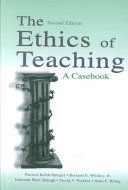
The Ethics of Teaching provides a frank discussion of the most frequently encountered ethical dilemmas that can arise in educational settings, as well as tips on how to avoid these predicaments and how to deal with them when they do occur. The goal is to stimulate discussion and raise faculties’ consciousness about ethical issues. Ethical dilemmas are presented as short, engaging case scenarios, most of which are based on actual situations, so as to furnish more realistic and interesting stimuli for individual reflection and group discussion. These scenarios offer the opportunity to consider the subtle complexities inherent in the social and psychological contexts in which educator-student interactions occur and the effects of those complexities on ethical decision making. Each case is followed by a detailed analysis and advice. The book’s 195 cases are grouped into 22 chapters representing topics, such as the controversial classroom presentations and assignments, debatable testing and grading practices, problematic student-faculty interactions, dual-role relationships with students, collegial conflicts, managing very difficult students, and confidentiality dilemmas. The Ethics of Teaching: A Casebook, Second Edition: *focuses on commonly encountered ethical “gray areas” that have no clear solution; *includes questions to stimulate discussion of related ethical issues; *concludes with a chapter on prevention, peer mentoring, and intervention; and *serves as excellent “assigned reading” to stimulate group discussion in teaching workshops and faculty development programs. The first edition of this book evolved by collecting a variety of teaching situations that commonly occur in college and university settings. The authors then created responses to the situations and circulated both the cases and the responses to reviewers from a number of departments across the country. As a result, the vast majority of the cases are “discipline free.” The second edition features many new cases to reflect recent trends and events related to academic ethics. Questions were added to stimulate discussion and to further elaborate the issues. The Ethics of Teaching: A Casebook is ideal for college and university faculty, graduate assistants, and administrators involved in workshops, graduate teaching assistant courses, and faculty development and new faculty orientation programs. As a result of the book’s cross-disciplinary development, it will be beneficial to faculty from a broad spectrum of disciplines.
Sentimental Rules is an ambitious and highly interdisciplinary work, which proposes and defends a new theory about the nature and evolution of moral judgment. In it, philosopher Shaun Nichols develops the theory that emotions play a critical role in both the psychological and the cultural underpinnings of basic moral judgment. Nichols argues that our norms prohibiting the harming of others are fundamentally associated with our emotional responses to those harms, and that such “sentimental rules” enjoy an advantage in cultural evolution, which partly explains the success of certain moral norms. This has sweeping and exciting implications for philosophical ethics. Nichols builds on an explosion of recent intriguing experimental work in psychology on our capacity for moral judgment and shows how this empirical work has broad import for enduring philosophical problems. The result is an account that illuminates fundamental questions about the character of moral emotions and the role of sentiment and reason in how we make our moral judgments. This work should appeal widely across philosophy and the other disciplines that comprise cognitive science.
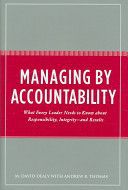
At its core, accountability is the responsibility to act. It is the commitment to do the right thing and stand by your decisions. Perhaps most importantly, it is a quality that must come from within; dishearteningly, even as legislators, shareholders, customers, and community activists are demanding greater accountability from corporate leaders, too many are waiting for some third party to take action. Whatever the endeavor, it is ultimately the individual who must hold himself to the highest standard first. Those who manage by accountability viscerally know that external rules cannot substitute for character. And they know that accountability is a quality that can be developed, honed through practice, and encouraged in others. Using stories drawn from David Dealy’s experiences on the front lines, as well as examples from other successful leaders, “Managing by Accountability” demonstrates how leaders who embark on a management philosophy of personal accountability imbue their organizations with the qualities of integrity and responsibility. In their down-to-earth style, the authors identify the five great accountability mistakes and offer a wealth of practical suggestions for overcoming them to achieve outstanding results throughout the organization. In some cases it may be Congress (e.g., Sarbanes-Oxley legislation), the media, the company’s legal or communications department, Wall Street, disgruntled customers, or angry community activists. This is not to say that formal accountability programs are useless; they do play an important role. Nevertheless, it is ultimately the individual who must hold himself to the highest standard first-without waiting to be told, pushed, or prodded. Those who manage by accountability viscerally know that external rules cannot substitute for character. And they also know that accountability can be developed, honed through practice, and encouraged in others. “Managing by Accountability” demonstrates how leaders who embark on a management philosophy of personal accountability imbue their organizations with the qualities of integrity and responsibility. Using stories drawn from David Dealy’s experiences on the front lines, as well as examples from other successful leaders, the book provides concrete examples of accountability in action. In their down-to-earth style, Dealy and Thomas identify the five great accountability mistakes and offer a wealth of practical suggestions for overcoming them to achieve outstanding results throughout the organization.
Emmanuel Levinas was a significant contributor to the field of philosophy, phenomenology and religion. A key interpreter of Husserl, he stressed the importance of attitudes to other people in any philosophical system. For Levinas, to be a subject is to take responsibility for others as well as yourself. He regarded ethics as the foundation for all other philosophy, but later admitted it could also be the foundation for theology. Michael Purcell outlines the basic themes of Levinas’ thought and the ways in which they might be deployed in fundamental and practical theology, and the study of the phenomenon of religion.
ما از اخلاق چه انتظاری داریم؟ این سوال شاید تاحدودی برای عموم مردم و یا متخصصان این رشته قابل پاسخ باشد؛ اینکه خوب بودن را به ما بیاموزد و در تنظیم روابط فردی م...

جشن کتاب تهران به ایستگاه سی و یکم رسیده است. حال و احوال نشر کتاب خوب نیست و باید فرهنگدوستان را به خرید و هدیه دادن کتاب ترغیب نمود. خانه اخلاقپژوهان جوان ب...

بنیاد کتابهای اخلاق اسلامی عمدتا پالایش جان از آلودگیها و آراستن آن به زیباییها است. اندیشه محوری این قبیل کتابها آن است که انسان فعلی آنی نیست که باید باشد...

-
0 Comments