Notice: تابع WP_Block_Type_Registry::register به طورنادرست فراخوانی شد. نامهای نوع بلوک نباید حروف بزرگ داشته باشند. لطفاً برای اطلاعات بیشتر، اشکال زدایی در وردپرس را مشاهده کنید. (این پیام در نگارش 5.0.0 افزوده شده است.) in /home/ethicsho/public_html/wp-includes/functions.php on line 5313
Warning: Use of undefined constant TDC_PATH_LEGACY - assumed 'TDC_PATH_LEGACY' (this will throw an Error in a future version of PHP) in /home/ethicsho/public_html/wp-content/plugins/td-composer/td-composer.php on line 109
Warning: Use of undefined constant TDSP_THEME_PATH - assumed 'TDSP_THEME_PATH' (this will throw an Error in a future version of PHP) in /home/ethicsho/public_html/wp-content/plugins/td-composer/td-composer.php on line 113 بایگانیهای Martin L. Cook - خانه اخلاق پژوهان جوان Notice: Trying to access array offset on value of type bool in /home/ethicsho/public_html/wp-content/plugins/wp-ulike/inc/general-functions.php on line 807
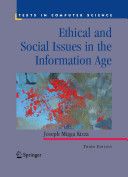
Ethical dilemmas have risen in number and intensity with the increasing dependence of contemporary society on computers and computer networks. Despite the proliferation of expert remedies, viable solutions to computer security issues remain too elusive, and society continues to suffer at the hands of cyber criminals, vandals, and hackers.This comprehensive third edition of the successful Ethical and Social Issues in the Information Age takes off where the second ended to examine ethical, social, and policy challenges stemming from the emergence of cyberspace, the convergence of telecommunication and computing technologies, and the miniaturalization of computing, telecommunication, and information-enabling devices. This accessible volume broadly surveys thought-provoking questions about the impact of these new technologies, with particular emphasis on the rapid growth of a multitude of computer networks, including the Internet. It assumes only a very modest familiarity with the basic computer literacy.Topics and features:• Describes how changes in information technology influence morality and the law• Provides fundamental discussion of network-security system design and operation to reveal vulnerable areas in computer network infrastructure (NEW chapter)• Surveys the history of computing and the evolution of computer crimes• Explores biometric techniques to system access control (NEW chapter)• Incorporates recent requirements for computer curricula• Introduces and explores techniques in electronic crime investigation (NEW chapter)• Assesses workplace concerns related to privacy, surveillance, and virtual offices• Offers a pertinent discussion on civil liberties, harassment, and discrimination• Contains chapter-ending exercises, and the author provides instructor classroom support materials and teaching guides at his websiteThis newly revised text/reference provides an updated discussion of the ethical and social issues that continue to evolve as computing and information technologies proliferate. Students at all levels who need to learn about computer ethics, the legal aspects of computing, network security, computer crime investigation, and biometrics will find this well documented work an invaluable resource. The book is also highly useful for practitioners needing such insights for their work.Supplementary material can be found at: www.utc.edu/faculty/Joseph-Kizza
Over the past decade, researchers from different academic disciplines have paid increasing attention to the productivity of online environments. The ethical underpinnings of research in such settings, however, remain contested and often controversial. As traditional debates have been reignited by the need to respond to the particular characteristics of technologically-mediated environments, researchers have entered anew key debates regarding the moral, legal and regulative aspects of research ethics. A growing trend in this work has been towards the promotion of localized and contextualized research ethics – the suggestion that the decisions we make should be informed by the nature of the environments we study and the habits/expectations of participants within them. Despite such moves, the relationship between the empirical, theoretical and methodological aspects of Internet research ethics remains underexplored. Drawing from ongoing sociological research into the practices of media cultures online, this book provides a timely and distinctive response to this need.This book explores the relationship between the production of ethical stances in two different contexts: the ethical manoeuvring of participants within online media-fan communities and the ethical decision-making of the author as Internet researcher, manoeuvring, as it were, in the academic community. In doing so, the book outlines a reflexive framework for exploring research ethics at different levels of analysis; the empirical settings of research; the theoretical perspectives which inform the researcher’s objectification of the research settings; and the methodological issues and practical decisions that constitute the activity as research. The analysis of these different levels develops a way of thinking about ethical practice in terms of stabilizing and destabilizing moves within and between research and researched communities. The analysis emphasizes the continuities and discontinuities between both research practice and online media-fan activity, and social activity in on and offline environments.
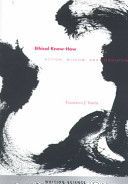
How can science be brought to connect with experience? This book addresses two of the most challenging problems facing contemporary neurobiology and cognitive science: first, understanding how we unconsciously execute habitual actions as a result of neurological and cognitive processes that are not formal actions of conscious judgment but part of a habitual nexus of systematic self-organization; second, creating an ethics adequate to our present awareness that there is no such thing as a transcendental self, a stable subject, or a soul.In earlier modes of cognitive science, cognition was conceptualized according to a model of representation and abstract reasoning. In the realm of ethics, this corresponded to the philosophical tenet that to do what is ethical is to do what corresponds to an abstract set of rules. By contrast to this computationalism, the author places central emphasis on what he terms “enaction”—cognition as the ability to negotiate embodied, everyday living in a world that is inseparable from our sensory-motor capacities.Apart from his researches in cognitive science, the bodies of thought that enable Varela to make this link are phenomenology and two representatives of what he calls the “wisdom traditions”: Confucian ethics and Buddhist epistemology. From the Confucian tradition, he draws upon the Mencius to propose an ethics of praxis, one in which ethical action is conceived as a project of being rather than as a system of judgment, less a matter of rules that are universally applicable than a goal of expertise, sagehood.The Buddhist contribution to his project encompasses “the embodiment of the void” and the “pragmatics of a virtual self.” How does a belief system that does not posit a unitary self or subject conceive the living of an “I”? In summation, the author proposes an ethics founded on “savoir faire” that is a practice of transformation based on a constant recognition of the “virtual” nature of ourselves in the actual operations of our mental lives.
ما از اخلاق چه انتظاری داریم؟ این سوال شاید تاحدودی برای عموم مردم و یا متخصصان این رشته قابل پاسخ باشد؛ اینکه خوب بودن را به ما بیاموزد و در تنظیم روابط فردی م...

جشن کتاب تهران به ایستگاه سی و یکم رسیده است. حال و احوال نشر کتاب خوب نیست و باید فرهنگدوستان را به خرید و هدیه دادن کتاب ترغیب نمود. خانه اخلاقپژوهان جوان ب...

بنیاد کتابهای اخلاق اسلامی عمدتا پالایش جان از آلودگیها و آراستن آن به زیباییها است. اندیشه محوری این قبیل کتابها آن است که انسان فعلی آنی نیست که باید باشد...

-
0 Comments