Notice: تابع WP_Block_Type_Registry::register به طورنادرست فراخوانی شد. نامهای نوع بلوک نباید حروف بزرگ داشته باشند. لطفاً برای اطلاعات بیشتر، اشکال زدایی در وردپرس را مشاهده کنید. (این پیام در نگارش 5.0.0 افزوده شده است.) in /home/ethicsho/public_html/wp-includes/functions.php on line 5313
Warning: Use of undefined constant TDC_PATH_LEGACY - assumed 'TDC_PATH_LEGACY' (this will throw an Error in a future version of PHP) in /home/ethicsho/public_html/wp-content/plugins/td-composer/td-composer.php on line 109
Warning: Use of undefined constant TDSP_THEME_PATH - assumed 'TDSP_THEME_PATH' (this will throw an Error in a future version of PHP) in /home/ethicsho/public_html/wp-content/plugins/td-composer/td-composer.php on line 113 بایگانیهای M. David Dealy - خانه اخلاق پژوهان جوان Notice: Trying to access array offset on value of type bool in /home/ethicsho/public_html/wp-content/plugins/wp-ulike/inc/general-functions.php on line 807
Writing in a conversational style filled with stories and examples, Jim Keenan breaks open the treasure trove of resources in the Catholic tradition for developing moral wisdom. He reclaims four key texts that bishops and lay people alike appealed to in nurturing their moral wisdom–the person of Jesus in the New Testament, the ten commandments in the catechism, the practice of the corporal works of mercy, and the development of the four cardinal virtues–and lifts up the lessons on love, conscience, sin, and suffering within these texts that form the content of the Catholic moral tradition.
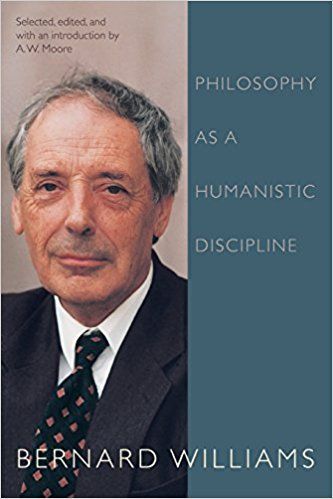
What can–and what can’t–philosophy do? What are its ethical risks–and its possible rewards? How does it differ from science? In Philosophy as a Humanistic Discipline, Bernard Williams addresses these questions and presents a striking vision of philosophy as fundamentally different from science in its aims and methods even though there is still in philosophy “something that counts as getting it right.” Written with his distinctive combination of rigor, imagination, depth, and humanism, the book amply demonstrates why Williams was one of the greatest philosophers of the twentieth century. Spanning his career from his first publication to one of his last lectures, the book’s previously unpublished or uncollected essays address metaphysics, epistemology, and ethics, as well as the scope and limits of philosophy itself. The essays are unified by Williams’s constant concern that philosophy maintain contact with the human problems that animate it in the first place. As the book’s editor, A. W. Moore, writes in his introduction, the title essay is “a kind of manifesto for Williams’s conception of his own life’s work.” It is where he most directly asks “what philosophy can and cannot contribute to the project of making sense of things”–answering that what philosophy can best help make sense of is “being human.”Philosophy as a Humanistic Discipline is one of three posthumous books by Williams to be published by Princeton University Press. In the Beginning Was the Deed: Realism and Moralism in Political Argument was published in the fall of 2005. The Sense of the Past: Essays in the History of Philosophy is being published shortly after the present volume.
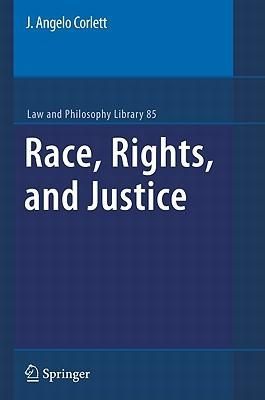
Race, Rights, and Justice explores questions of the nature of law and constitutional interpretation, international law and global justice, and the nature, function, and importance of rights each from a perspective that takes seriously the realities of race and racism. After a critical assessment of various contemporary theories of law is provided, a new theory of legal interpretation is set forth and defended. The respective words of Immanuel Kant and H. L. A. Hart on the possibility and desirability of international law are carefully explicated. Following this, Race, Rights, and Justice defends John Rawls’ Law of Peoples from the cosmopolitan liberal critique of it. The nature and importance of rights, both individual and collective, are clarified while correcting some political philosophies that have propagated confused rhetoric about rights. And the collective right to humanitarian intervention is investigated philosophically in terms of the recent problems in Colombia, with surprisingly original results. While the methodology of this book is thoroughly analytical, philosophically speaking, some of the conclusions drawn are substantially original, infusing the facts of race and racism into mainstream matters of philosophy of law.”In this collection of essays, J. Angelo Corlett continues his important work of bringing the perspective of indigenous peoples, and more generally of race, into mainstream philosophical debates about justice and rights. Corlett’s book also has very valuable insights into the nature of international law that will greatly enrich our contemporary debates.”Larry May, Washington University in St. Louis, USA”Angelo Corlett is a prolific writer whose work is invariably stimulating, provocative, and insightful. Race, Rights, and Justice is an important addition to the oeuvre. Corlett is not afraid to tackle big problems, and big names. See, for example, his scathing criticisms of Bork and Scalia on constitutional interpretation.”Burleigh T. Wilkins, University of California, Santa Barbara, USA
ما از اخلاق چه انتظاری داریم؟ این سوال شاید تاحدودی برای عموم مردم و یا متخصصان این رشته قابل پاسخ باشد؛ اینکه خوب بودن را به ما بیاموزد و در تنظیم روابط فردی م...

جشن کتاب تهران به ایستگاه سی و یکم رسیده است. حال و احوال نشر کتاب خوب نیست و باید فرهنگدوستان را به خرید و هدیه دادن کتاب ترغیب نمود. خانه اخلاقپژوهان جوان ب...

بنیاد کتابهای اخلاق اسلامی عمدتا پالایش جان از آلودگیها و آراستن آن به زیباییها است. اندیشه محوری این قبیل کتابها آن است که انسان فعلی آنی نیست که باید باشد...

-
0 Comments