Notice: تابع WP_Block_Type_Registry::register به طورنادرست فراخوانی شد. نامهای نوع بلوک نباید حروف بزرگ داشته باشند. لطفاً برای اطلاعات بیشتر، اشکال زدایی در وردپرس را مشاهده کنید. (این پیام در نگارش 5.0.0 افزوده شده است.) in /home/ethicsho/public_html/wp-includes/functions.php on line 5313
Warning: Use of undefined constant TDC_PATH_LEGACY - assumed 'TDC_PATH_LEGACY' (this will throw an Error in a future version of PHP) in /home/ethicsho/public_html/wp-content/plugins/td-composer/td-composer.php on line 109
Warning: Use of undefined constant TDSP_THEME_PATH - assumed 'TDSP_THEME_PATH' (this will throw an Error in a future version of PHP) in /home/ethicsho/public_html/wp-content/plugins/td-composer/td-composer.php on line 113 بایگانیهای Logi Gunnarsson - خانه اخلاق پژوهان جوان Notice: Trying to access array offset on value of type bool in /home/ethicsho/public_html/wp-content/plugins/wp-ulike/inc/general-functions.php on line 807
Fichte’s System of Ethics, originally published in 1798, is at once the most accessible presentation of its author’s comprehensive philosophical project, The Science of Knowledge or Wissenschaftslehre, and the most important work in moral philosophy written between Kant and Hegel. This study integrates the discussion of our moral duties into the systematic framework of a transcendental theory of the human subject. Ranging over numerous important philosophical themes, the volume offers a new translation of the work together with an introduction that sets it in its philosophical and historical contexts.
Like nature itself, modern economic life is driven by relentless competition and unbridled selfishness. Or is it? Drawing on converging evidence from neuroscience, social science, biology, law, and philosophy,Moral Marketsmakes the case that modern market exchange works only because most people, most of the time, act virtuously. Competition and greed are certainly part of economics, butMoral Marketsshows how the rules of market exchange have evolved to promote moral behavior and how exchange itself may make us more virtuous. Examining the biological basis of economic morality, tracing the connections between morality and markets, and exploring the profound implications of both,Moral Marketsprovides a surprising and fundamentally new view of economics–one that also reconnects the field to Adam Smith’s position that morality has a biological basis.Moral Markets, the result of an extensive collaboration between leading social and natural scientists, includes contributions by neuroeconomist Paul Zak; economists Robert H. Frank, Herbert Gintis, Vernon Smith (winner of the 2002 Nobel Prize in economics), and Bart Wilson; law professors Oliver Goodenough, Erin O’Hara, and Lynn Stout; philosophers William Casebeer and Robert Solomon; primatologists Sarah Brosnan and Frans de Waal; biologists Carl Bergstrom, Ben Kerr, and Peter Richerson; anthropologists Robert Boyd and Michael Lachmann; political scientists Elinor Ostrom and David Schwab; management professor Rakesh Khurana; computational science and informatics doctoral candidate Erik Kimbrough; and business writer Charles Handy.
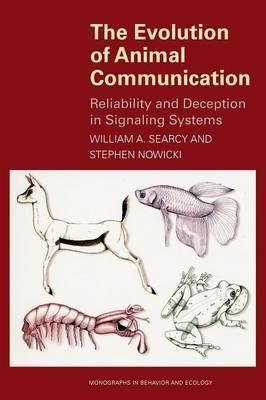
Gull chicks beg for food from their parents. Peacocks spread their tails to attract potential mates. Meerkats alert family members of the approach of predators. But are these–and other animals–sometimes dishonest? That’s what William Searcy and Stephen Nowicki ask inThe Evolution of Animal Communication. They take on the fascinating yet perplexing question of the dependability of animal signaling systems. The book probes such phenomena as the begging of nesting birds, alarm calls in squirrels and primates, carotenoid coloration in fish and birds, the calls of frogs and toads, and weapon displays in crustaceans. Do these signals convey accurate information about the signaler, its future behavior, or its environment? Or do they mislead receivers in a way that benefits the signaler? For example, is the begging chick really hungry as its cries indicate or is it lobbying to get more food than its brothers and sisters? Searcy and Nowicki take on these and other questions by developing clear definitions of key issues, by reviewing the most relevant empirical data and game theory models available, and by asking how well theory matches data. They find that animal communication is largely reliable–but that this basic reliability also allows the clever deceiver to flourish. Well researched and clearly written, their book provides new insight into animal communication, behavior, and evolution.
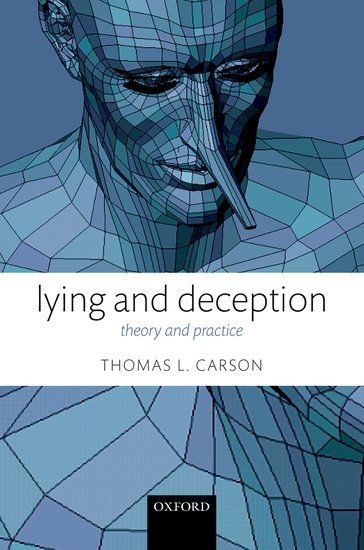
Thomas Carson offers the most comprehensive and up-to-date investigation of moral and conceptual questions about lying and deception. Part I addresses conceptual questions and offers definitions of lying, deception, and related concepts such as withholding information, “keeping someone in the dark,” and “half truths.” Part II deals with questions in ethical theory. Carson argues that standard debates about lying and deception between act-utilitarians and their critics are inconclusive because they rest on appeals to disputed moral intuitions. He defends a version of the golden rule and a theory of moral reasoning. His theory implies that there is a moral presumption against lying and deception that causes harm — a presumption at least as strong as that endorsed by act-utilitarianism. He uses this theory to justify his claims about the issues he addresses in Part III: deception and withholding information in sales, deception in advertising, bluffing in negotiations, the duties of professionals to inform clients, lying and deception by leaders as a pretext for fighting wars, and lying and deception about history (with special attention to the Holocaust), and cases of distorting the historical record by telling half-truths. The book concludes with a qualified defence of the view that honesty is a virtue.
ما از اخلاق چه انتظاری داریم؟ این سوال شاید تاحدودی برای عموم مردم و یا متخصصان این رشته قابل پاسخ باشد؛ اینکه خوب بودن را به ما بیاموزد و در تنظیم روابط فردی م...

جشن کتاب تهران به ایستگاه سی و یکم رسیده است. حال و احوال نشر کتاب خوب نیست و باید فرهنگدوستان را به خرید و هدیه دادن کتاب ترغیب نمود. خانه اخلاقپژوهان جوان ب...

بنیاد کتابهای اخلاق اسلامی عمدتا پالایش جان از آلودگیها و آراستن آن به زیباییها است. اندیشه محوری این قبیل کتابها آن است که انسان فعلی آنی نیست که باید باشد...

-
0 Comments