Notice: تابع WP_Block_Type_Registry::register به طورنادرست فراخوانی شد. نامهای نوع بلوک نباید حروف بزرگ داشته باشند. لطفاً برای اطلاعات بیشتر، اشکال زدایی در وردپرس را مشاهده کنید. (این پیام در نگارش 5.0.0 افزوده شده است.) in /home/ethicsho/public_html/wp-includes/functions.php on line 5313
Warning: Use of undefined constant TDC_PATH_LEGACY - assumed 'TDC_PATH_LEGACY' (this will throw an Error in a future version of PHP) in /home/ethicsho/public_html/wp-content/plugins/td-composer/td-composer.php on line 109
Warning: Use of undefined constant TDSP_THEME_PATH - assumed 'TDSP_THEME_PATH' (this will throw an Error in a future version of PHP) in /home/ethicsho/public_html/wp-content/plugins/td-composer/td-composer.php on line 113 بایگانیهای Laurie Shrage - خانه اخلاق پژوهان جوان Notice: Trying to access array offset on value of type bool in /home/ethicsho/public_html/wp-content/plugins/wp-ulike/inc/general-functions.php on line 807
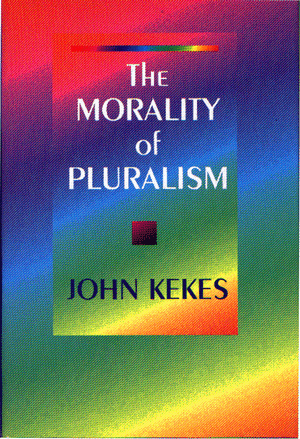
Current controversies about abortion, the environment, pornography, AIDS, capital punishment, and similar issues naturally lead to the question of whether there are any values that can be ultimately justified, or whether values are simply conventional. John Kekes argues that the present moral and political uncertainties are due to a deep change in our society from a dogmatic to a pluralistic view of values. Dogmatism is committed to there being only one justifiable system of values. Pluralism recognizes many such systems, and yet it avoids a chaotic relativism according to which all values are in the end arbitrary. Maintaining that good lives must be reasonable, but denying that they must conform to one true pattern, Kekes develops and justifies a pluralistic account of good lives and values, and works out its political, moral, and personal implications. The author defines values as possibilities whose realization would make lives good. He recognizes that their realization is difficult, especially since it involves choices among many, often conflicting, values. He argues, however, that living a good life requires a resolution of these conflicts, although reasonable resolutions are themselves plural in nature. His central claim is that pluralism is both reasonable and a preferable alternative to dogmatism and relativism.
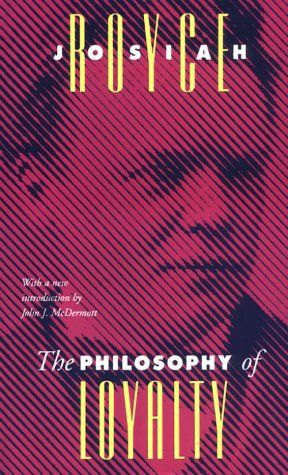
Josiah Royce (1855-1916), one of the outstanding classical American philosophers, is regarded by many as the foremost American idealist. A transitional book in the development of Royce’s thought, The Philosophy of Loyalty is a key to understanding his influence on the development of pragmatism. Royce’s basic argument is clear. Individual wills are a given, and social training is a natural aspect of community. But the two are not fully compatible, and conflicts naturally emerge. Loyalty to a cause unites many individuals into a community, but fanatical loyalty to causes often has inimical results. Long out of print and never before available in paperback, The Philosophy of Loyalty has many beneficial implications for understanding contemporary social passions and outlooks, especially for our own fragmented American culture. As Royce himself asserted nearly ninety years ago, in the preface of this book, “I am writing…not merely and not mainly for philosophers, but for all those who love…ideals, and also for those who love…their country – a country so ripe at present for idealism, and so confused, nevertheless, by the vastness and the complication of its social and political problems.” Royce speaks to these continuing concerns in a voice that is perceptive, learned, and sensitive to the human situation, and he offers powerful conceptual tools for our own troubled times.
ما از اخلاق چه انتظاری داریم؟ این سوال شاید تاحدودی برای عموم مردم و یا متخصصان این رشته قابل پاسخ باشد؛ اینکه خوب بودن را به ما بیاموزد و در تنظیم روابط فردی م...

جشن کتاب تهران به ایستگاه سی و یکم رسیده است. حال و احوال نشر کتاب خوب نیست و باید فرهنگدوستان را به خرید و هدیه دادن کتاب ترغیب نمود. خانه اخلاقپژوهان جوان ب...

بنیاد کتابهای اخلاق اسلامی عمدتا پالایش جان از آلودگیها و آراستن آن به زیباییها است. اندیشه محوری این قبیل کتابها آن است که انسان فعلی آنی نیست که باید باشد...

-
0 Comments