Notice: تابع WP_Block_Type_Registry::register به طورنادرست فراخوانی شد. نامهای نوع بلوک نباید حروف بزرگ داشته باشند. لطفاً برای اطلاعات بیشتر، اشکال زدایی در وردپرس را مشاهده کنید. (این پیام در نگارش 5.0.0 افزوده شده است.) in /home/ethicsho/public_html/wp-includes/functions.php on line 5313
Warning: Use of undefined constant TDC_PATH_LEGACY - assumed 'TDC_PATH_LEGACY' (this will throw an Error in a future version of PHP) in /home/ethicsho/public_html/wp-content/plugins/td-composer/td-composer.php on line 109
Warning: Use of undefined constant TDSP_THEME_PATH - assumed 'TDSP_THEME_PATH' (this will throw an Error in a future version of PHP) in /home/ethicsho/public_html/wp-content/plugins/td-composer/td-composer.php on line 113 بایگانیهای Jeffrey Dudiak - خانه اخلاق پژوهان جوان Notice: Trying to access array offset on value of type bool in /home/ethicsho/public_html/wp-content/plugins/wp-ulike/inc/general-functions.php on line 807
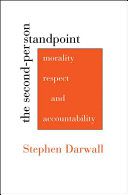
Why should we avoid doing moral wrong? The inability of philosophy to answer this question in a compelling manner–along with the moral skepticism and ethical confusion that ensue–result, Stephen Darwall argues, from our failure to appreciate the essentially interpersonal character of moral obligation. After showing how attempts to vindicate morality have tended to change the subject–falling back on nonmoral values or practical, first-person considerations–Darwall elaborates the interpersonal nature of moral obligations: their inherent link to our responsibilities to one another as members of the moral community.As Darwall defines it, the concept of moral obligation has an irreducibly second-person aspect; it presupposes our authority to make claims and demands on one another. And so too do many other central notions, including those of rights, the dignity of and respect for persons, and the very concept of person itself. The result is nothing less than a fundamental reorientation of moral theory that enables it at last to account for morality’s supreme authority–an account that Darwall carries from the realm of theory to the practical world of second-person attitudes, emotions, and actions.
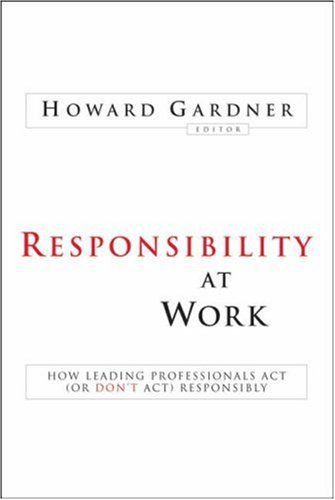
Responsibilityat WorkMost persons strive to produce work that is of excellent technical quality, is pursued in an ethical and socially responsible way, and has the qualities of being engaging and meaningful. How can we attain this ideal of good work in a world that changes so rapidly and all too often features an ethically compromised milieu? Filled with original essays by Howard Gardner, William Damon, Mihaly Csikszentmihalyi, and Jeanne Nakamura and based on a large-scale research project, the GoodWork(R) Project, Responsibility at Work reflects the information gleaned from in-depth interviews with more than 1,200 people from nine different professions–journalism, genetics, theatre, higher education, philanthropy, law, medicine, business, and precollegiate education. The book reveals how motivation, culture, and professional norms can intersect to produce work that is personally, socially, and economically beneficial.?At the heart of the study is the revelation that the key to good work is responsibilty–taking ownership for one’s work and its wider impact.The authors examine how responsibility for work is shaped by both personal and professional components and explore the factors that cause a sense of responsibility, the obstacles that lead to compromised work, and the educational interventions that can lead to a greater sense of responsibility. Most important, this volume provides strategies for cultivating greater responsibility in both seasoned workers as well as the young people who will one day enter the workplace.?
Recent scientific advances have placed many traditional philosophical concepts under great stress. In this pathbreaking book, the eminent philosopher Robert Nozick rethinks and transforms the concepts of truth, objectivity, necessity, contingency, consciousness, and ethics. Using an original method, he presents bold new philosophical theories that take account of scientific advances in physics, evolutionary biology, economics, and cognitive neuroscience, and casts current cultural controversies (such as whether all truth is relative and whether ethics is objective) in a wholly new light. Throughout, the book is open to, and engages in, the bold exploration of new philosophical possibilities.Philosophy will never look the same. Truth is embedded in space-time and is relative to it. However, truth is not socially relative among human beings (extraterrestrials are another matter). Objective facts are invariant under specified transformations; objective beliefs are arrived at by a process in which biasing factors do not play a significant role. Necessity’s domain is contracted (there are no important metaphysical necessities; water is not necessarily H2O) while the important and useful notion of degrees of contingency is elaborated. Gradations of consciousness (based upon “common registering”) yield increasing capacity to fit actions to the world. The originating function of ethics is cooperation to mutual benefit, and evolution has instilled within humans a “normative module”: the capacities to learn, internalize, follow norms, and make evaluations. Ethics has normative force because of the connection between ethics and conscious self-awareness. Nozick brings together the book’s novel theories to show the extent to which there are objective ethical truths.
Doctors and medical students confront increasingly complicated ethical dilemmas. To respond effectively they need skills in ethical reasoning and an understanding of the law and professional guidance. This book helps them achieve these things. It provides practical advice and guidance that draws upon the large volume of enquiries received by the BMAs Medical Ethics Department.Although rooted in moral theory and legal practice, the book is designed both to provide practical advice for doctors day to day working lives and to stimulate debate on broader areas of public policy.
The Animal Ethics Readeris the first comprehensive, state-of-the-art anthology of readings on this substantial area of study and interest. A subject that regularly captures the headlines, the book is designed to appeal to anyone interested in tracing the history of the subject, as well as providing a powerful insight into the debate as it has developed. The recent wealth of material published in this area has not, until now, been collected in one volume. Readings are arranged thematically, carefully presenting a balanced representation of the subject as it stands. It will be essential reading for students taking a course in the subject as well as being of considerable interest to the general reader. Articles are arranged under the following headings: Theories of Animal Ethics; Animal Capacities; Animals for Food; Animal Experimentation; Genetic Engineering of Animals; Ethics and Wildlife; Zoos, Aquaria, and Animals in Entertainment; Companion Animals; Legal Rights for Animals. Readings from leading experts in the field including Peter Singer, Mary Midgley and Bernard Rollin are featured as well as selections from Donald Griffin, Mark Bekoff, Jane Goodall, Raymond Frey, Barbara Orlans, Tom Regan, and Baird Callicott. There is an emphasis on balancing classic and contemporary readings with a view to presenting debates as they stand at this point in time. Each chapter is introduced by the editors and study questions feature at the end. The foreword has been written by Bernard Rollin.
ما از اخلاق چه انتظاری داریم؟ این سوال شاید تاحدودی برای عموم مردم و یا متخصصان این رشته قابل پاسخ باشد؛ اینکه خوب بودن را به ما بیاموزد و در تنظیم روابط فردی م...

جشن کتاب تهران به ایستگاه سی و یکم رسیده است. حال و احوال نشر کتاب خوب نیست و باید فرهنگدوستان را به خرید و هدیه دادن کتاب ترغیب نمود. خانه اخلاقپژوهان جوان ب...

بنیاد کتابهای اخلاق اسلامی عمدتا پالایش جان از آلودگیها و آراستن آن به زیباییها است. اندیشه محوری این قبیل کتابها آن است که انسان فعلی آنی نیست که باید باشد...

-
0 Comments