Notice: تابع WP_Block_Type_Registry::register به طورنادرست فراخوانی شد. نامهای نوع بلوک نباید حروف بزرگ داشته باشند. لطفاً برای اطلاعات بیشتر، اشکال زدایی در وردپرس را مشاهده کنید. (این پیام در نگارش 5.0.0 افزوده شده است.) in /home/ethicsho/public_html/wp-includes/functions.php on line 5313
Warning: Use of undefined constant TDC_PATH_LEGACY - assumed 'TDC_PATH_LEGACY' (this will throw an Error in a future version of PHP) in /home/ethicsho/public_html/wp-content/plugins/td-composer/td-composer.php on line 109
Warning: Use of undefined constant TDSP_THEME_PATH - assumed 'TDSP_THEME_PATH' (this will throw an Error in a future version of PHP) in /home/ethicsho/public_html/wp-content/plugins/td-composer/td-composer.php on line 113 بایگانیهای Gilbert Meilaender - خانه اخلاق پژوهان جوان Notice: Trying to access array offset on value of type bool in /home/ethicsho/public_html/wp-content/plugins/wp-ulike/inc/general-functions.php on line 807
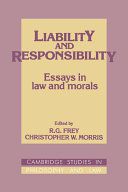
This collection of contemporary essays by a group of well-known philosophers and legal theorists covers various topics in the philosophy of law, focusing on issues concerning liability in contract, tort, and criminal law. The book is divided into four sections. The first provides a conceptual overview of the issues at stake in a philosophical discussion of liability and responsibility. The second, third, and fourth sections present, in turn, more detailed explorations of the roles of notions of liability and responsibility in contracts, torts, and punishment. The collection not only presents some of the most challenging work being done in legal philosophy today, it also demonstrates the interdisciplinary character of the field of philosophy of law, with contributors taking into account recent developments in economics, political science, and rational choice theory. This thought-provoking volume will help to shed light on the underexplored ground that lies between law and morals.
Provides a unique approach to the study of ethics by incorporating both the philosophical and religious perspectives against a discussion of moral issues. It requires readers to examine their own positions on a range of moral issues and to provide reasons in support of those opinions through readings that emphasize the use of critical thinking skills as necessary to moral reasoning.
A new account of Aristotle’s Ethics, this book argues for the central importance of the concept of techne or craft in Aristotle’s moral theory. Exploring the importance of techne in the Platonic and pre-Platonic intellectual context in which Aristotle was writing, Tom Angier here shows that this concept has an important role in Aristotle’s Ethics that has rarely been studied in Anglo-American scholarship. Through close-analysis of the primary texts, this book uses the focus on techne to systematically critique and renew Aristotelian moral philosophy. Techne in Aristotle’s Ethics provides a novel and challenging approach to one of the Ancient World’s most enduring intellectual legacies.
The Edge of Life: Human Dignity and Contemporary Bioethics treats a number of distinct moral questions and ?nds their answer in the dignity of the person, both as an agent and as a patient (in the sense of the recipient of action). Characteristically one’s view of the human being ultimately shapes one’s outlook on these matters. This book addresses questions that divide a culture of life from a culture of death as well as a number of questions debated within the Catholic tradition itself. The Edge of Life offers a critique of the new bio-ethic, represented by such notable authors as Peter Singer; it also attempts to shore up some of the dif?culties leveled by critics against the traditional ethic as well as to answer some questions disputed by those within the tradition. This book does not treat the basic principles of morality but rather many of their applications and suppositions. (For an account of contemporary debates within the Catholic tradition on these matters, see Kaczor 2002). Rather, The Edge of Life seeks to address a number of disputed contemporary questions touching upon human dignity at what has been called “the margins of life. ” The ?rst section of the book treats the dignity of the human person as recipient of action and as agent. Chapter two examines various accounts of when a human being becomes a person.
ما از اخلاق چه انتظاری داریم؟ این سوال شاید تاحدودی برای عموم مردم و یا متخصصان این رشته قابل پاسخ باشد؛ اینکه خوب بودن را به ما بیاموزد و در تنظیم روابط فردی م...

جشن کتاب تهران به ایستگاه سی و یکم رسیده است. حال و احوال نشر کتاب خوب نیست و باید فرهنگدوستان را به خرید و هدیه دادن کتاب ترغیب نمود. خانه اخلاقپژوهان جوان ب...

بنیاد کتابهای اخلاق اسلامی عمدتا پالایش جان از آلودگیها و آراستن آن به زیباییها است. اندیشه محوری این قبیل کتابها آن است که انسان فعلی آنی نیست که باید باشد...

-
0 Comments