Notice: تابع WP_Block_Type_Registry::register به طورنادرست فراخوانی شد. نامهای نوع بلوک نباید حروف بزرگ داشته باشند. لطفاً برای اطلاعات بیشتر، اشکال زدایی در وردپرس را مشاهده کنید. (این پیام در نگارش 5.0.0 افزوده شده است.) in /home/ethicsho/public_html/wp-includes/functions.php on line 5313
Warning: Use of undefined constant TDC_PATH_LEGACY - assumed 'TDC_PATH_LEGACY' (this will throw an Error in a future version of PHP) in /home/ethicsho/public_html/wp-content/plugins/td-composer/td-composer.php on line 109
Warning: Use of undefined constant TDSP_THEME_PATH - assumed 'TDSP_THEME_PATH' (this will throw an Error in a future version of PHP) in /home/ethicsho/public_html/wp-content/plugins/td-composer/td-composer.php on line 113 بایگانیهای Gemeinsame Verantwortung und moralische Pflicht English - خانه اخلاق پژوهان جوان Notice: Trying to access array offset on value of type bool in /home/ethicsho/public_html/wp-content/plugins/wp-ulike/inc/general-functions.php on line 807
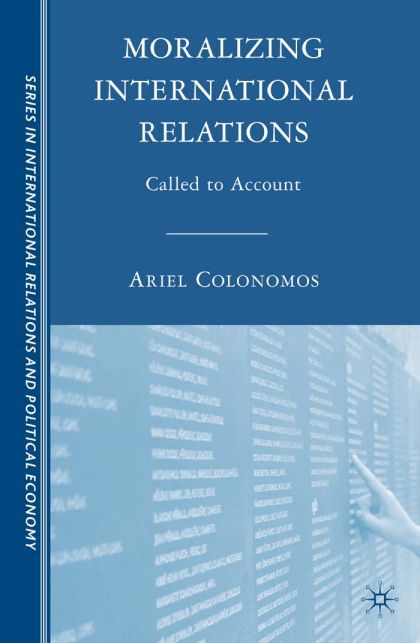
“The end of the cold war politics and the fall of the Berlin wall have had major ethical consequences. In the 90s Ethics have become a rallying point for non-state actors and experts who gather around values and norms in order to oblige institutions to justify their behavior. This process is the result of different changes, the transformation of the international system, the individualization of Western societies and the growing importance of expertise in the justification of decisions in risk adverse societies. Along with the globalization of the economy and the formation of new political coalitions, global ethics are the pillar of our era of international ‘turbulence’.”–BOOK JACKET.
Throughout history, men have repeatedly made judgments regarding their own conduct and that of their fellow men. Some acts have been judged to be right or good, while other acts have been denounced as wrong or evil. Ethical judgment in medicine, as in other areas of life, is an attempt to distinguish between good and bad conduct.This book is based on three lectures given by the author as the Medical Director of Eye Clinic Singapura International. The first lecture was an address delivered to medical undergraduates at the National University of Singapore in 1975. The second was a Commonwealth Medical Association lecture delivered a decade ago. The third was a Singapore Medical Association lecture delivered in 1981. This volume, emphasizing the principles of medical ethics, has been kept simple and brief, and it is hoped that it will make interesting reading for both medical professionals and the general public.
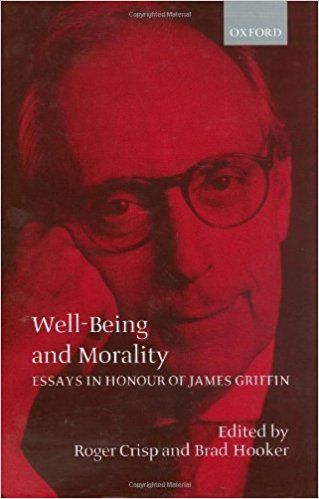
An international line-up of fourteen distinguished philosophers presents new essays in honor of James Griffin, White’s Professor of Moral Philosophy at Oxford University. The essays take up topics relating to well-being and morality, prominent themes in contemporary ethics and particularly in Griffin’s work. Griffin himself provides replies to these essays, offering a fascinating development of his own thinking on these topics.
In 1784, the German newspaper Berlinische Monatsschrift asked its audience to reply to the question “What is Enlightenment?” Immanuel Kant took the opportunity to investigate the purported truths and assumptions of his age. Two hundred years later, Michel Foucault wrote a response to Kant’s initial essay, positioning Kant as the initiator of the discourse and critique of modernity. The Politics of Truth takes this initial encounter between Foucault and Kant, as a framework for its selection of unpublished essays and transcripts of lectures Foucault gave in America and France between 1978 and 1984, the year of his death. Ranging from reflections on the Enlightenment and revolution to a consideration of the Frankfurt School, this collection offers insight into the topics preoccupying Foucault as he worked on what would be his last body of published work, the three-volume History of Sexuality. It also offers what is in a sense the most “American” moment of Foucault’s thinking, for it was in America that he realized the necessity of tying his own thought to that of the Frankfurt School.
ما از اخلاق چه انتظاری داریم؟ این سوال شاید تاحدودی برای عموم مردم و یا متخصصان این رشته قابل پاسخ باشد؛ اینکه خوب بودن را به ما بیاموزد و در تنظیم روابط فردی م...

جشن کتاب تهران به ایستگاه سی و یکم رسیده است. حال و احوال نشر کتاب خوب نیست و باید فرهنگدوستان را به خرید و هدیه دادن کتاب ترغیب نمود. خانه اخلاقپژوهان جوان ب...

بنیاد کتابهای اخلاق اسلامی عمدتا پالایش جان از آلودگیها و آراستن آن به زیباییها است. اندیشه محوری این قبیل کتابها آن است که انسان فعلی آنی نیست که باید باشد...

-
0 Comments