Notice: تابع WP_Block_Type_Registry::register به طورنادرست فراخوانی شد. نامهای نوع بلوک نباید حروف بزرگ داشته باشند. لطفاً برای اطلاعات بیشتر، اشکال زدایی در وردپرس را مشاهده کنید. (این پیام در نگارش 5.0.0 افزوده شده است.) in /home/ethicsho/public_html/wp-includes/functions.php on line 5313
Warning: Use of undefined constant TDC_PATH_LEGACY - assumed 'TDC_PATH_LEGACY' (this will throw an Error in a future version of PHP) in /home/ethicsho/public_html/wp-content/plugins/td-composer/td-composer.php on line 109
Warning: Use of undefined constant TDSP_THEME_PATH - assumed 'TDSP_THEME_PATH' (this will throw an Error in a future version of PHP) in /home/ethicsho/public_html/wp-content/plugins/td-composer/td-composer.php on line 113 بایگانیهای G. William Barnard - خانه اخلاق پژوهان جوان Notice: Trying to access array offset on value of type bool in /home/ethicsho/public_html/wp-content/plugins/wp-ulike/inc/general-functions.php on line 807
What can–and what can’t–philosophy do? What are its ethical risks–and its possible rewards? How does it differ from science? In Philosophy as a Humanistic Discipline, Bernard Williams addresses these questions and presents a striking vision of philosophy as fundamentally different from science in its aims and methods even though there is still in philosophy “something that counts as getting it right.” Written with his distinctive combination of rigor, imagination, depth, and humanism, the book amply demonstrates why Williams was one of the greatest philosophers of the twentieth century. Spanning his career from his first publication to one of his last lectures, the book’s previously unpublished or uncollected essays address metaphysics, epistemology, and ethics, as well as the scope and limits of philosophy itself. The essays are unified by Williams’s constant concern that philosophy maintain contact with the human problems that animate it in the first place. As the book’s editor, A. W. Moore, writes in his introduction, the title essay is “a kind of manifesto for Williams’s conception of his own life’s work.” It is where he most directly asks “what philosophy can and cannot contribute to the project of making sense of things”–answering that what philosophy can best help make sense of is “being human.”Philosophy as a Humanistic Discipline is one of three posthumous books by Williams to be published by Princeton University Press. In the Beginning Was the Deed: Realism and Moralism in Political Argument was published in the fall of 2005. The Sense of the Past: Essays in the History of Philosophy is being published shortly after the present volume.
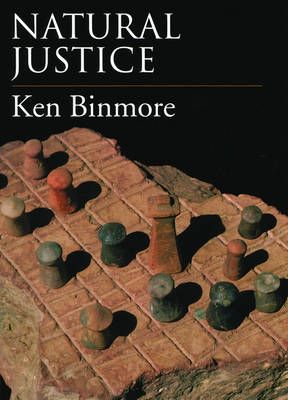
This book lays out foundations for a “science of morals.” Binmore uses game theory as a systematic tool for investigating ethical matters. He reinterprets classical social contract ideas within a game-theory framework and generates new insights into the fundamental questions of social philosophy. In contrast to the previous writing in moral philosophy that relied on vague notion such as ” societal well-being” and “moral duty,” Binmore begins with individuals; rational decision-makers with the ability to emphasize with one another. Any social arrangement that prescribes them to act against their interests will become unstable and eventually will be replaced by another, until one is found that includes worthwhile actions for all individuals involved.
Bob Brecher claims that it is wrong to think that morality is simply rooted in what people want. Brecher explains that in our consumerist society, we make the assumption that getting “what people want” is our natural goal, and that this goal is usually a good one. We see that whether it is a matter of pornography or getting married–if people want it, then that’s that. But is this really a good thing? Getting What You Want offers a critique of liberal morality and an analysis of its understanding of the individual as a wanting thing. Brecher boldly argues that the Anglo-American liberalism cannot give an adequate account of moral reasoning and action, or any justification of moral principles or demands.
Book Summary of Classical Moralists: Selections Illustrating EthicsThis book is a history of ethics based upon selections from the original sources and upon translations of the authors themselves. The evolution of ethical thought is thereby revealed from Socrates to Martineau. Contents: Socrates; Plato; Aristotle; Zeno; Epicurus; Titus Lucretius Carus; Epictetus; Marcus Aurelius Antoninus; Plotinus; Saint Augustine; Peter Abelard; Thomas Abelard; Thomas Aquinas; Hugo Grotius; Thomas Hobbes; Ralph Cudworth; Henry More; Richard Cumberland; Baruch De Spinoza; Nicolas Malebranche; John Locke; Samuel Clarke; Third Earl of Shaftesbury; Benard De Mandeville; William Wollaston; Joseph Butler; Francis Hutcheson; David Hartley; David Hume; Adam Smith; Claude Adrien Helvetius; William Paley; Jeremy Bentham; Richard Price; Thomas Reid; Immanuel Kant; Johann Gottlieb; Georg Wilhelm Friedrich; Arthur Schopnehauer; Friedrich Eduard Beneke; John Stuart Mill; Herbert Spencer; Henry Sidgwick..
ما از اخلاق چه انتظاری داریم؟ این سوال شاید تاحدودی برای عموم مردم و یا متخصصان این رشته قابل پاسخ باشد؛ اینکه خوب بودن را به ما بیاموزد و در تنظیم روابط فردی م...

جشن کتاب تهران به ایستگاه سی و یکم رسیده است. حال و احوال نشر کتاب خوب نیست و باید فرهنگدوستان را به خرید و هدیه دادن کتاب ترغیب نمود. خانه اخلاقپژوهان جوان ب...

بنیاد کتابهای اخلاق اسلامی عمدتا پالایش جان از آلودگیها و آراستن آن به زیباییها است. اندیشه محوری این قبیل کتابها آن است که انسان فعلی آنی نیست که باید باشد...

-
0 Comments