Notice: تابع WP_Block_Type_Registry::register به طورنادرست فراخوانی شد. نامهای نوع بلوک نباید حروف بزرگ داشته باشند. لطفاً برای اطلاعات بیشتر، اشکال زدایی در وردپرس را مشاهده کنید. (این پیام در نگارش 5.0.0 افزوده شده است.) in /home/ethicsho/public_html/wp-includes/functions.php on line 5313
Warning: Use of undefined constant TDC_PATH_LEGACY - assumed 'TDC_PATH_LEGACY' (this will throw an Error in a future version of PHP) in /home/ethicsho/public_html/wp-content/plugins/td-composer/td-composer.php on line 109
Warning: Use of undefined constant TDSP_THEME_PATH - assumed 'TDSP_THEME_PATH' (this will throw an Error in a future version of PHP) in /home/ethicsho/public_html/wp-content/plugins/td-composer/td-composer.php on line 113 بایگانیهای Anthony Dyson - خانه اخلاق پژوهان جوان Notice: Trying to access array offset on value of type bool in /home/ethicsho/public_html/wp-content/plugins/wp-ulike/inc/general-functions.php on line 807
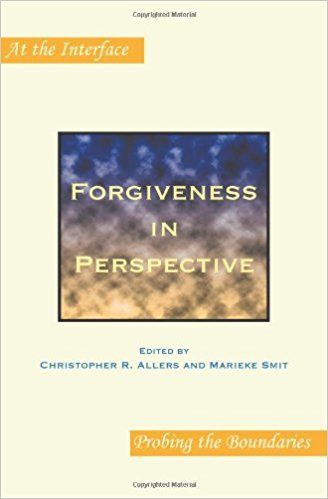
Amidst the cacophony of claims made about forgiveness, this book serves to aid in an effort to put żforgiveness in perspective.ż Marieke Smit and Christopher R. Allers have collected here ten essays written by twelve authors from around the world and across the disciplinary spectrum including philosophers, practitioners, psychologists, literary theorists, and prison chaplains. All the essays offer a perspective on forgiveness and put forgiveness in perspective whether by tracing what forgiveness żis,ż how this religious inheritance is worked out in our secularizing societies, how forgiveness works in our quotidian experience, or a particular manifestation in a particular context such as marriage, prison, or after an abortion, to name a few. The multi-disciplinary character of this book provides a multi-disciplinary appeal as well as a resource to enlarge oneżs own perspective on this perplexing, enigmatic, and wonderfully complex concept of forgiveness.Marieke Smit is a researcher at the Centre for Prison Pastoral Care at the University of Tilburg, The Netherlands. Her research concerns the role of forgiveness in detention. She is also working as a prison chaplain in Dutch prisons.Christopher R. Allers (M.A., Institute for Christian Studies, Toronto) is Adjunct Professor of Philosophy at Cornerstone University (Grand Rapids, MI) and Sessional Instructor in Philosophy at the Institute for Christian Studies, Toronto (ICS) where he is also a doctoral student in the conjoint degree program between ICS and the Vrije Universiteit, Amsterdam. He is currently working on a dissertation on forgiveness which is tentatively titled The Miracle of Forgiveness.
Purchase of this book includes free trial access to www.million-books.com where you can read more than a million books for free. This is an OCR edition with typos. Excerpt from book: CHAPTER III. ON QUALITY OF PLEASURE. I Alluded in the last chapter to the two great unsettled questions, to what degree happiness is different for different people, and how far it is in each man’s own power for himself. Both these questions concern the subject of this chapter. If happiness is different for different people, how far ought it to be so ? And how far can we raise the character of our happiness ? There is perhaps a disposition in our age to accept A morality jTi i iT ofhappi- a morality of happiness as better, more like what we ness, espe- expect morality to be, than one of rule: such a hoi,,1 morality may take the form of a utilitarianism recog- rj;e nizing different kinds of pleasures, some worthier and is more c- more to be striven after than others. Religion too than’a mo- has not unfrequently shown itself more in harmony i1ety of with the moral philosophy which speaks much of happiness than with that which speaks much of law. And though it is true that when religion has spoken the language of bare utilitarianism, as in Paley, it has not much commended itself to real human feeling: still when it is presented to us not only as conformable to our desire, but also as what is to regulate our desire, uniting with its promises to make us happy a call upon us for effort after a worthy happiness, and elevation of our idea of happiness (as we are told on the one hand that the ways of religion are pleasantness and her paths peace, while on the other hand we pray that we may love that which God commands and desire that he promises); the morality which is thus proposed to us has charms in our view which do not belong to a morality of rule. But this But then it is to be observed that this more at- worthiness tractive form of utilitarianism involves …
Bioethics was “born in the USA” and the values American bioethics embrace are based on American law, including liberty and justice. This book crosses the borders between bioethics and law, but moves beyond the domestic law/bioethics struggles for dominance by exploring attempts to articulate universal principles based on international human rights. The isolationism of bioethics in the US is not tenable in the wake of scientific triumphs like decoding the human genome, and civilizational tragedies like international terrorism. Annas argues that by crossing boundaries which have artificially separated bioethics and health law from the international human rights movement, American bioethics can be reborn as a global force for good, instead of serving mainly the purposes of U.S. academics. This thesis is explored in a variety of international contexts such as terrorism and genetic engineering, and in U.S. domestic disputes such as patient rights and market medicine. The citizens of the world have created two universal codes: science has sequenced the human genome and the United Nations has produced the Universal Declaration of Human Rights. The challenge for American bioethics is to combine these two great codes in imaginative and constructive ways to make the world a better, and healthier, place to live.
ما از اخلاق چه انتظاری داریم؟ این سوال شاید تاحدودی برای عموم مردم و یا متخصصان این رشته قابل پاسخ باشد؛ اینکه خوب بودن را به ما بیاموزد و در تنظیم روابط فردی م...

جشن کتاب تهران به ایستگاه سی و یکم رسیده است. حال و احوال نشر کتاب خوب نیست و باید فرهنگدوستان را به خرید و هدیه دادن کتاب ترغیب نمود. خانه اخلاقپژوهان جوان ب...

بنیاد کتابهای اخلاق اسلامی عمدتا پالایش جان از آلودگیها و آراستن آن به زیباییها است. اندیشه محوری این قبیل کتابها آن است که انسان فعلی آنی نیست که باید باشد...

-
0 Comments