Notice: تابع WP_Block_Type_Registry::register به طورنادرست فراخوانی شد. نامهای نوع بلوک نباید حروف بزرگ داشته باشند. لطفاً برای اطلاعات بیشتر، اشکال زدایی در وردپرس را مشاهده کنید. (این پیام در نگارش 5.0.0 افزوده شده است.) in /home/ethicsho/public_html/wp-includes/functions.php on line 5313
Warning: Use of undefined constant TDC_PATH_LEGACY - assumed 'TDC_PATH_LEGACY' (this will throw an Error in a future version of PHP) in /home/ethicsho/public_html/wp-content/plugins/td-composer/td-composer.php on line 109
Warning: Use of undefined constant TDSP_THEME_PATH - assumed 'TDSP_THEME_PATH' (this will throw an Error in a future version of PHP) in /home/ethicsho/public_html/wp-content/plugins/td-composer/td-composer.php on line 113 بایگانیهای Angus Ritchie - خانه اخلاق پژوهان جوان Notice: Trying to access array offset on value of type bool in /home/ethicsho/public_html/wp-content/plugins/wp-ulike/inc/general-functions.php on line 807
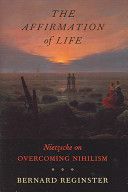
Among all the great thinkers of the past two hundred years, Nietzsche continues to occupy a special place–not only for a broad range of academics but also for members of a wider public, who find some of their most pressing existential concerns addressed in his works. Central among these concerns is the question of the meaning of a life characterized by inescapable suffering, at a time when the traditional responses inspired by Christianity are increasingly losing their credibility. While most recent studies of Nietzsche’s works have lost sight of this fundamental issue, Bernard Reginster’s book The Affirmation of Life brings it sharply into focus. Reginster identifies overcoming nihilism as a central objective of Nietzsche’s philosophical project, and shows how this concern systematically animates all of his main ideas. In particular, Reginster’s work develops an original and elegant interpretation of the will to power, which convincingly explains how Nietzsche uses this doctrine to mount a critique of the dominant Christian values, to overcome the nihilistic despair they produce, and to determine the conditions of a new affirmation of life. Thus, Reginster attributes to Nietzsche a compelling substantive ethical outlook based on the notions of challenge and creativity–an outlook that involves a radical reevaluation of the role and significance of suffering in human existence. Replete with deeply original insights on many familiar–and frequently misunderstood–Nietzschean concepts, Reginster’s book will be essential to anyone approaching this towering figure of Western intellectual history.
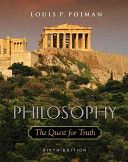
Praised for its accessibility and comprehensiveness, Philosophy: The Quest for Truth provides an excellent selection of classical and contemporary readings on nineteen key problems in philosophy. Louis P. Pojman has carefully organized the essays in each section so that they present pro/con dialogues that allow students to compare and contrast the philosophers’ positions. Topics covered include the nature of philosophy, the existence of God, immortality, knowledge, the mind-body question, personal identity, free will and determinism, ethics, political philosophy, and the meaning of life. The sixth edition offers selections from Plato, Rene Descartes, John Locke, David Hume, William James, Bertrand Russell, John Hick, John Hospers, and James Rachels–as well as essays by Aristotle, Thomas Aquinas, Blaise Pascal, Thomas Hobbes, George Berkeley, Immanuel Kant, Gilbert Ryle, Albert Camus, Jean-Paul Sartre, Alvin Plantinga, and many others. In Philosophy: The Quest for Truth, Sixth Edition, Pojman offers substantial introductions to each of the nineteen philosophical problems. In addition, each of the seventy-six readings is accompanied by an individual introduction with a biographical sketch of the philosopher, study questions, and reflective questions that challenge students to analyze and critique the material. Short bibliographies following each major section and a detailed glossary further enhance the text’s pedagogical value. Invaluable for introductory courses in philosophy, this highly acclaimed text inspires and guides students’ quest for wisdom. New to the Sixth Edition:: * Six selections: William Lane Craig: The Kalam Cosmological Argument and the Anthropic Principle William Rowe: An Analysis of the Ontological Argument Daniel Dennett: Postmodernism and Truth William James: The Dilemma of Determinism Harry Frankfurt: Freedom of the Will and the Concept of a Person John Rawls: The Contemporary Liberal Answer * More exercises in the excursus on logic
Addictive thought is inherently self-deceptive, yet offers a superficial logic that can be misleading to the addict as well as to the addict’s family members.Abnormal thinking in addiction was originally recognized by members of Alcoholics Anonymous, who coined the term “stinking thinking.” Addictive thinking often appears rational, but only on a superficial level. Addicts, as well as their family members, are easily seduced by the attendant–and erroneous–reasoning process it can foster. In Addictive Thinking, author Abraham Twerski reveals how self-deceptive thought can undermine self-esteem and threaten the sobriety of a recovering individual. This timely revision of the original classic includes updated information and research on depression and affective disorders, the relationship between addictive thinking and relapse, and the origins of addictive thought. Ultimately, Addictive Thinking offers hope to those seeking a healthy and rewarding life in recovery. Dr. Twerski is founder and medical director of the Gateway Rehabilitation Center in Pittsburgh, Pennsylvania. A rabbi, psychiatrist, and chemical dependency counselor, he is the author of numerous journal articles and books including Self Discovery in Recovery, I Didn’t Ask to be in This Family: Sibling Relationships and How They Shame Adult Behavior and Dependencies, and with “Peanuts” cartoonist Charles Schulz, When Do the Good Things Start?
ما از اخلاق چه انتظاری داریم؟ این سوال شاید تاحدودی برای عموم مردم و یا متخصصان این رشته قابل پاسخ باشد؛ اینکه خوب بودن را به ما بیاموزد و در تنظیم روابط فردی م...

جشن کتاب تهران به ایستگاه سی و یکم رسیده است. حال و احوال نشر کتاب خوب نیست و باید فرهنگدوستان را به خرید و هدیه دادن کتاب ترغیب نمود. خانه اخلاقپژوهان جوان ب...

بنیاد کتابهای اخلاق اسلامی عمدتا پالایش جان از آلودگیها و آراستن آن به زیباییها است. اندیشه محوری این قبیل کتابها آن است که انسان فعلی آنی نیست که باید باشد...

-
0 Comments