Notice: تابع WP_Block_Type_Registry::register به طورنادرست فراخوانی شد. نامهای نوع بلوک نباید حروف بزرگ داشته باشند. لطفاً برای اطلاعات بیشتر، اشکال زدایی در وردپرس را مشاهده کنید. (این پیام در نگارش 5.0.0 افزوده شده است.) in /home/ethicsho/public_html/wp-includes/functions.php on line 5313
Warning: Use of undefined constant TDC_PATH_LEGACY - assumed 'TDC_PATH_LEGACY' (this will throw an Error in a future version of PHP) in /home/ethicsho/public_html/wp-content/plugins/td-composer/td-composer.php on line 109
Warning: Use of undefined constant TDSP_THEME_PATH - assumed 'TDSP_THEME_PATH' (this will throw an Error in a future version of PHP) in /home/ethicsho/public_html/wp-content/plugins/td-composer/td-composer.php on line 113 بایگانیهای Alain Badiou - خانه اخلاق پژوهان جوان Notice: Trying to access array offset on value of type bool in /home/ethicsho/public_html/wp-content/plugins/wp-ulike/inc/general-functions.php on line 807
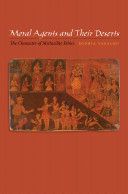
Must good deeds be rewarded and wrongdoers punished? Would God be unjust if He failed to punish and reward? And what is it about good or evil actions and moral identity that might generate such necessities? These were some of the vital religious and philosophical questions that eighth- and ninth-century Mu’tazilite theologians and their sophisticated successors attempted to answer, giving rise to a distinctive ethical position and one of the most prominent and controversial intellectual trends in medieval Islam. The Mu’tazilites developed a view of ethics whose distinguishing features were its austere moral objectivism and the crucial role it assigned to reason in the knowledge of moral truths. Central to this ethical vision was the notion of moral desert, and of the good and evil consequences–reward or punishment–deserved through a person’s acts. Moral Agents and Their Desertsis the first book-length study of this central theme in Mu’tazilite ethics, and an attempt to grapple with the philosophical questions it raises. At the same time, it is a bid to question the ways in which modern readers, coming to medieval Islamic thought with a philosophical interest, seek to read and converse with Mu’tazilite theology.Moral Agents and Their Desertstracks the challenges and rewards involved in the pursuit of the right conversation at the seams between modern and medieval concerns.
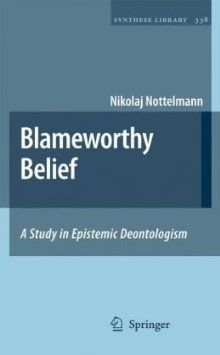
Believing the wrong thing may sometimes have drastic consequences. The question as to when a person is not only ill-guided, but genuinely at fault for holding a particular belief is an important one: It touches upon the roots of our understanding of such notions as criminal negligence and moral responsibility. The answer to this question may influence the extent to which we are willing to submit each other to punishments ranging from mild resentment to harsh prison terms.This book presents an extensive effort to shed light on the conditions under which we may appropriately deem someone blameworthy for holding a particular belief. It regiments and unifies several debates within contemporary epistemology, ethics and legal scholarship. Finally, the book brings a new philosophical look on issues like our power to control beliefs and the extent and nature of foresight. “Blameworthy Belief is unique in being an up-to-date monograph devoted entirely to the problem of a moral appraisal of beliefs and the closely related problem of deciding to believe (doxastic voluntarism and anti-voluntarism). It is bound to become a highly influential work and is of great interest not only to epistemologists, but also to philosophers of law and moral philosophers.” Heinrich Wansing, Professor of Philosophy of Science and Logic, Dresden University of Technology, Germany “Nottelmann has nicely managed to weave accounts of competing views into his discussion, and so this book provides an excellent survey of the literature en route to the development of a sensible account of how we could be said to be responsible for believing various things, even though belief formation is not under our voluntary control.” John Heil, Professor of Philosophy, Washington University in St. Louis, U.S.A., and Monash University, Australia
This volume analyzes concepts of nature and ‘the natural’ in discussions of biotechnology with four broad concerns in mind. First, it surveys the recent history of biotechnology debates and identifies characteristic reactions and approaches to new biotechnological developments that invoke appeals to nature. Second, it analyzes concepts of nature and ‘the natural’ as they are invoked and interpreted in five characteristic modes of discourse; viz., spirituality and religion, philosophy, science and medicine, law and economics, and aesthetics. Third, it identifies a core cluster of ontological, epistemological, moral, and aesthetic questions that arise in conversations about nature as normative. Fourth, it highlights the findings of each of the five chapters, identifies areas of contrast and commonality, and identifies areas for further research.
How do modern Muslims adapt their traditions to engage with today’s world? Charles Tripp’s erudite and incisive book considers one of the most significant challenges faced by Muslims over the last sixty years: the challenge of capitalism. By reference to the works of noted Muslim scholars, the author shows how, faced by this challenge, these intellectuals devised a range of strategies which have enabled Muslims to remain true to their faith, whilst engaging effectively with a world not of their own making. The work is framed around the development of their ideas on Islamic socialism, economics and the rationale for Islamic banking. While some Muslims have resorted to confrontation or insularity to cope with the challenges of modernity, most have aspired to innovation and ingenuity in the search for compromise and interaction with global capitalism in the twenty-first century.
ما از اخلاق چه انتظاری داریم؟ این سوال شاید تاحدودی برای عموم مردم و یا متخصصان این رشته قابل پاسخ باشد؛ اینکه خوب بودن را به ما بیاموزد و در تنظیم روابط فردی م...

جشن کتاب تهران به ایستگاه سی و یکم رسیده است. حال و احوال نشر کتاب خوب نیست و باید فرهنگدوستان را به خرید و هدیه دادن کتاب ترغیب نمود. خانه اخلاقپژوهان جوان ب...

بنیاد کتابهای اخلاق اسلامی عمدتا پالایش جان از آلودگیها و آراستن آن به زیباییها است. اندیشه محوری این قبیل کتابها آن است که انسان فعلی آنی نیست که باید باشد...

-
0 Comments