Notice: تابع WP_Block_Type_Registry::register به طورنادرست فراخوانی شد. نامهای نوع بلوک نباید حروف بزرگ داشته باشند. لطفاً برای اطلاعات بیشتر، اشکال زدایی در وردپرس را مشاهده کنید. (این پیام در نگارش 5.0.0 افزوده شده است.) in /home/ethicsho/public_html/wp-includes/functions.php on line 5313
Warning: Use of undefined constant TDC_PATH_LEGACY - assumed 'TDC_PATH_LEGACY' (this will throw an Error in a future version of PHP) in /home/ethicsho/public_html/wp-content/plugins/td-composer/td-composer.php on line 109
Warning: Use of undefined constant TDSP_THEME_PATH - assumed 'TDSP_THEME_PATH' (this will throw an Error in a future version of PHP) in /home/ethicsho/public_html/wp-content/plugins/td-composer/td-composer.php on line 113 بایگانیهای Sosa, Ernest - خانه اخلاق پژوهان جوان Notice: Trying to access array offset on value of type bool in /home/ethicsho/public_html/wp-content/plugins/wp-ulike/inc/general-functions.php on line 807
All students and advocates of human rights will be interested in this concerted exploration of the human rights moral obligations that fall, not directly on states, but on private and public organisations. Such an approach to human rights opens up the possibility of holding corporations and bureaucracies to account for human rights violations even when they have acted in accordance with the law. This interdisciplinary and international project brings together eminent philosophers, lawyers, social scientists and practitioners to articulate theoretically and develop in practical contexts the moral implications of human rights for non-state actors. What emerges from the book as a whole is a distinctive contemporary vision of the emerging moral impact of human rights and its significance for organisational behaviour and performance.
An original study of the philosophical problems associated with inductive reasoning. Like most of the main questions in epistemology, the classical problem of induction arises from doubts about a mode of inference used to justify some of our most familiar and pervasive beliefs. The experience of each individual is limited and fragmentary, yet the scope of our beliefs is much wider; and it is the relation between belief and experience, in particular the belief that the future will in some respects resemble the past and the unobserved the observed, which forms the subject of this book. Dr Blackburn’s first aim is to state the problem of induction properly, to show that there does exist a genuine problem immune to the solutions in vogue at present, yet no tin principle insoluble. He gives an extended and original account of the concept of a reason and goes on to discuss prediction. In the end Dr Blackburn produces a rationale for belief in certain short-term predictions based on his reinterpretation of the classical principle of indifference. He claims that a justification for induction can be found along the lines he has suggested and must indeed be found there if anywhere.
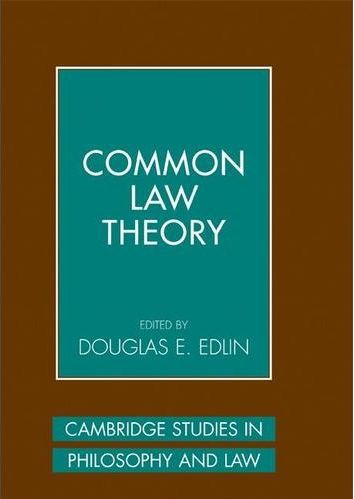
Legal scholars, philosophers, historians, and political scientists from Australia, Canada, New Zealand, the United Kingdom, and the United States analyze the common law through three of its classic themes: rules, reasoning, and constitutionalism. Their essays, specially commissioned for this volume, provide an opportunity for thinkers from different jurisdictions and disciplines to talk to each other and to their wider audience within and beyond the common law world. This book allows scholars and students to consider how these themes and concepts relate to one another. It will initiate and sustain a more inclusive and well-informed theoretical discussion of the common law’s method, process, and structure. It will be valuable to lawyers, philosophers, political scientists, and historians interested in constitutional law, comparative law, judicial process, legal theory, law and society, legal history, democratic theory, political philosophy, and the relationship of the common law tradition to other legal systems of the world.
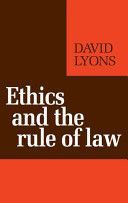
An introduction to the philosophy of law, which offers a modern and critical appraisal of all the main issues and problems. This has become a very active area in the last ten years, and one on which philosophers, legal practitioners and theorists and social scientists have tended to converge. The more abstract questions about the nature of law and its relationship to social norms and moral standards are now seen to be directly relevant to more practical and indeed pressing questions about the justification of punishment, civil disobedience, the enforcement of morality, and problems about justice, rights, welfare, and freedom. David Lyons is a shrewd, clear and systematic guide through this tangled area. The book presupposes no formal training in law or philosophy and is intended to serve as a textbook in a range of introductory courses.
ما از اخلاق چه انتظاری داریم؟ این سوال شاید تاحدودی برای عموم مردم و یا متخصصان این رشته قابل پاسخ باشد؛ اینکه خوب بودن را به ما بیاموزد و در تنظیم روابط فردی م...

جشن کتاب تهران به ایستگاه سی و یکم رسیده است. حال و احوال نشر کتاب خوب نیست و باید فرهنگدوستان را به خرید و هدیه دادن کتاب ترغیب نمود. خانه اخلاقپژوهان جوان ب...

بنیاد کتابهای اخلاق اسلامی عمدتا پالایش جان از آلودگیها و آراستن آن به زیباییها است. اندیشه محوری این قبیل کتابها آن است که انسان فعلی آنی نیست که باید باشد...

-
0 Comments