Notice: تابع WP_Block_Type_Registry::register به طورنادرست فراخوانی شد. نامهای نوع بلوک نباید حروف بزرگ داشته باشند. لطفاً برای اطلاعات بیشتر، اشکال زدایی در وردپرس را مشاهده کنید. (این پیام در نگارش 5.0.0 افزوده شده است.) in /home/ethicsho/public_html/wp-includes/functions.php on line 5313
Warning: Use of undefined constant TDC_PATH_LEGACY - assumed 'TDC_PATH_LEGACY' (this will throw an Error in a future version of PHP) in /home/ethicsho/public_html/wp-content/plugins/td-composer/td-composer.php on line 109
Warning: Use of undefined constant TDSP_THEME_PATH - assumed 'TDSP_THEME_PATH' (this will throw an Error in a future version of PHP) in /home/ethicsho/public_html/wp-content/plugins/td-composer/td-composer.php on line 113 بایگانیهای Social Science / Media Studies - خانه اخلاق پژوهان جوان Notice: Trying to access array offset on value of type bool in /home/ethicsho/public_html/wp-content/plugins/wp-ulike/inc/general-functions.php on line 807
InProfessional Ethics and Civic Morals, Emile Durkheim outlined the core of his theory of morality and social rights which was to dominate his work throughout the course of his life. In Durkheim’s view, sociology is a science of morals which are objective social facts, and these moral regulations form the basis of individual rights and obligations. This book is crucial to an understanding of Durkheim’s sociology because it contains his much-neglected theory of the state as a moral institution, and it provides an understanding of his critique of anomie and egoistic individualism. The growing interest in cultural revolution and moral regulation make this edition of Durkheim’s classic work especially timely. The new preface by Bryan Turner sets the book in its intellectual and historical context, and illustrates the relevance of this work to present day debates on the state, society, and moral regulation.
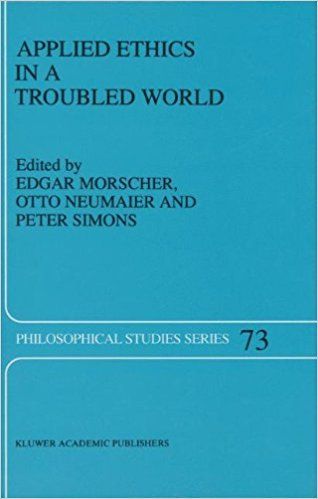
During the last two decades, applied ethics has not only developed into one of the most important philosophical disciplines but has also differentiated into so many subdisciplines that it is becoming increasingly difficult to survey it. A much-needed overview is provided by the eighteen contributions to this volume, in which internationally renowned experts deal with central questions of environmental ethics, bioethics and medical ethics, professional and business ethics, social, political, and legal ethics as well as with the aims and foundations of applied ethics in general. Thanks to a philosophical introduction and selected bibliographical references added to each chapter, the book is very well suited as a basis for courses in applied ethics. It is directed not only to philosophers and to ethicists from other disciplines but to scientists in general and to all people who are interested in the rational discussion of moral principles and their application to concrete problems in the sciences and in everyday life.
Everywhere people share certain moral principles–it is bad to steal, to kill, to lie–and yet we often subvert these rules. As Robert Hinde points out in this provocative book, the politician will vote with his party instead of his conscience, a lawyer will argue a point that he or she personally abhors. And this constant bending the rules ultimately endangers our world. Hinde, an eminent Cambridge biologist and psychologist, here presents a new approach to morality–combining insights from evolutionary science with observations on how people actually behave. Featuring contributions by Nobel Peace Laureate Sir Joseph Rotblat, the book illuminates how rule-bending–hardening in-group boundaries, putting duty over other moral obligations, and much more–occurs within personal relationships, law, science, medicine, politics, business, and war. Hinde argues that many of the world’s problems are related to the disregard of moral rules–for instance, racism, religious intolerance, excessive consumerism, and global warming. With growing reliance on nuclear weapons, we are heading for a world ruled by threat and fear, instead of one ruled by law and mutual understanding. We need a new understanding of morality, its nature, sources, and importance for communal living. This book helps to provide that understanding.
ما از اخلاق چه انتظاری داریم؟ این سوال شاید تاحدودی برای عموم مردم و یا متخصصان این رشته قابل پاسخ باشد؛ اینکه خوب بودن را به ما بیاموزد و در تنظیم روابط فردی م...

جشن کتاب تهران به ایستگاه سی و یکم رسیده است. حال و احوال نشر کتاب خوب نیست و باید فرهنگدوستان را به خرید و هدیه دادن کتاب ترغیب نمود. خانه اخلاقپژوهان جوان ب...

بنیاد کتابهای اخلاق اسلامی عمدتا پالایش جان از آلودگیها و آراستن آن به زیباییها است. اندیشه محوری این قبیل کتابها آن است که انسان فعلی آنی نیست که باید باشد...

-
0 Comments