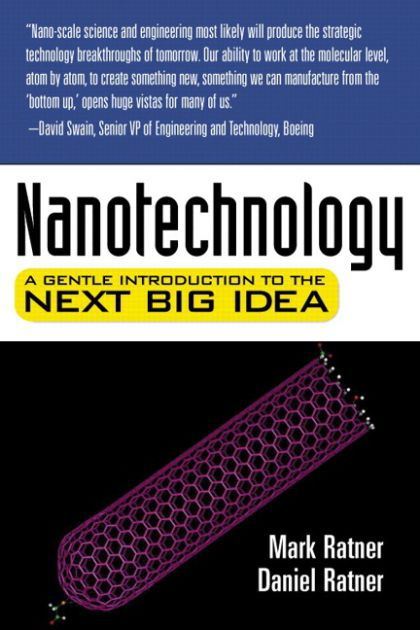
— An explanation of what Nanotechnology is all about and its business aspects written in an approachable and witty style.– Nanotechnology’s impact will reach beyond science to touch our everyday health, work, and businesses.– Explains the federal dollars going into nanotechnology research and discusses why the NSF has estimated that it could be a $1 trillion market by 2015.This book is the technical and business overview of tomorrow’s scientific breakthrough. The authors survey the scientific research and business aspects of the field, try to explain the key concepts, provide a look at current developments, and give some thoughts on where nanotechnology is likely to go in the next few years. The focus of the book is on science and technology, but business is discussed as well. The growing interest in nanotechnology by the investment community and the federal dollars going into nanotechnology are explained. Nanotechnology, or, as it is sometimes called, molecular manufacturing, is a branch of engineering that deals with the design and manufacture of extremely small electronic circuits and mechanical devices built at the molecular level of matter. Nanotechnology holds promise in the quest for ever-more-powerful computers and communications devices. But the most fascinating applications are in medical science. Nanorobots might serve as programmable antibodies. As disease-causing bacteria and viruses mutate in their endless attempts to get around medical treatments, nanorobots could be reprogrammed to selectively seek out and destroy them.
Anita Superson challenges the traditional picture of the skeptic who asks, “Why be moral?” While holding that the skeptic’s position is important, she builds an argument against it by understanding it more deeply, and then shows what it would take to successfully defeat it. Superson argues that we must defeat not only the action skeptic, but the disposition skeptic, who denies that being morally disposed is rationally required, and the motive skeptic, who believes that merely going through the motions in acting morally is rationally permissible. We also have to address the amoralist, who is not moved by moral reasons he recognizes. Superson argues for expanding the skeptic’s position from self-interest to privilege to include morally unjustified behavior targeting disenfranchised social groups, as well as revising the traditional expected utility model to exclude desires deformed by patriarchy as irrational. Lastly she argues that the challenge can be answered if it can be shown that it is, in an important way, inconsistent and therefore irrational to privilege oneself over others. The Moral Skeptic makes an important contribution to both metaethics/moral theory and feminist philosophy, and brings feminist thinking into the larger discussion of the skeptical challenge.
From Plato and Leibniz to externalism and the frame problem, from Husserl to neural Darwinism, from mental causation to the problem of consciousness, this guide outlines the main positions, key figures, important terms, and longstanding debates of the philosophy of mind.
The Oxford Handbook of Practical Ethics is a lively and authoritative guide to current thought about ethical issues in all areas of human activity–personal, medical, sexual, social, political, judicial, and international, from the natural world to the world of business. Twenty-eight topics are covered in specially written surveys by leading figures in their fields: each gives an authoritative map of the ethical terrain, explaining how the debate has developed in recent years, engaging critically with the most notable work in the area, and pointing directions for future work. The Handbook will be essential reading, and a fascinating resource of ideas and information, for academics and students across a wide range of disciplines.
In this book, S. A. Lloyd offers a radically new interpretation of Hobbes’s laws of nature, revealing them to be not egoistic precepts of personal prudence but rather moral instructions for obtaining the common good. This account of Hobbes’s moral philosophy stands in contrast to both divine command and rational choice interpretations. Drawing from the core notion of reciprocity, Lloyd explains Hobbes’s system of “cases in the law of nature” and situates Hobbes’s moral philosophy in the broader context of his political philosophy and views on religion. Offering ingenious new arguments, Lloyd defends a reciprocity interpretation of the laws of nature through which humanity’s common good is secured.
ما از اخلاق چه انتظاری داریم؟ این سوال شاید تاحدودی برای عموم مردم و یا متخصصان این رشته قابل پاسخ باشد؛ اینکه خوب بودن را به ما بیاموزد و در تنظیم روابط فردی م...

جشن کتاب تهران به ایستگاه سی و یکم رسیده است. حال و احوال نشر کتاب خوب نیست و باید فرهنگدوستان را به خرید و هدیه دادن کتاب ترغیب نمود. خانه اخلاقپژوهان جوان ب...

بنیاد کتابهای اخلاق اسلامی عمدتا پالایش جان از آلودگیها و آراستن آن به زیباییها است. اندیشه محوری این قبیل کتابها آن است که انسان فعلی آنی نیست که باید باشد...

-
0 Comments