Notice: تابع WP_Block_Type_Registry::register به طورنادرست فراخوانی شد. نامهای نوع بلوک نباید حروف بزرگ داشته باشند. لطفاً برای اطلاعات بیشتر، اشکال زدایی در وردپرس را مشاهده کنید. (این پیام در نگارش 5.0.0 افزوده شده است.) in /home/ethicsho/public_html/wp-includes/functions.php on line 5313
Warning: Use of undefined constant TDC_PATH_LEGACY - assumed 'TDC_PATH_LEGACY' (this will throw an Error in a future version of PHP) in /home/ethicsho/public_html/wp-content/plugins/td-composer/td-composer.php on line 109
Warning: Use of undefined constant TDSP_THEME_PATH - assumed 'TDSP_THEME_PATH' (this will throw an Error in a future version of PHP) in /home/ethicsho/public_html/wp-content/plugins/td-composer/td-composer.php on line 113 بایگانیهای Recreation Areas - Lebanon - خانه اخلاق پژوهان جوان Notice: Trying to access array offset on value of type bool in /home/ethicsho/public_html/wp-content/plugins/wp-ulike/inc/general-functions.php on line 807
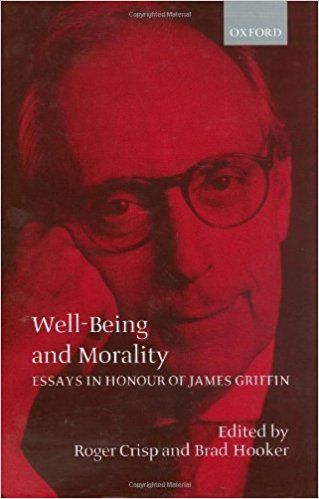
An international line-up of fourteen distinguished philosophers presents new essays in honor of James Griffin, White’s Professor of Moral Philosophy at Oxford University. The essays take up topics relating to well-being and morality, prominent themes in contemporary ethics and particularly in Griffin’s work. Griffin himself provides replies to these essays, offering a fascinating development of his own thinking on these topics.
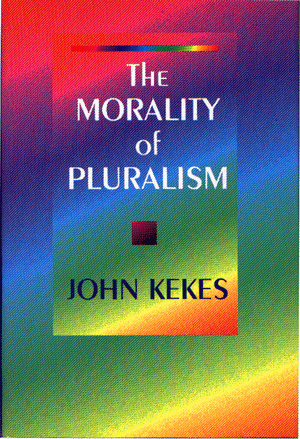
Current controversies about abortion, the environment, pornography, AIDS, capital punishment, and similar issues naturally lead to the question of whether there are any values that can be ultimately justified, or whether values are simply conventional. John Kekes argues that the present moral and political uncertainties are due to a deep change in our society from a dogmatic to a pluralistic view of values. Dogmatism is committed to there being only one justifiable system of values. Pluralism recognizes many such systems, and yet it avoids a chaotic relativism according to which all values are in the end arbitrary. Maintaining that good lives must be reasonable, but denying that they must conform to one true pattern, Kekes develops and justifies a pluralistic account of good lives and values, and works out its political, moral, and personal implications. The author defines values as possibilities whose realization would make lives good. He recognizes that their realization is difficult, especially since it involves choices among many, often conflicting, values. He argues, however, that living a good life requires a resolution of these conflicts, although reasonable resolutions are themselves plural in nature. His central claim is that pluralism is both reasonable and a preferable alternative to dogmatism and relativism.
When Michael Walzer’s Spheres of Justice was published ten years ago, the front page of The New York Times Book Review hailed the work as “an imaginative alternative to the current debate over distributive justice.” Now in Thick and Thin, Walzer revises and extends his arguments in Spheres of Justice, framing his ideas about justice, social criticism, and national identity in light of the new political world that has arisen in the past decade. Walzer focuses on two different but interrelated kinds of moral argument: maximalist and minimalist, thick and thin, local and universal.
This work explains how human beings can live more peacefully with one another by understanding the conditions of possibility for dialogue. Philosophically, this challenge is articulated as the problem of: how dialogue as dia-logos is possible when the shared logos is precisely that which is in question. Emmanuel Levinas, in demonstrating that the shared logos is a function of interhuman relationship, helps us to make some progress in understanding the possibilities for dialogue in this situation. If the terms of the argument to his point are taken largely from Levina’s 1961 Totality & Infinity, Dudiak further proposes that Levina’s 1974 Otherwise than Being can be read as a deepening of these earlier analyses, delineating, both the conditions of possibility & impossibility for discourse itself. Throughout these analyses Dudiak discovers that in Levina’s view dialogue is ultimately possible, only for a gracious subjectivity already graced by God by way of the other, but where the word God is inseparable from my subjectivity as a graciousness to the other. Finally, for Levinas, the facilitation of dialogue, the facilitation of peace, comes down to the subject’s capacity & willingness to be who he or she is, to take the beautiful risk of a peaceful gesture offered to the other & that peace, in this gesture itself. As Levinas himself puts it: “Peace then is under my responsibility. I am a hostage, for I am alone to wage it, running a fine risk, dangerously.” Levinas’s philosophical discourse is precisely itself to be read as such a gesture.
What if there were no objective facts, no objective truth, no objectivity at all, only our belief in them? What if our consciousness itself is an unconscious invention, constructed out of logic and language? In this thought-provoking volume, Lynn Segal describes how the ideas of Heinz von Foerster compel us to explore the question, “Do we discover the world or do we invent it?” and suggests that we must first know how we think before we can claim knowledge of the world. The resulting philosophy, Constructivism, examines the limits of what we can know and argues that understanding these limits can lead us to be more responsible for our personal and collective behavior. After tracing the historical transition from religious belief to a belief in science, Segal examines objectivity from semantic, philosophical, and neurological perspectives. Segal shows that we can never achieve objectivity and that the scientific method ensures only a consensus among observers. Next, he details how language and logic unwittingly predetermine the very conclusions we derive when we try to know the world. Finally, he describes a computational model of cognition that does not depend on first positing the world to account for cognition and consciousness. While Constructivism may seem relevant only to those in the cognitive sciences, it is, in fact, highly relevant to everyone. Paradoxically, grasping the limits of our own under-standing can free us to live more creative and meaningful personal and professional lives.
ما از اخلاق چه انتظاری داریم؟ این سوال شاید تاحدودی برای عموم مردم و یا متخصصان این رشته قابل پاسخ باشد؛ اینکه خوب بودن را به ما بیاموزد و در تنظیم روابط فردی م...

جشن کتاب تهران به ایستگاه سی و یکم رسیده است. حال و احوال نشر کتاب خوب نیست و باید فرهنگدوستان را به خرید و هدیه دادن کتاب ترغیب نمود. خانه اخلاقپژوهان جوان ب...

بنیاد کتابهای اخلاق اسلامی عمدتا پالایش جان از آلودگیها و آراستن آن به زیباییها است. اندیشه محوری این قبیل کتابها آن است که انسان فعلی آنی نیست که باید باشد...

-
0 Comments