Notice: تابع WP_Block_Type_Registry::register به طورنادرست فراخوانی شد. نامهای نوع بلوک نباید حروف بزرگ داشته باشند. لطفاً برای اطلاعات بیشتر، اشکال زدایی در وردپرس را مشاهده کنید. (این پیام در نگارش 5.0.0 افزوده شده است.) in /home/ethicsho/public_html/wp-includes/functions.php on line 5313
Warning: Use of undefined constant TDC_PATH_LEGACY - assumed 'TDC_PATH_LEGACY' (this will throw an Error in a future version of PHP) in /home/ethicsho/public_html/wp-content/plugins/td-composer/td-composer.php on line 109
Warning: Use of undefined constant TDSP_THEME_PATH - assumed 'TDSP_THEME_PATH' (this will throw an Error in a future version of PHP) in /home/ethicsho/public_html/wp-content/plugins/td-composer/td-composer.php on line 113 بایگانیهای Reason - Cross-cultural Studies - خانه اخلاق پژوهان جوان Notice: Trying to access array offset on value of type bool in /home/ethicsho/public_html/wp-content/plugins/wp-ulike/inc/general-functions.php on line 807
Wittgenstein and Levinasexamines the oft-neglected relationship between the philosophies of two of the most important and notoriously difficult thinkers of the twentieth century. By bringing the work of each philosopher to bear upon the other, Plant navigates between the antagonistic intellectual traditions that they helped to share. The central focus on the book is the complex yet illuminating interplay between a number of ethical-religious themes in both Wittgenstein’s mature thinking and Levinas’s distinctive account of ethical responsibility.
Must good deeds be rewarded and wrongdoers punished? Would God be unjust if He failed to punish and reward? And what is it about good or evil actions and moral identity that might generate such necessities? These were some of the vital religious and philosophical questions that eighth- and ninth-century Mu’tazilite theologians and their sophisticated successors attempted to answer, giving rise to a distinctive ethical position and one of the most prominent and controversial intellectual trends in medieval Islam. The Mu’tazilites developed a view of ethics whose distinguishing features were its austere moral objectivism and the crucial role it assigned to reason in the knowledge of moral truths. Central to this ethical vision was the notion of moral desert, and of the good and evil consequences–reward or punishment–deserved through a person’s acts. Moral Agents and Their Desertsis the first book-length study of this central theme in Mu’tazilite ethics, and an attempt to grapple with the philosophical questions it raises. At the same time, it is a bid to question the ways in which modern readers, coming to medieval Islamic thought with a philosophical interest, seek to read and converse with Mu’tazilite theology.Moral Agents and Their Desertstracks the challenges and rewards involved in the pursuit of the right conversation at the seams between modern and medieval concerns.
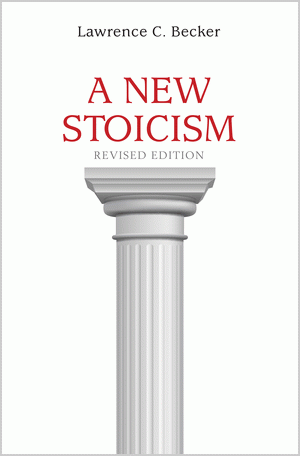
What would stoic ethics be like today if stoicism had survived as a systematic approach to ethical theory, if it had coped successfully with the challenges of modern philosophy and experimental science? A New Stoicism proposes an answer to that question, offered from within the stoic tradition but without the metaphysical and psychological assumptions that modem philosophy and science have abandoned. Lawrence Becker argues that a secular version of the stoic ethical project, based on contemporary cosmology and developmental psychology; provides the basis for a sophisticated form of ethics naturalism, in which virtually all the hard doctrines of the ancient Stoics can be clearly restated and defended.”From the beginning to the end of this compact but lucid book, Becker skillfully brings to life both the arguments and the intuitive appeal of stoicism…. In its essentials (the new stoicism is recognizable, with its particularly astringent rational charm enhanced by Becker’s focused and self-disciplined argumentation.
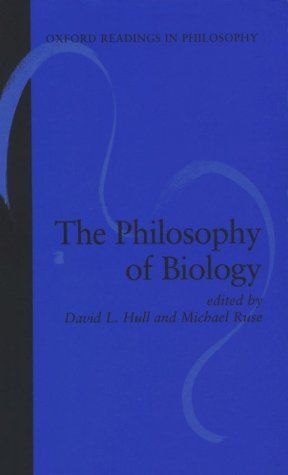
The aim of this series is to bring together important recent writings in major areas of philosophical inquiry, selected from a variety of sources, mostly periodicals, which may not be conveniently available to the university student or the general reader. The editors of each volume contribute an introductory essay on the items chosen and on the questions with which they deal. A selective bibliography is appended as a guide to further reading. The philosophy of biology today is one of the most exciting areas in philosophical inquiry. Drawing on work of the past decade, this volume brings together articles from the philosophy, history, and sociology of science, as well as many branches of the biological sciences, to consider issues including the nature of evolutionary theory, biology and ethics, the challenge from religion, and the social implications of biology today (in particular the Human Genome Project). The 36 articles in this collection are divided into 10 parts, each with an introduction by the editors. Spanning issues from epistemology across to ethics, the volume delves into the latest theoretical controversies as well as burning questions of contemporary social importance. Throughout the volume an attempt is made to offer positions from different perspectives, so that the reader will be challenged as well as informed. The Philosophy of Biology will be essential and fascinating reading for students of philosophy and biology as well as the general reader with an interest in the natural sciences and evolution.
ما از اخلاق چه انتظاری داریم؟ این سوال شاید تاحدودی برای عموم مردم و یا متخصصان این رشته قابل پاسخ باشد؛ اینکه خوب بودن را به ما بیاموزد و در تنظیم روابط فردی م...

جشن کتاب تهران به ایستگاه سی و یکم رسیده است. حال و احوال نشر کتاب خوب نیست و باید فرهنگدوستان را به خرید و هدیه دادن کتاب ترغیب نمود. خانه اخلاقپژوهان جوان ب...

بنیاد کتابهای اخلاق اسلامی عمدتا پالایش جان از آلودگیها و آراستن آن به زیباییها است. اندیشه محوری این قبیل کتابها آن است که انسان فعلی آنی نیست که باید باشد...

-
0 Comments