Notice: تابع WP_Block_Type_Registry::register به طورنادرست فراخوانی شد. نامهای نوع بلوک نباید حروف بزرگ داشته باشند. لطفاً برای اطلاعات بیشتر، اشکال زدایی در وردپرس را مشاهده کنید. (این پیام در نگارش 5.0.0 افزوده شده است.) in /home/ethicsho/public_html/wp-includes/functions.php on line 5313
Warning: Use of undefined constant TDC_PATH_LEGACY - assumed 'TDC_PATH_LEGACY' (this will throw an Error in a future version of PHP) in /home/ethicsho/public_html/wp-content/plugins/td-composer/td-composer.php on line 109
Warning: Use of undefined constant TDSP_THEME_PATH - assumed 'TDSP_THEME_PATH' (this will throw an Error in a future version of PHP) in /home/ethicsho/public_html/wp-content/plugins/td-composer/td-composer.php on line 113 بایگانیهای Psychology / Movements / Psychoanalysis - خانه اخلاق پژوهان جوان Notice: Trying to access array offset on value of type bool in /home/ethicsho/public_html/wp-content/plugins/wp-ulike/inc/general-functions.php on line 807
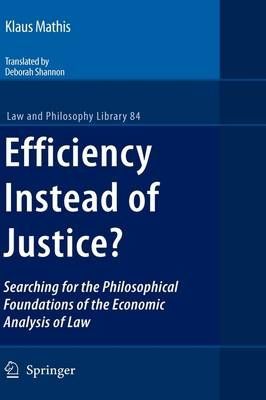
Economic analysis of law is an interesting and challenging attempt to employ the concepts and reasoning methods of modern economic theory so as to gain a deeper understanding of legal problems. According to Richard A. Posner it is the role of the law to encourage market competition and, where the market fails because transaction costs are too high, to simulate the result of competitive markets. This would maximize economic efficiency and social wealth.In this work, the lawyer and economist Klaus Mathis critically appraises Posner’s normative justification of the efficiency paradigm from the perspective of the philosophy of law. Posner acknowledges the influences of Adam Smith and Jeremy Bentham, whom he views as the founders of normative economics. He subscribes to Smith’s faith in the market as an ideal allocation model, and to Bentham’s ethical consequentialism. Finally, aligning himself with John Rawls’s contract theory, he seeks to legitimize his concept of wealth maximization with a consensus theory approach.In his interdisciplinary study, the author points out the possibilities as well as the limits of economic analysis of law. It provides a method of analysing the law which, while very helpful, is also rather specific. The efficiency arguments therefore need to be incorporated into a process for resolving value conflicts. In a democracy this must take place within the political decision-making process. In this clearly written work, Klaus Mathis succeeds in making even non-economists more aware of the economic aspects of the law.
The Oxford Handbook of Epistemology contains 19 previously unpublished chapters by today’s leading figures in the field. These chapters function not only as a survey of key areas, but as original scholarship on a range of vital topics. Written accessibly for advanced undergraduates, graduate students, and professional philosophers, the Handbook explains the main ideas and problems of contemporary epistemology while avoiding overly technical detail.
The recent revival of natural law theory in modern moral philosophy has been an exciting and important development. This book brings together an international group of moral philosophers who make original contributions to the project of developing natural law ethics as a comprehensive treatment of modern ethical theory and practice.
Christine M. Korsgaard is one of today’s leading moral philosophers: this volume collects ten influential papers by her on practical reason and moral psychology. Korsgaard draws on the work of important figures in the history of philosophy such as Plato, Aristotle, Kant, and Hume, showing how their ideas can inform the solution of contemporary and traditional philosophical problems, such as the foundations of morality and practical reason, the nature of agency, and the role of the emotions in action. In Part 1, The Principles of Practical Reason, Korsgaard defends the view that the principles of practical reason are constitutive principles of action. By governing our actions in accordance with Kant’s categorical imperative and the principle of instrumental reason, she argues, we take control of our own movements and so render ourselves active, self-determining beings. She criticizes rival attempts to give a normative foundation to the principles of practical reason, challenges the claims of the principle of maximizing one’s own interests to be a rational principle, and argues for some deep continuities between Plato’s account of the connection between justice and agency and Kant’s account of the connection between autonomy and agency. In Part II, Moral Virtue and Moral Psychology , Korsgaard takes up the question of the role of our more passive or receptive faculties–our emotions and responses –in constituting our agency. She sketches a reading of the Nicomachean Ethics , based on the idea that our emotions can serve as perceptions of good and evil, and argues that this view of the emotions is at the root of the apparent differences between Aristotle and Kant’s accounts of morality. She argues that in fact, Aristotle and Kant share a distinctive view about the locus of moral value and the nature of human choice that, among other things, gives them account of what it means to act rationally that is superior to other accounts. In Part III, Other Reflections, Korsgaard takes up question how we come to view one another as moral agents in Hume’s philosophy. She examines the possible clash between the agency of the state and that of the individual that led to Kant’s paradoxical views about revolution. And finally, she discusses her methodology in an account of what it means to be a constructivist moral philosopher. The essays are united by an introduction in which Korsgaard explains their connections to each other and to her current work.
ما از اخلاق چه انتظاری داریم؟ این سوال شاید تاحدودی برای عموم مردم و یا متخصصان این رشته قابل پاسخ باشد؛ اینکه خوب بودن را به ما بیاموزد و در تنظیم روابط فردی م...

جشن کتاب تهران به ایستگاه سی و یکم رسیده است. حال و احوال نشر کتاب خوب نیست و باید فرهنگدوستان را به خرید و هدیه دادن کتاب ترغیب نمود. خانه اخلاقپژوهان جوان ب...

بنیاد کتابهای اخلاق اسلامی عمدتا پالایش جان از آلودگیها و آراستن آن به زیباییها است. اندیشه محوری این قبیل کتابها آن است که انسان فعلی آنی نیست که باید باشد...

-
0 Comments