Notice: تابع WP_Block_Type_Registry::register به طورنادرست فراخوانی شد. نامهای نوع بلوک نباید حروف بزرگ داشته باشند. لطفاً برای اطلاعات بیشتر، اشکال زدایی در وردپرس را مشاهده کنید. (این پیام در نگارش 5.0.0 افزوده شده است.) in /home/ethicsho/public_html/wp-includes/functions.php on line 5313
Warning: Use of undefined constant TDC_PATH_LEGACY - assumed 'TDC_PATH_LEGACY' (this will throw an Error in a future version of PHP) in /home/ethicsho/public_html/wp-content/plugins/td-composer/td-composer.php on line 109
Warning: Use of undefined constant TDSP_THEME_PATH - assumed 'TDSP_THEME_PATH' (this will throw an Error in a future version of PHP) in /home/ethicsho/public_html/wp-content/plugins/td-composer/td-composer.php on line 113 بایگانیهای Platonists - خانه اخلاق پژوهان جوان Notice: Trying to access array offset on value of type bool in /home/ethicsho/public_html/wp-content/plugins/wp-ulike/inc/general-functions.php on line 807
‘It’s all relative’. In a world of increasing cultural diversity, it can seem that everything is indeed relative. But should we concede that there is no such thing as right and wrong, and no objective truth? Can we reconcile relativism and pluralism? Relativism surveys the different varieties of relativism and the arguments for and against them, and examines why relativism has survived for two thousand years despite all the criticisms levelled against it. Beginning with a historical overview of relativism, from Pythagoras in ancient Greece to Derrida and postmodernism, Maria Baghramian explores the resurgence of relativism throughout the history of philosophy. She then turns to the arguments for and against the many subdivisions of relativism, including Kuhn and Feyerabend’s ideas of relativism in science, Rorty’s relativism about truth, and the conceptual relativism of Quine and Putnam. Baghramian questions whether moral relativism leads to moral indifference or even nihilism, and whether feminist epistemology’s concerns about the very notion of objectivity can be considered a form of relativism. She concludes the relativism debate by assessing the recent criticisms such as Quine’s argument from translation and Davidson’s claim that even the motivations behind relativism are unintelligible. Finding these criticisms lacking, Baghramian proposes a moderate form of pluralism which addresses the legitimate worries that give rise to relativism without incurring charges of nihilism or anarchy. Relativism is essential reading for anyone interested in contemporary philosophy, sociology and politics.
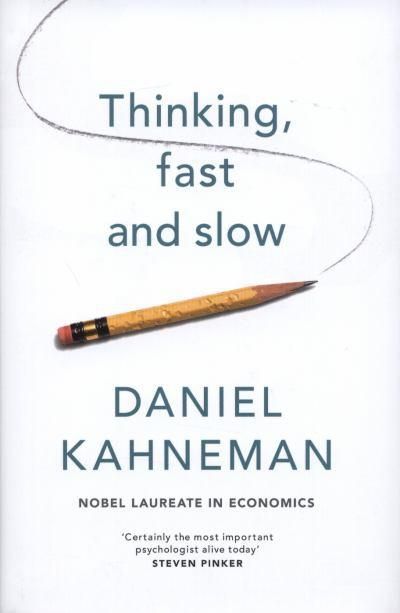
Daniel Kahneman, recipient of the Nobel Prize in Economic Sciences for his seminal work in psychology challenging the rational model of judgment and decision making, is one of the world’s most important thinkers. His ideas have had a profound impact on many fields-including business, medicine, and politics-but until now, he has never brought together his many years of research in one book.In Thinking, Fast and Slow, Kahneman takes us on a groundbreaking tour of the mind and explains the two systems that drive the way we think and make choices. One system is fast, intuitive, and emotional; the other is slower, more deliberative, and more logical. Kahneman exposes the extraordinary capabilities-and also the faults and biases-of fast thinking, and reveals the pervasive influence of intuitive impressions on our thoughts and behaviour. The importance of properly framing risks, the effects of cognitive biases on how we view others, the dangers of prediction, the right ways to develop skills, the pros and cons of fear and optimism, the difference between our experience and memory of events, the real components of happiness-each of these can be understood only by knowing how the two systems work together to shape our judgments and decisions.Drawing on a lifetime’s experimental experience, Kahneman reveals where we can and cannot trust our intuitions and how we can tap into the benefits of slow thinking. He offers practical and enlightening insights into how choices are made in both our professional and our personal lives-and how we can use different techniques to guard against the mental glitches that often get us into trouble. Thinking, Fast and Slow will transform the way you take decisions and experience the world.
This is an EXACT reproduction of a book published before 1923. This IS NOT an OCR’d book with strange characters, introduced typographical errors, and jumbled words. This book may have occasional imperfections such as missing or blurred pages, poor pictures, errant marks, etc. that were either part of the original artifact, or were introduced by the scanning process. We believe this work is culturally important, and despite the imperfections, have elected to bring it back into print as part of our continuing commitment to the preservation of printed works worldwide. We appreciate your understanding of the imperfections in the preservation process, and hope you enjoy this valuable book.
The idea that religion has a dangerous tendency to promote violence is part of the conventional wisdom of Western societies, and it underlies many of our institutions and policies, from limits on the public role of religion to efforts to promote liberal democracy in the Middle East. William T. Cavanaugh challenges this conventional wisdom by examining how the twin categories of religion and the secular are constructed. A growing body of scholarly work explores how the category ‘religion’ has been constructed in the modern West and in colonial contexts according to specific configurations of political power. Cavanaugh draws on this scholarship to examine how timeless and transcultural categories of ‘religion and ‘the secular’ are used in arguments that religion causes violence. He argues three points: 1) There is no transhistorical and transcultural essence of religion. What counts as religious or secular in any given context is a function of political configurations of power; 2) Such a transhistorical and transcultural concept of religion as non-rational and prone to violence is one of the foundational legitimating myths of Western society; 3) This myth can be and is used to legitimate neo-colonial violence against non-Western others, particularly the Muslim world.
ما از اخلاق چه انتظاری داریم؟ این سوال شاید تاحدودی برای عموم مردم و یا متخصصان این رشته قابل پاسخ باشد؛ اینکه خوب بودن را به ما بیاموزد و در تنظیم روابط فردی م...

جشن کتاب تهران به ایستگاه سی و یکم رسیده است. حال و احوال نشر کتاب خوب نیست و باید فرهنگدوستان را به خرید و هدیه دادن کتاب ترغیب نمود. خانه اخلاقپژوهان جوان ب...

بنیاد کتابهای اخلاق اسلامی عمدتا پالایش جان از آلودگیها و آراستن آن به زیباییها است. اندیشه محوری این قبیل کتابها آن است که انسان فعلی آنی نیست که باید باشد...

-
0 Comments