Notice: تابع WP_Block_Type_Registry::register به طورنادرست فراخوانی شد. نامهای نوع بلوک نباید حروف بزرگ داشته باشند. لطفاً برای اطلاعات بیشتر، اشکال زدایی در وردپرس را مشاهده کنید. (این پیام در نگارش 5.0.0 افزوده شده است.) in /home/ethicsho/public_html/wp-includes/functions.php on line 5313
Warning: Use of undefined constant TDC_PATH_LEGACY - assumed 'TDC_PATH_LEGACY' (this will throw an Error in a future version of PHP) in /home/ethicsho/public_html/wp-content/plugins/td-composer/td-composer.php on line 109
Warning: Use of undefined constant TDSP_THEME_PATH - assumed 'TDSP_THEME_PATH' (this will throw an Error in a future version of PHP) in /home/ethicsho/public_html/wp-content/plugins/td-composer/td-composer.php on line 113 بایگانیهای Motion Pictures - Philosophy - خانه اخلاق پژوهان جوان Notice: Trying to access array offset on value of type bool in /home/ethicsho/public_html/wp-content/plugins/wp-ulike/inc/general-functions.php on line 807
This book examines the ways in which reasonable people can disagree about the requirements of political morality. Christopher McMahon argues that there will be a ‘zone of reasonable disagreement’ surrounding most questions of political morality. Moral notions of right and wrong evolve over time as new zones of reasonable disagreement emerge out of old ones; thus political morality is both different in different societies with varying histories, and different now from what it was in the past. McMahon explores this feature of his theory in detail and traces its implications for the possibility of making moral judgments about other polities, past or present. His study sheds light on an important and often overlooked aspect of political life, and will be of interest to a wide range of readers in moral and political philosophy and in political theory.
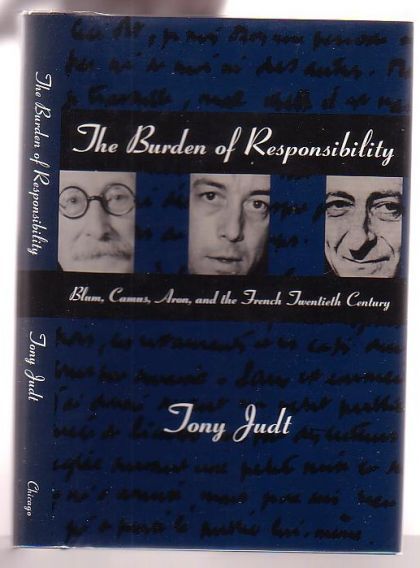
Using the lives of the three outstanding French intellectuals of the twentieth century, renowned historian Tony Judt offers a unique look at how intellectuals can ignore political pressures and demonstrate a heroic commitment to personal integrity and moral responsibility unfettered by the difficult political exigencies of their time.Through the prism of the lives of Leon Blum, Albert Camus, and Raymond Aron, Judt examines pivotal issues in the history of contemporary French societyantisemitism and the dilemma of Jewish identity, political and moral idealism in public life, the Marxist moment in French thought, the traumas of decolonization, the disaffection of the intelligentsia, and the insidious quarrels rending Right and Left. Judt focuses particularly on Blum’s leadership of the Popular Front and his stern defiance of the Vichy governments, on Camus’s part in the Resistance and Algerian War, and on Aron’s cultural commentary and opposition to the facile acceptance by many French intellectuals of communism’s utopian promise. Severely maligned by powerful critics and rivals, each of these exemplary figures stood fast in their principles and eventually won some measure of personal and public redemption.Judt constructs a compelling portrait of modern French intellectual life and politics. He challenges the conventional account of the role of intellectuals precisely because they mattered in France, because they could shape public opinion and influence policy. In Blum, Camus, and Aron, Judt finds three very different men who did not simply play the role, but evinced a courage and a responsibility in public life that far outshone their contemporaries.
“A Letter Concerning Toleration is an English translation of a Latin work, the Epistola de Tolerantia , that John Locke wrote towards the end of the year 1685, while living – often in hiding – in the Dutch Republic. The Epistola was not however published until 1689, after Locke’s return to England, and the English translation followed very shortly after. It soon met with a critical reply, in a pamphlet written by the Oxford chaplain Jonas Proast, which was to launch a polemical exchange in the course of which Locke wrote three further defences of his argument for toleration. Unlike the Epistola/Letter (hereafter: Letter ), which is intense and compactly expressed, these defences are lengthy and often repetitive. But they comprise Locke’s most fully elaborated statement of his case; they are valuable, too, because the pressure of controversy led him to clarify the priorities among his arguments”–
This is the only environmental casebook of its kind, presenting current and classic cases with the detail required for students to experience serious and complex issues. The authors present cases of immediate interest to students in a balanced and impartial manner.
ما از اخلاق چه انتظاری داریم؟ این سوال شاید تاحدودی برای عموم مردم و یا متخصصان این رشته قابل پاسخ باشد؛ اینکه خوب بودن را به ما بیاموزد و در تنظیم روابط فردی م...

جشن کتاب تهران به ایستگاه سی و یکم رسیده است. حال و احوال نشر کتاب خوب نیست و باید فرهنگدوستان را به خرید و هدیه دادن کتاب ترغیب نمود. خانه اخلاقپژوهان جوان ب...

بنیاد کتابهای اخلاق اسلامی عمدتا پالایش جان از آلودگیها و آراستن آن به زیباییها است. اندیشه محوری این قبیل کتابها آن است که انسان فعلی آنی نیست که باید باشد...

-
0 Comments