Notice: تابع WP_Block_Type_Registry::register به طورنادرست فراخوانی شد. نامهای نوع بلوک نباید حروف بزرگ داشته باشند. لطفاً برای اطلاعات بیشتر، اشکال زدایی در وردپرس را مشاهده کنید. (این پیام در نگارش 5.0.0 افزوده شده است.) in /home/ethicsho/public_html/wp-includes/functions.php on line 5313
Warning: Use of undefined constant TDC_PATH_LEGACY - assumed 'TDC_PATH_LEGACY' (this will throw an Error in a future version of PHP) in /home/ethicsho/public_html/wp-content/plugins/td-composer/td-composer.php on line 109
Warning: Use of undefined constant TDSP_THEME_PATH - assumed 'TDSP_THEME_PATH' (this will throw an Error in a future version of PHP) in /home/ethicsho/public_html/wp-content/plugins/td-composer/td-composer.php on line 113 بایگانیهای Monopolies - خانه اخلاق پژوهان جوان Notice: Trying to access array offset on value of type bool in /home/ethicsho/public_html/wp-content/plugins/wp-ulike/inc/general-functions.php on line 807
Although Kantian autonomy is often considered independent of time and place, J.B. Schneewind’s landmark study, The Invention of Autonomy, has shown that much can be learned by analyzing Kant’s moral philosophy in the context of the history of modern moral philosophy. Distinguished contributors accordingly relate Kant’s work to the historical context of his predecessors (as well as the empirical context of human agency) in this valuable resource for professionals and advanced students.
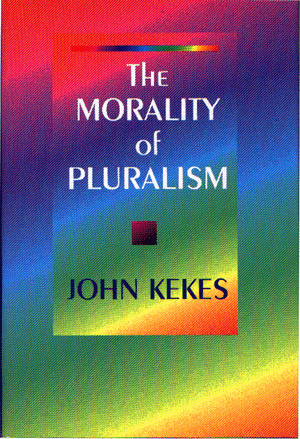
Current controversies about abortion, the environment, pornography, AIDS, capital punishment, and similar issues naturally lead to the question of whether there are any values that can be ultimately justified, or whether values are simply conventional. John Kekes argues that the present moral and political uncertainties are due to a deep change in our society from a dogmatic to a pluralistic view of values. Dogmatism is committed to there being only one justifiable system of values. Pluralism recognizes many such systems, and yet it avoids a chaotic relativism according to which all values are in the end arbitrary. Maintaining that good lives must be reasonable, but denying that they must conform to one true pattern, Kekes develops and justifies a pluralistic account of good lives and values, and works out its political, moral, and personal implications. The author defines values as possibilities whose realization would make lives good. He recognizes that their realization is difficult, especially since it involves choices among many, often conflicting, values. He argues, however, that living a good life requires a resolution of these conflicts, although reasonable resolutions are themselves plural in nature. His central claim is that pluralism is both reasonable and a preferable alternative to dogmatism and relativism.
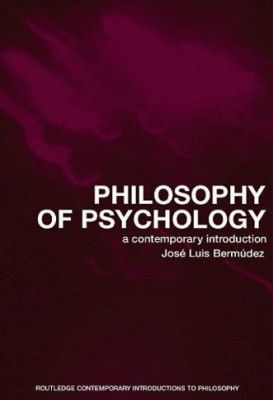
Philosophy of Psychology is an introduction to philosophical problems that arise in the scientific study of cognition and behavior. José Luis Bermúdez introduces the philosophy of psychology as an interdisciplinary exploration of the nature and mechanisms of cognition. He charts out four influential “pictures of the mind” and uses them to explore central topics in the philosophical foundations of psychology, covering all the core concepts and themes found in undergraduate courses in philosophy and psychology, including: * Models of psychological explanation * The nature of commonsense psychology * Arguments for the autonomy of psychology * Fuctionalist approaches to cognition * Computational models of the mind * Neural network modeling * Rationality and mental causation * Perception, action and cognition * The language of thought and the architecture of cognition Philosophy of Psychology: AContemporary Introductionis a very clear and well-structured textbook from one of the leaders in the field.
This volume contains C. D. Broad’s Cambridge lectures on Ethics. Broad gave a course of lectures on the subject, intended primarily for Part I of the Moral Sciences Tripos, every academic year from 1933 – 34 up to and in cluding 1952 – 53 (except that he did not lecture on Ethics in 1935 – 36). The course however was frequently revised, and the present version is es sentially that which he gave in 1952 – 53. Broad always wrote out his lectures fully beforehand, and the manuscript on Ethics, although full of revisions, is in a reasonably good state. But his handwriting is small and close and in places difficult to decipher. I therefore fear that some words may have been misread. There was an additional complication. In the summer of 1953 Broad revised and enlarged two sections of the course, namely the section on “Moore’s theory” and that on “Naturalistic theories” (both sections occur in Chapter 4). The revised version of the section on Moore is undoubtedly superior to the earlier version, and I have therefore included it. But in my opinion this is not true of the new version of the section on naturalistic theories: although more comprehensive than the earlier version, it is not only repetitive in itself, but also repeats, sometimes almost verbatim, passages which occur elsewhere in the lectures. In brief, the new version is not fully integrated with the rest of the course.
ما از اخلاق چه انتظاری داریم؟ این سوال شاید تاحدودی برای عموم مردم و یا متخصصان این رشته قابل پاسخ باشد؛ اینکه خوب بودن را به ما بیاموزد و در تنظیم روابط فردی م...

جشن کتاب تهران به ایستگاه سی و یکم رسیده است. حال و احوال نشر کتاب خوب نیست و باید فرهنگدوستان را به خرید و هدیه دادن کتاب ترغیب نمود. خانه اخلاقپژوهان جوان ب...

بنیاد کتابهای اخلاق اسلامی عمدتا پالایش جان از آلودگیها و آراستن آن به زیباییها است. اندیشه محوری این قبیل کتابها آن است که انسان فعلی آنی نیست که باید باشد...

-
0 Comments