
Notice: تابع WP_Block_Type_Registry::register به طورنادرست فراخوانی شد. نامهای نوع بلوک نباید حروف بزرگ داشته باشند. لطفاً برای اطلاعات بیشتر، اشکال زدایی در وردپرس را مشاهده کنید. (این پیام در نگارش 5.0.0 افزوده شده است.) in /home/ethicsho/public_html/wp-includes/functions.php on line 5313
Warning: Use of undefined constant TDC_PATH_LEGACY - assumed 'TDC_PATH_LEGACY' (this will throw an Error in a future version of PHP) in /home/ethicsho/public_html/wp-content/plugins/td-composer/td-composer.php on line 109
Warning: Use of undefined constant TDSP_THEME_PATH - assumed 'TDSP_THEME_PATH' (this will throw an Error in a future version of PHP) in /home/ethicsho/public_html/wp-content/plugins/td-composer/td-composer.php on line 113 بایگانیهای Kierkegaard, Søren , 1813-1855 - خانه اخلاق پژوهان جوان Notice: Trying to access array offset on value of type bool in /home/ethicsho/public_html/wp-content/plugins/wp-ulike/inc/general-functions.php on line 807
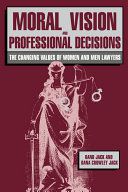
What does it mean today to “think like a lawyer”? Drawing on extensive interviews with men and women attorneys, the authors explore how moral reasoning affects lawyers’ understanding of justice and their own role in promoting it. This examination of personal and institutional imperatives in the legal profession, illustrated with quotations from the lawyers themselves, raises questions that transcend traditional discussions of legal ethics. The authors examine: the relationship between gender and patterns of moral thinking; the ways that personal morality affects public and professional responsibility; the legal system’s response to social changes in public ethics and in women’s roles. For example, has the recent influx of women to the legal profession brought moral views that challenge the traditional defining characteristics of a lawyer’s job? What happens when a lawyer’s personal morality conflicts with the role demands of the profession? In conclusion the authors offer suggestions for constructive changes in legal education and the code of professional ethics to foster morally responsive democracy. All those concerned with moral reasoning, gender roles, and the evolution of the legal system will find this stimulating and timely reading.
Many words and expressions are viewed as ‘taboo’, such as those used to describe sex, our bodies and their functions, and those used to insult other people. This book provides a fascinating insight into taboo language and its role in everyday life. It looks at the ways we use language to be polite or impolite, politically correct or offensive, depending on whether we are ‘sweet-talking’, ‘straight-talking’ or being deliberately rude. Using a range of colourful examples, it shows how we use language playfully and figuratively in order to swear, to insult, and also to be politically correct, and what our motivations are for doing so. It goes on to examine the differences between institutionalized censorship and the ways individuals censor their own language. Lively and revealing, Forbidden Words will fascinate anyone who is interested in how and why we use and avoid taboos in daily conversation.
Most recent texts in moral philosophy have either concentrated on practical moral issues or else, if theoretical, have tended toward one-sided presentations of recent, fashionable views. Discussions of applied ethics cannot go very far without revealing underlying philosophical assumptions about how deeper, more general issues are treated. Similarly, recent approaches to ethics are difficult to understand without a knowledge of the context of the historical views against which these approaches are reacting. The Nature of Moral Thinkingwill satisfy the intellectually curious student, providing a solid and fair discussion of the classical philosophical questions about our moral thinking, surveying the main types of meta-ethical and normative ethical theories, while not excluding the more recent discussions of moral realism, of anti-realism, and of virtue morality. Francis Snare demonstrates that glib intellectualistic thinking about morality, especially in regard to relativism andsubjectivism, is seriously flawed. He also focuses attention on the question of whether particular theories of the origins of morality (for example, those of Nietzsche and Marx) undermine morality. All students and teachers of ethics and philosophy will find this book one of the most complete and detailed introductory-level surveys of the foundations of ethics with emphasis on the problems of the subjectivity, the relativity, and the origins of morality.
ما از اخلاق چه انتظاری داریم؟ این سوال شاید تاحدودی برای عموم مردم و یا متخصصان این رشته قابل پاسخ باشد؛ اینکه خوب بودن را به ما بیاموزد و در تنظیم روابط فردی م...

جشن کتاب تهران به ایستگاه سی و یکم رسیده است. حال و احوال نشر کتاب خوب نیست و باید فرهنگدوستان را به خرید و هدیه دادن کتاب ترغیب نمود. خانه اخلاقپژوهان جوان ب...

بنیاد کتابهای اخلاق اسلامی عمدتا پالایش جان از آلودگیها و آراستن آن به زیباییها است. اندیشه محوری این قبیل کتابها آن است که انسان فعلی آنی نیست که باید باشد...

-
0 Comments