Notice: تابع WP_Block_Type_Registry::register به طورنادرست فراخوانی شد. نامهای نوع بلوک نباید حروف بزرگ داشته باشند. لطفاً برای اطلاعات بیشتر، اشکال زدایی در وردپرس را مشاهده کنید. (این پیام در نگارش 5.0.0 افزوده شده است.) in /home/ethicsho/public_html/wp-includes/functions.php on line 5313
Warning: Use of undefined constant TDC_PATH_LEGACY - assumed 'TDC_PATH_LEGACY' (this will throw an Error in a future version of PHP) in /home/ethicsho/public_html/wp-content/plugins/td-composer/td-composer.php on line 109
Warning: Use of undefined constant TDSP_THEME_PATH - assumed 'TDSP_THEME_PATH' (this will throw an Error in a future version of PHP) in /home/ethicsho/public_html/wp-content/plugins/td-composer/td-composer.php on line 113 بایگانیهای Judges - Biography. - United States - خانه اخلاق پژوهان جوان Notice: Trying to access array offset on value of type bool in /home/ethicsho/public_html/wp-content/plugins/wp-ulike/inc/general-functions.php on line 807
“Critically examines theories of cosmopolitan justice grounded in the major traditions of moral philosophy. Drawing upon the international ethics tradition, this book presents an argument for the validity of obligations of social justice between countries”–
Immanuel Kant (1724-1804) is arguably the most influential of the Enlightenment Philosophers. In this outstanding introduction, Paul Guyer introduces and assesses all the major aspects of Kant’s thought. Beginning with a helpful overview of Kant’s life and times, Guyer introduces the “Copernican revolution” Kant brought about in metaphysics and epistemology, carefully introducing his arguments about the nature of experience, space and time in his most influential but difficult work,The Critique of Pure Reason.He gives a much-needed explanation of Kant’s famous theory of transcendental idealism, a cornerstone of his philosophy as a whole. He then examines Kant’s moral philosophy, clearly explaining Kant’s celebrated “categorical imperative” and his theories of duty, freedom of the will, and rights. Finally, he covers Kant’s aesthetics, in particular his arguments about the nature of beauty and the sublime and their relation to human freedom and happiness. A concluding chapterconsiders Kant’s legacy and his influence on the shape of contemporary philosophy. Kant is an ideal starting point for anyone coming to the philosopher for the first time, as well as those studying Kant in related disciplines.
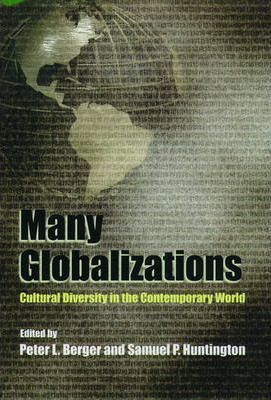
Much discussed but poorly understood, globalization is praised as the answer to all the world’s problems and blamed for everything from pollution to poverty. In Many Globalizations, Peter Berger and Samuel Huntington bring together an array of scholars from around the world, who paint a far subtler and more richly shaded portrait, showing both the power and the unexpected consequences of this great force. Here the stereotypes of globalization as American imperialism on the one hand or economic cure-all on the other fall apart under the close scrutiny of these leading scholars. Looking at globalization in countries such as Chile, Japan, South Africa, Germany, Turkey, Hungary, Taiwan, India, and the United States, they show that an emerging global culture does indeed exist, one that is heavily American in origin and content, but that is far from a centrally directed force like classic imperialism–nor is it simply a “metastasized Disneyland.” They examine the currents that carry this culture, from a worldwide class of young professionals to nongovernmental organizations, and define globalization’s many variations (ranging from Buddhist influences to Islamic modernism) as well as subglobalizations that bind regions together. The authors also draw attention to globalizing forces that have escaped media scrutiny, such as the role of evangelical Protestantism (which both adapts to local languages and cultures, and introduce distinctively American values) and Opus Dei, the conservative Catholic movement that originated in Spain. Analytical, incisive and stimulating, Many Globalizations offers rare insight into perhaps the central issue of modern times, one that is changing the West as much as the developing world.
A great deal has been written on the theoretical aspects of copyright and the cultural industries but less so on the applied side – how copyright law works in practice. How do lawyers, firms and artists manage and administer copyright and what economic and legal problems does this raise? In recent times in particular, technological inventions appear to have outpaced the development of copyright law. This volume addresses these issues and looks at the serious implications for copyright policy in the future.
This book discusses Alasdair MacIntyre’s engagement with Marxism from the early 1950s to the present. It begins with his early writings on Marxism and Christianity, moving through his period in the New Left and the Socialist Labour League and International Socialism in the late 1950s and 1960s. It then discusses MacIntyre’s break with Marxism by developing the brief but telling five-point critique he gives of Marxism in his 1981 volume After Virtue. Marxism, Ethics and Politics highlights MacIntyre’s continuing admiration for much in Marx’s thought, noting that his contemporary project is developed in response to what he now sees as the inadequacies of Marxism, particularly Marxist politics. It concludes by examining the place of Marxism in the contemporary MacIntyrean debate and by pointing out the contested nature of the claims about Marxism that MacIntyre makes.
ما از اخلاق چه انتظاری داریم؟ این سوال شاید تاحدودی برای عموم مردم و یا متخصصان این رشته قابل پاسخ باشد؛ اینکه خوب بودن را به ما بیاموزد و در تنظیم روابط فردی م...

جشن کتاب تهران به ایستگاه سی و یکم رسیده است. حال و احوال نشر کتاب خوب نیست و باید فرهنگدوستان را به خرید و هدیه دادن کتاب ترغیب نمود. خانه اخلاقپژوهان جوان ب...

بنیاد کتابهای اخلاق اسلامی عمدتا پالایش جان از آلودگیها و آراستن آن به زیباییها است. اندیشه محوری این قبیل کتابها آن است که انسان فعلی آنی نیست که باید باشد...

-
0 Comments