
Notice: تابع WP_Block_Type_Registry::register به طورنادرست فراخوانی شد. نامهای نوع بلوک نباید حروف بزرگ داشته باشند. لطفاً برای اطلاعات بیشتر، اشکال زدایی در وردپرس را مشاهده کنید. (این پیام در نگارش 5.0.0 افزوده شده است.) in /home/ethicsho/public_html/wp-includes/functions.php on line 5313
Warning: Use of undefined constant TDC_PATH_LEGACY - assumed 'TDC_PATH_LEGACY' (this will throw an Error in a future version of PHP) in /home/ethicsho/public_html/wp-content/plugins/td-composer/td-composer.php on line 109
Warning: Use of undefined constant TDSP_THEME_PATH - assumed 'TDSP_THEME_PATH' (this will throw an Error in a future version of PHP) in /home/ethicsho/public_html/wp-content/plugins/td-composer/td-composer.php on line 113 بایگانیهای Islam And Humanism - خانه اخلاق پژوهان جوان Notice: Trying to access array offset on value of type bool in /home/ethicsho/public_html/wp-content/plugins/wp-ulike/inc/general-functions.php on line 807
To be responsible for their acts, agents must both perform those acts voluntarily and in some sense know what they are doing. Of these requirements, the voluntariness condition has been much discussed, but the epistemic condition has received far less attention. In Who Knew? George Sher seeks to rectify that imbalance. The book is divided in two halves, the first of which criticizes a popular but inadequate way of understanding the epistemic condition, while the second seeks to develop a more adequate alternative. It is often assumed that agents are responsible only for what they are aware of doing or bringing about–that their responsibility extends only as far as the searchlight of their consciousness. The book criticizes this “searchlight view” on two main grounds: first, that it is inconsistent with our attributions of responsibility to a broad range of agents who should but do not realize that they are acting wrongly or foolishly, and, second, that the view is not independently defensible. The book’s positive view construes the crucial relation between an agent and his failure to recognize the wrongness or foolishness of what he is doing in causal terms: the agent is responsible when, and because, his failure to respond to his reasons for believing that he is acting wrongly or foolishly has its origins in the same constitutive psychology that generally does render him reason-responsive.
Why democracy? Most often this question is met with an appeal to some decidedly moral value, such as equality, liberty, dignity, or even peace. But in contemporary democratic societies, there is deep disagreement and conflict about the precise nature and relative worth of these values. And when democracy votes, some of those who lose will see the prevailing outcome as not merely disappointing, but morally intolerable. How should citizens react when confronted with a democratic result that they regard as intolerable? Should they revolt, or instead pursue democratic means of social change? In this book, Robert Talisse argues that each of us has reasons to uphold democracy – even when it makes serious moral errors – and that these reasons are rooted in our most fundamental epistemic commitments. His original and compelling study will be of interest to a wide range of readers in political philosophy and political theory.
“This book examines the relationship between politics, ethics and law in risk governance involving multi-valued human biological materials, such as blood. HIV blood contamination episodes in the USA, England and France are used to examine the emergence of and the consequences resulting from the politicization of risk. The emergence of the phenomenon is examined through a focus on the role of the gift relationship in blood donation, as well as scientific expertise and innovation in risk governance processes involving the blood system. Its consequences are examined through an analysis of legal action taken by aggrieved patient groups, in addition to a critique of the increased use of precautionary and regulatory strategies in dealing with emerging risks to blood safety”– Provided by publisher.
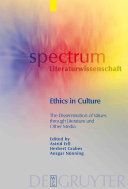
Alongside the recent cultural turn in the humanities, there has been a noticeable return to ethical considerations. With regard to literature as well as other media, this has rekindled awareness of a tension, antagonism, or even disparity between ethics and aesthetics. This volume of articles takes a more systematic and cross-disciplinary approach to the widely mooted ethical turn in literature and other media than has been pursued so far. It brings together a wide range of critical perspectives from literary studies, media and cultural memory studies, and philosophy, tracing the complex and sometimes conflicting relationship between ethics and aesthetics in theoretical contexts and individual case studies as diverse as colonial architecture, nineteenth-century literary histories, and postmodern writing and art.
Purchase of this book includes free trial access to www.million-books.com where you can read more than a million books for free. This is an OCR edition with typos. Excerpt from book: CHAPTER III. ON QUALITY OF PLEASURE. I Alluded in the last chapter to the two great unsettled questions, to what degree happiness is different for different people, and how far it is in each man’s own power for himself. Both these questions concern the subject of this chapter. If happiness is different for different people, how far ought it to be so ? And how far can we raise the character of our happiness ? There is perhaps a disposition in our age to accept A morality jTi i iT ofhappi- a morality of happiness as better, more like what we ness, espe- expect morality to be, than one of rule: such a hoi,,1 morality may take the form of a utilitarianism recog- rj;e nizing different kinds of pleasures, some worthier and is more c- more to be striven after than others. Religion too than’a mo- has not unfrequently shown itself more in harmony i1ety of with the moral philosophy which speaks much of happiness than with that which speaks much of law. And though it is true that when religion has spoken the language of bare utilitarianism, as in Paley, it has not much commended itself to real human feeling: still when it is presented to us not only as conformable to our desire, but also as what is to regulate our desire, uniting with its promises to make us happy a call upon us for effort after a worthy happiness, and elevation of our idea of happiness (as we are told on the one hand that the ways of religion are pleasantness and her paths peace, while on the other hand we pray that we may love that which God commands and desire that he promises); the morality which is thus proposed to us has charms in our view which do not belong to a morality of rule. But this But then it is to be observed that this more at- worthiness tractive form of utilitarianism involves …
ما از اخلاق چه انتظاری داریم؟ این سوال شاید تاحدودی برای عموم مردم و یا متخصصان این رشته قابل پاسخ باشد؛ اینکه خوب بودن را به ما بیاموزد و در تنظیم روابط فردی م...

جشن کتاب تهران به ایستگاه سی و یکم رسیده است. حال و احوال نشر کتاب خوب نیست و باید فرهنگدوستان را به خرید و هدیه دادن کتاب ترغیب نمود. خانه اخلاقپژوهان جوان ب...

بنیاد کتابهای اخلاق اسلامی عمدتا پالایش جان از آلودگیها و آراستن آن به زیباییها است. اندیشه محوری این قبیل کتابها آن است که انسان فعلی آنی نیست که باید باشد...

-
0 Comments