Notice: تابع WP_Block_Type_Registry::register به طورنادرست فراخوانی شد. نامهای نوع بلوک نباید حروف بزرگ داشته باشند. لطفاً برای اطلاعات بیشتر، اشکال زدایی در وردپرس را مشاهده کنید. (این پیام در نگارش 5.0.0 افزوده شده است.) in /home/ethicsho/public_html/wp-includes/functions.php on line 5313
Warning: Use of undefined constant TDC_PATH_LEGACY - assumed 'TDC_PATH_LEGACY' (this will throw an Error in a future version of PHP) in /home/ethicsho/public_html/wp-content/plugins/td-composer/td-composer.php on line 109
Warning: Use of undefined constant TDSP_THEME_PATH - assumed 'TDSP_THEME_PATH' (this will throw an Error in a future version of PHP) in /home/ethicsho/public_html/wp-content/plugins/td-composer/td-composer.php on line 113 بایگانیهای Human Rights/ Religious Aspects/ Islam - خانه اخلاق پژوهان جوان Notice: Trying to access array offset on value of type bool in /home/ethicsho/public_html/wp-content/plugins/wp-ulike/inc/general-functions.php on line 807
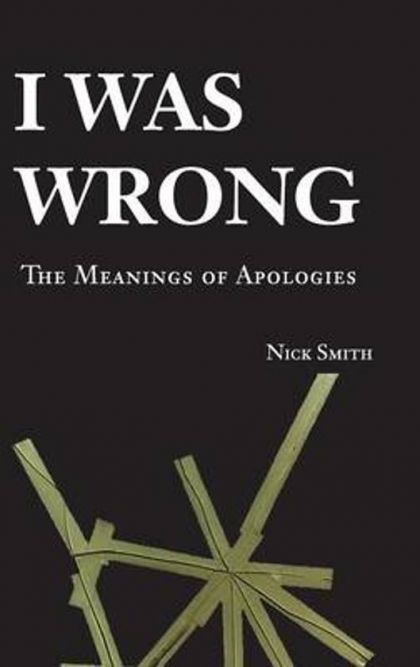
Apologies pervade our news headlines and our private affairs, but how should we evaluate these often vague and deceptive rituals? Discussing numerous examples from ancient and recent history, I Was Wrong: On The Meanings of Apologies argues that we suffer from considerable confusion about the moral meanings and social functions of these complex interactions. Rather than asking whether a speech act “is or is not” an apology, Smith offers a nuanced theory of apologetic meaning. Smith leads us with a clear voice though a series of rich philosophical and interdisciplinary questions, arguing that apologies have evolved from a confluence of diverse cultural and religious practices that do not translate easily into pluralistic secular discourse. After describing several varieties of apologies between individuals, Smith turns to collectives. Although apologies from corporations, governments, and other groups can be profoundly significant, Smith guides readers to appreciate the kinds of meaning that collective apologies often do not convey and warns of the dangers of collective acts of contrition that allow individual wrongdoers to obscure their personal blame. Dr. Smith is an assistant professor of philosophy at the University of New Hampshire. A graduate of Vassar College, he earned a law degree from SUNY at Buffalo and a Ph.D. in philosophy from Vanderbilt University. Before coming to UNH, he worked as a litigator for LeBoeuf, Lamb, Greene, and MacRae and as a judicial clerk for the Honorable R.L. Nygaard of the United States Court of Appeals for the Third Circuit. He specializes in the philosophy of Law, Politics, and Society and he writes on and teaches aesthetics. He is working with Cambridge University Press on the sequel to I Was Wrong, applying his framework for apologetic meanings to examples in criminal and civil law. His writings have appeared in journals such as Continental Philosophy Review, Social Theory and Practice, The Journal of Social Philosophy, Culture, Theory & Critique, The Rutgers Law Journal, and The Buffalo Law Review.
Nietzsche is one of the most important and controversial thinkers in the history of philosophy. His writings on moral philosophy are amongst the most widely read works both by philosophers and non-philosophers. Many of the ideas raised are both startling and disturbing and have been the source of great contention. On the Geneaology of Morality is Nietzsche’s most sustained and important contribution to moral philosophy, featuring many of the ideas fir which he is best known: the slave revolt in morals, will to power, geneaology, perspectivism. The Routledge Philosophy GuideBook to Nietzsche on Morality introduces the reader to these and other important Nietzschean themes patiently and clearly. It is the first book to examine the work in such a way and will be a vital point of reference for any Nietzsche scholar. The Routledge Philosophy GuideBook to Nietzsche on Morality will be vital for all studentnts coming to Nietzsche for the first time.
Nicomachean Ethics VI is considered one of classical philosophy’s greatest achievements. Aristotle on Practical Wisdom is the first full-scale commentary on this work to be issued in over a century, and is the most comprehensive and philosophically illuminating to date. A meticulous translation coupled with facing-page analysis enables readers to engage directly with the account of phronêsis or practical wisdom that Aristotle is developing, while a full introduction locates that account in the context of his ethical thought and of later ethical thought more generally.The commentary discusses the text line by line, illuminating obscure passages, explaining technical ones, and providing a new overall interpretation of the work and the nature of practical reason. A companion volume, Action, Contemplation, and Happiness, expands on this interpretation to provide a startling new picture of Aristotle’s thought as a whole. Although the two books can be approached separately, together they constitute one of the most daring and original contemporary readings of Aristotle’s philosophy. Aimed at committed students of these notoriously difficult writings, C. D. C. Reeve’s engaging and lucid books should find a wide audience among philosophers, classicists, and all readers willing to wrestle with a thinker of unparalleled subtlety, depth, and scope.
Most people believe that there are limits to the sacrifices that morality can demand. Although it would often be meritorious, we are not, in fact, morally required to do all that we can to promote overall good. What’s more, most people also believe that certain types of acts are simply forbidden, morally off limits, even when necessary for promoting the overall good. In this provocative analysis Kagan maintains that despite the intuitive appeal of these views, they cannot be adequately defended. In criticizing arguments for limited moral requirements as well as those for unconditionally prohibited acts, Kagan offers a sustained attack on two of the most basic features of ordinary common sense morality.
The growth of evidence-based medicine has occurred against a backdrop of health care reform, managed care, cost containment, and quality improvement. Clinicians have been urged to adopt the rigors of science while remaining true to their ‘clinical judgment’. This incisive book reviews the history and conceptual origins of evidence-based practice and discusses key ethical issues that arise in clinical practice, public health, and health policy. It is essential reading for all physicians, and practitioners in epidemiology and public health.
ما از اخلاق چه انتظاری داریم؟ این سوال شاید تاحدودی برای عموم مردم و یا متخصصان این رشته قابل پاسخ باشد؛ اینکه خوب بودن را به ما بیاموزد و در تنظیم روابط فردی م...

جشن کتاب تهران به ایستگاه سی و یکم رسیده است. حال و احوال نشر کتاب خوب نیست و باید فرهنگدوستان را به خرید و هدیه دادن کتاب ترغیب نمود. خانه اخلاقپژوهان جوان ب...

بنیاد کتابهای اخلاق اسلامی عمدتا پالایش جان از آلودگیها و آراستن آن به زیباییها است. اندیشه محوری این قبیل کتابها آن است که انسان فعلی آنی نیست که باید باشد...

-
0 Comments