Notice: تابع WP_Block_Type_Registry::register به طورنادرست فراخوانی شد. نامهای نوع بلوک نباید حروف بزرگ داشته باشند. لطفاً برای اطلاعات بیشتر، اشکال زدایی در وردپرس را مشاهده کنید. (این پیام در نگارش 5.0.0 افزوده شده است.) in /home/ethicsho/public_html/wp-includes/functions.php on line 5313
Warning: Use of undefined constant TDC_PATH_LEGACY - assumed 'TDC_PATH_LEGACY' (this will throw an Error in a future version of PHP) in /home/ethicsho/public_html/wp-content/plugins/td-composer/td-composer.php on line 109
Warning: Use of undefined constant TDSP_THEME_PATH - assumed 'TDSP_THEME_PATH' (this will throw an Error in a future version of PHP) in /home/ethicsho/public_html/wp-content/plugins/td-composer/td-composer.php on line 113 بایگانیهای Human Reproductive Technology - Law And Legislation - خانه اخلاق پژوهان جوان Notice: Trying to access array offset on value of type bool in /home/ethicsho/public_html/wp-content/plugins/wp-ulike/inc/general-functions.php on line 807
This is a close and comprehensive study of the main themes of Aristotle’s ethics. Sarah Broadie concentrates on what he has to teach about happiness, virtue, voluntary agency, practical reason, incontinence, pleasure, and the place of theoria in the best life. Never forgetting that ethics for Aristotle is above all a practical enterprise, she sheds new light on ways in which this practical orientation affects both content and method of his inquiry. The book culminates in a sustained argument showing how even Aristotle’s ideal of theoretic contemplation in integral to his essentially practical vision of human nature. Ethics with Aristotle is a major contribution toward the further understanding of Aristotle’s ethics.
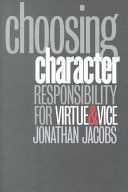
Are there key respects in which character and character defects are voluntary? Can agents with serious vices be rational agents? Jonathan Jacobs answers in the affirmative. Moral character is shaped through voluntary habits, including the ways we habituate ourselves, Jacobs believes. Just as individuals can voluntarily lead unhappy lives without making unhappiness an end, so can they degrade their ethical characters through voluntary action that does not have establishment of vice as its end. Choosing Character presents an account of ethical disability, expanding the domain of responsibility and explicating the role of character in ethical cognition.Jacobs contends that agents become ethically disabled voluntarily when their habits impair their ability to properly appreciate ethical considerations. Such agents are rational, responsible individuals who are yet incapable of virtuous action. The view develops and modifies Aristotelian claims concerning the fixity of character. Jacobs’ interpretation is developed in contrast to the overlooked work of Maimonides, who also used Aristotelian resources but argued for the possibility of character change. The notion of ethical disability has profound ramifications for ethics and for current debates about blame and punishment.
Distributive justice in its modern sense calls on the state to guarantee that everyone is supplied with a certain level of material means. Samuel Fleischacker argues that guaranteeing aid to the poor is a modern idea, developed only in the last two centuries. Earlier notions of justice, including Aristotle’s, were concerned with the distribution of political office, not of property. It was only in the eighteenth century, in the work of philosophers such as Adam Smith and Immanuel Kant, that justice began to be applied to the problem of poverty. To attribute a longer pedigree to distributive justice is to fail to distinguish between justice and charity. Fleischacker explains how confusing these principles has created misconceptions about the historical development of the welfare state. Socialists, for instance, often claim that modern economics obliterated ancient ideals of equality and social justice. Free-market promoters agree but applaud the apparent triumph of skepticism and social-scientific rigor. Both interpretations overlook the gradual changes in thinking that yielded our current assumption that justice calls for everyone, if possible, to be lifted out of poverty. By examining major writings in ancient, medieval, and modern political philosophy, Fleischacker shows how we arrived at the contemporary meaning of distributive justice.
ما از اخلاق چه انتظاری داریم؟ این سوال شاید تاحدودی برای عموم مردم و یا متخصصان این رشته قابل پاسخ باشد؛ اینکه خوب بودن را به ما بیاموزد و در تنظیم روابط فردی م...

جشن کتاب تهران به ایستگاه سی و یکم رسیده است. حال و احوال نشر کتاب خوب نیست و باید فرهنگدوستان را به خرید و هدیه دادن کتاب ترغیب نمود. خانه اخلاقپژوهان جوان ب...

بنیاد کتابهای اخلاق اسلامی عمدتا پالایش جان از آلودگیها و آراستن آن به زیباییها است. اندیشه محوری این قبیل کتابها آن است که انسان فعلی آنی نیست که باید باشد...

-
0 Comments