Notice: تابع WP_Block_Type_Registry::register به طورنادرست فراخوانی شد. نامهای نوع بلوک نباید حروف بزرگ داشته باشند. لطفاً برای اطلاعات بیشتر، اشکال زدایی در وردپرس را مشاهده کنید. (این پیام در نگارش 5.0.0 افزوده شده است.) in /home/ethicsho/public_html/wp-includes/functions.php on line 5313
Warning: Use of undefined constant TDC_PATH_LEGACY - assumed 'TDC_PATH_LEGACY' (this will throw an Error in a future version of PHP) in /home/ethicsho/public_html/wp-content/plugins/td-composer/td-composer.php on line 109
Warning: Use of undefined constant TDSP_THEME_PATH - assumed 'TDSP_THEME_PATH' (this will throw an Error in a future version of PHP) in /home/ethicsho/public_html/wp-content/plugins/td-composer/td-composer.php on line 113 بایگانیهای Human-animal Relationships - Philosophy - خانه اخلاق پژوهان جوان Notice: Trying to access array offset on value of type bool in /home/ethicsho/public_html/wp-content/plugins/wp-ulike/inc/general-functions.php on line 807
John Rawls is the preeminent political philosopher of our time. His 1971 masterpiece, A Theory of Justice, permanently changed the landscape of moral political theory, revitalizing the normative study of social issues and taking stands about justice, ethics, rationality and philosophical method that continue to draw followers and critics today.In these five volumes, Henry S. Richardson and Paul Weithman draw together almost 90 of the most incisive and influential articles in that body of literature. The reprinted articles, many of them drawn from difficult-to-find sources, cover the gamut of controversies and conversations sparked by Rawls’s work and represent a wide range of philosophical points of view. The selection also includes articles that reflect Rawls’s reception in economics, law, and the social science more broadly.The publication of these five volumes will be welcomed by students and scholars of contemporary political philosophy, and by anyone interested in the most probing reactions to the premier political philosopher of our time.
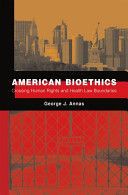
Bioethics was “born in the USA” and the values American bioethics embrace are based on American law, including liberty and justice. This book crosses the borders between bioethics and law, but moves beyond the domestic law/bioethics struggles for dominance by exploring attempts to articulate universal principles based on international human rights. The isolationism of bioethics in the US is not tenable in the wake of scientific triumphs like decoding the human genome, and civilizational tragedies like international terrorism. Annas argues that by crossing boundaries which have artificially separated bioethics and health law from the international human rights movement, American bioethics can be reborn as a global force for good, instead of serving mainly the purposes of U.S. academics. This thesis is explored in a variety of international contexts such as terrorism and genetic engineering, and in U.S. domestic disputes such as patient rights and market medicine. The citizens of the world have created two universal codes: science has sequenced the human genome and the United Nations has produced the Universal Declaration of Human Rights. The challenge for American bioethics is to combine these two great codes in imaginative and constructive ways to make the world a better, and healthier, place to live.
Based on a non-consequentialist ethical theory, this book critically examines the prevalent view that if a fetus has the moral standing of a person, it has a right to life and abortion is impermissible. Most discussion of abortion has assumed that this view is correct, and so has focused on the question of the personhood of the fetus. Kamm begins by considering in detail the permissibility of killing in non-abortion cases which are similar to abortion cases. She goes on to consider the case for the permissibility of abortion in many types of pregnancies, including ones resulting from rape, voluntary pregnancy, and pregnancy resulting from a voluntary sex act, even if the fetus is considered a person. This argument emerges as part of a broader theory of creating new people responsibly. Kamm explores the implications of this argument for informed consent to abortion; responsibilities in pregnancy that is not aborted, and the significance of extra-uterine gestation devices for the permissibility of abortion.
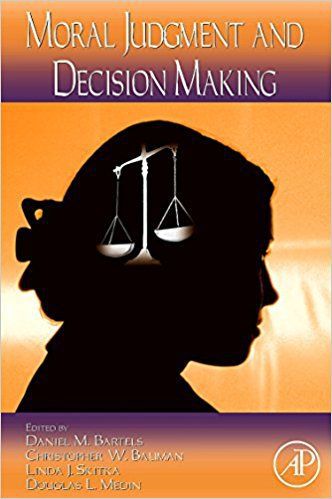
This volume presents a variety of perspectives from within and outside moral psychology. Recently there has been an explosion of research in moral psychology, but it is one of the subfields most in need of bridge-building, both within and across areas. Interests in moral phenomena have spawned several separate lines of research that appear to address similar concerns from a variety of perspectives. The contributions to this volume examine key theoretical and empirical issues these perspectives share that connect these issues with the broader base of theory and research in social and cognitive psychology. The first two chapters discuss the role of mental representation in moral judgment and reasoning. Sloman, Fernbach, and Ewing argue that causal models are the canonical representational medium underlying moral reasoning, and Mikhail offers an account that makes use of linguistic structures and implicates legal concepts. Bilz and Nadler follow with a discussion of the ways in which laws, which are typically construed in terms of affecting behavior, exert an influence on moral attitudes, cognition, and emotions. Baron and Ritov follow with a discussion of how people’s moral cognition is often driven by law-like rules that forbid actions and suggest that value-driven judgment is relatively less concerned by the consequences of those actions than some normative standards would prescribe. Iliev et al. argue that moral cognition makes use of both rules and consequences, and review a number of laboratory studies that suggest that values influence what captures our attention, and that attention is a powerful determinant of judgment and preference. Ginges follows with a discussion of how these value-related processes influence cognition and behavior outside the laboratory, in high-stakes, real-world conflicts. Two subsequent chapters discuss further building blocks of moral cognition. Lapsley and Narvaez discuss the development of moral characters in children, and Reyna and Casillas offer a memory-based account of moral reasoning, backed up by developmental evidence. Their theoretical framework is also very relevant to the phenomena discussed in the Sloman et al., Baron and Ritov, and Iliev et al. chapters. The final three chapters are centrally focused on the interplay of hot and cold cognition. They examine the relationship between recent empirical findings in moral psychology and accounts that rely on concepts and distinctions borrowed from normative ethics and decision theory. Connolly and Hardman focus on bridge-building between contemporary discussions in the judgment and decision making and moral judgment literatures, offering several useful methodological and theoretical critiques. Ditto, Pizarro, and Tannenbaum argue that some forms of moral judgment that appear objective and absolute on the surface are, at bottom, more about motivated reasoning in service of some desired conclusion. Finally, Bauman and Skitka argue that moral relevance is in the eye of the perceiver and emphasize an empirical approach to identifying whether people perceive a given judgment as moral or non-moral. They describe a number of behavioral implications of people’s reported perception that a judgment or choice is a moral one, and in doing so, they suggest that the way in which researchers carve out the moral domain a priori might be dubious.
ما از اخلاق چه انتظاری داریم؟ این سوال شاید تاحدودی برای عموم مردم و یا متخصصان این رشته قابل پاسخ باشد؛ اینکه خوب بودن را به ما بیاموزد و در تنظیم روابط فردی م...

جشن کتاب تهران به ایستگاه سی و یکم رسیده است. حال و احوال نشر کتاب خوب نیست و باید فرهنگدوستان را به خرید و هدیه دادن کتاب ترغیب نمود. خانه اخلاقپژوهان جوان ب...

بنیاد کتابهای اخلاق اسلامی عمدتا پالایش جان از آلودگیها و آراستن آن به زیباییها است. اندیشه محوری این قبیل کتابها آن است که انسان فعلی آنی نیست که باید باشد...

-
0 Comments