Notice: تابع WP_Block_Type_Registry::register به طورنادرست فراخوانی شد. نامهای نوع بلوک نباید حروف بزرگ داشته باشند. لطفاً برای اطلاعات بیشتر، اشکال زدایی در وردپرس را مشاهده کنید. (این پیام در نگارش 5.0.0 افزوده شده است.) in /home/ethicsho/public_html/wp-includes/functions.php on line 5313
Warning: Use of undefined constant TDC_PATH_LEGACY - assumed 'TDC_PATH_LEGACY' (this will throw an Error in a future version of PHP) in /home/ethicsho/public_html/wp-content/plugins/td-composer/td-composer.php on line 109
Warning: Use of undefined constant TDSP_THEME_PATH - assumed 'TDSP_THEME_PATH' (this will throw an Error in a future version of PHP) in /home/ethicsho/public_html/wp-content/plugins/td-composer/td-composer.php on line 113 بایگانیهای Epistemology - خانه اخلاق پژوهان جوان Notice: Trying to access array offset on value of type bool in /home/ethicsho/public_html/wp-content/plugins/wp-ulike/inc/general-functions.php on line 807
The articles in this volume dedicated to Hans Daiber, one of the pioneering scholars in the history of Islamic thought in the Middle Ages, offer new insights into this field from a variety of perspectives: philological, philosophical, and historical.
Whether firms can be said to be moral agents and to have the capacity for moral responsibility has significant practical consequences. In most legal systems in the world, business firms are recognized as persons with the ability to own property, to maintain and defend lawsuits, and to self-organize governance structures. To recognize that these business persons can also act morally or immorally as organizations, however, would justify the imposition of other legal constraints and normative expectations on organizations. In the criminal law, for example, the idea that an organized firm may itself have criminal culpability is accepted in many countries (such as the United States) but rejected in others (such as Germany). This book collects new contributions by leading business scholars in business ethics, philosophy, and related disciplines to extend our understanding of the moral responsibility of firms.
Undermining the fundamental place of freedom, equality and universal reason, Nietzsche’s philosophy recognises that we occupy multiple and contradictory subject positions within social life. With no metaphysical realm of reason, no divine inspiration for morality, and no transcendental basis for human essence, we are left with the embodied, reflective and creative self as a source of ethics. From this perspective arises Nietzsche’s bermensch, a continuous process of overcoming and becoming, interpreted as a metaphor for education that honours difference and incorporates otherness. The book explores the development of Nietzsche’s philosophy and its application to the problems of education, disturbing traditional liberal and democratic accounts of the relationship between individual and society. Threaded throughout is the author’s critique of the way educational institutions are driven by political and economic considerations, explored through notions of autonomy and subjectivity. The book is suitable for graduate students and academics wanting to engage either with postmodern interpretations of ethics in education, or with political philosophy in relation to development of self and community.
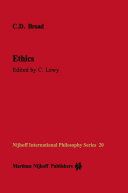
This volume contains C. D. Broad’s Cambridge lectures on Ethics. Broad gave a course of lectures on the subject, intended primarily for Part I of the Moral Sciences Tripos, every academic year from 1933 – 34 up to and in cluding 1952 – 53 (except that he did not lecture on Ethics in 1935 – 36). The course however was frequently revised, and the present version is es sentially that which he gave in 1952 – 53. Broad always wrote out his lectures fully beforehand, and the manuscript on Ethics, although full of revisions, is in a reasonably good state. But his handwriting is small and close and in places difficult to decipher. I therefore fear that some words may have been misread. There was an additional complication. In the summer of 1953 Broad revised and enlarged two sections of the course, namely the section on “Moore’s theory” and that on “Naturalistic theories” (both sections occur in Chapter 4). The revised version of the section on Moore is undoubtedly superior to the earlier version, and I have therefore included it. But in my opinion this is not true of the new version of the section on naturalistic theories: although more comprehensive than the earlier version, it is not only repetitive in itself, but also repeats, sometimes almost verbatim, passages which occur elsewhere in the lectures. In brief, the new version is not fully integrated with the rest of the course.
Neither the morality of human rights nor its relation to the law of human rights is well understood. In this book, Perry addresses three large issues: – There is undeniably a religious ground for the morality of human rights. But is there a nonreligious (secular) ground for the morality of human rights? – What is the relation between the morality of human rights and the law of human rights? Perry here addresses the controversial issues of capital punishment, abortion, and same-sex unions. – What is the proper role of courts, in a liberal democracy, in protecting – and therefore in interpreting – constitutionally entrenched human rights? In considering this question, special attention is paid to the Supreme Court and how it should rule on hot button issues such as capital punishment and abortion. Toward a Theory of Human Rights makes a significant contribution both to human rights studies and to constitutional theory.
ما از اخلاق چه انتظاری داریم؟ این سوال شاید تاحدودی برای عموم مردم و یا متخصصان این رشته قابل پاسخ باشد؛ اینکه خوب بودن را به ما بیاموزد و در تنظیم روابط فردی م...

جشن کتاب تهران به ایستگاه سی و یکم رسیده است. حال و احوال نشر کتاب خوب نیست و باید فرهنگدوستان را به خرید و هدیه دادن کتاب ترغیب نمود. خانه اخلاقپژوهان جوان ب...

بنیاد کتابهای اخلاق اسلامی عمدتا پالایش جان از آلودگیها و آراستن آن به زیباییها است. اندیشه محوری این قبیل کتابها آن است که انسان فعلی آنی نیست که باید باشد...

-
0 Comments