

Notice: تابع WP_Block_Type_Registry::register به طورنادرست فراخوانی شد. نامهای نوع بلوک نباید حروف بزرگ داشته باشند. لطفاً برای اطلاعات بیشتر، اشکال زدایی در وردپرس را مشاهده کنید. (این پیام در نگارش 5.0.0 افزوده شده است.) in /home/ethicsho/public_html/wp-includes/functions.php on line 5313
Warning: Use of undefined constant TDC_PATH_LEGACY - assumed 'TDC_PATH_LEGACY' (this will throw an Error in a future version of PHP) in /home/ethicsho/public_html/wp-content/plugins/td-composer/td-composer.php on line 109
Warning: Use of undefined constant TDSP_THEME_PATH - assumed 'TDSP_THEME_PATH' (this will throw an Error in a future version of PHP) in /home/ethicsho/public_html/wp-content/plugins/td-composer/td-composer.php on line 113 بایگانیهای Environmental Justice - خانه اخلاق پژوهان جوان Notice: Trying to access array offset on value of type bool in /home/ethicsho/public_html/wp-content/plugins/wp-ulike/inc/general-functions.php on line 807
Research Ethics for Social Scientists sets out to do four things: The first is to demonstrate the practical value of thinking seriously and systematically about what constitutes ethical conduct in social science research. Secondly, the text identifies how and why current regulatory regimes have emerged. Thirdly, it seeks to reveal those practices that have contributed to the adversarial relationships between researchers and regulators. Finally, the book hopes to encourage both parties to develop shared solutions to ethical and regulatory problems. (Backcover)
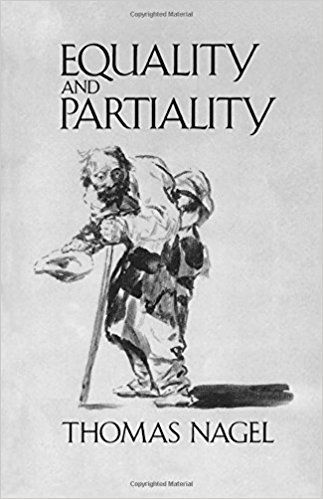
Derived from Thomas Nagel’s Locke Lectures, Equality and Partiality proposes a nonutopian account of political legitimacy, based on the need to accommodate both personal and impersonal motives in any credible moral theory, and therefore in any political theory with a moral foundation. Within each individual, Nagel believes, there is a division between two standpoints, the personal and the impersonal. Without the impersonal standpoint, there would be no morality, only the clash, compromise, and occasional convergence of individual perspectives. It is because a human being does not occupy only his own point of view that each of us is susceptible to the claims of others through private and public morality. Political systems, to be legitimate, must achieve an integration of these two standpoints within the individual. These ideas are applied to specific problems such as social and economic inequality, toleration, international justice, and the public support of culture. Nagel points to the problem of balancing equality and partiality as the most important issue with which political theorists are now faced.
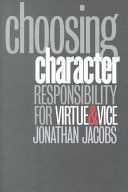
Are there key respects in which character and character defects are voluntary? Can agents with serious vices be rational agents? Jonathan Jacobs answers in the affirmative. Moral character is shaped through voluntary habits, including the ways we habituate ourselves, Jacobs believes. Just as individuals can voluntarily lead unhappy lives without making unhappiness an end, so can they degrade their ethical characters through voluntary action that does not have establishment of vice as its end. Choosing Character presents an account of ethical disability, expanding the domain of responsibility and explicating the role of character in ethical cognition.Jacobs contends that agents become ethically disabled voluntarily when their habits impair their ability to properly appreciate ethical considerations. Such agents are rational, responsible individuals who are yet incapable of virtuous action. The view develops and modifies Aristotelian claims concerning the fixity of character. Jacobs’ interpretation is developed in contrast to the overlooked work of Maimonides, who also used Aristotelian resources but argued for the possibility of character change. The notion of ethical disability has profound ramifications for ethics and for current debates about blame and punishment.
ما از اخلاق چه انتظاری داریم؟ این سوال شاید تاحدودی برای عموم مردم و یا متخصصان این رشته قابل پاسخ باشد؛ اینکه خوب بودن را به ما بیاموزد و در تنظیم روابط فردی م...

جشن کتاب تهران به ایستگاه سی و یکم رسیده است. حال و احوال نشر کتاب خوب نیست و باید فرهنگدوستان را به خرید و هدیه دادن کتاب ترغیب نمود. خانه اخلاقپژوهان جوان ب...

بنیاد کتابهای اخلاق اسلامی عمدتا پالایش جان از آلودگیها و آراستن آن به زیباییها است. اندیشه محوری این قبیل کتابها آن است که انسان فعلی آنی نیست که باید باشد...

-
0 Comments