Notice: تابع WP_Block_Type_Registry::register به طورنادرست فراخوانی شد. نامهای نوع بلوک نباید حروف بزرگ داشته باشند. لطفاً برای اطلاعات بیشتر، اشکال زدایی در وردپرس را مشاهده کنید. (این پیام در نگارش 5.0.0 افزوده شده است.) in /home/ethicsho/public_html/wp-includes/functions.php on line 5313
Warning: Use of undefined constant TDC_PATH_LEGACY - assumed 'TDC_PATH_LEGACY' (this will throw an Error in a future version of PHP) in /home/ethicsho/public_html/wp-content/plugins/td-composer/td-composer.php on line 109
Warning: Use of undefined constant TDSP_THEME_PATH - assumed 'TDSP_THEME_PATH' (this will throw an Error in a future version of PHP) in /home/ethicsho/public_html/wp-content/plugins/td-composer/td-composer.php on line 113 بایگانیهای Environmental Ethics - History - خانه اخلاق پژوهان جوان Notice: Trying to access array offset on value of type bool in /home/ethicsho/public_html/wp-content/plugins/wp-ulike/inc/general-functions.php on line 807
From the relative obscurity in which Levinas’s work languished until very recently, Emmanuel Levinas must now be judged as one of the most influential figures in contemporary Continental philosophy. There is no better guide than John Lewelyn to lead one through the thickets of Levinas’s prose. Bursting with questions, multiple references, cascading citations and multilingual puns and nuances, this book is the compelling record of intellectual obsession. Taking as its guiding thre the theme of genealogy, the book gives a broadly chronological and impressively manageable presentation of the whole sweep of the Levinas’s work. Balanced and finely grained, Llewelyn confronts questions of method, Heidegger, phenomenology, the theme of sensibility, religion, enjoyment, feminity, eros, justice and the political. The book reaches a stunning climax in a series of chapters that give a hestitant but tolerant discussion of the question of God in Levinas, the relation to Levinasian ethics to Nietzscheangenealogy, and an extraordinary discussion of metaphor that leads into a wholly original analysis of Levinas’s poetics and metaphorics. The book concludes with a sensitive reading of the autobiographical epigraphs to Levinas’sOtherwise than Being…and a consideration of the Holocaust.
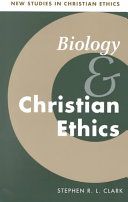
This stimulating and wide-ranging book mounts a profound enquiry into some of the most pressing questions of our age, by examining the relationship between biological science and Christianity. The history of biological discovery is explored from the point of view of a leading philosopher and ethicist. What effect should modern biological theory and practice have on Christian understanding of ethics? How much of that theory and practice should Christians endorse? To what extent can “nature” set our standards? Professor Clark takes a reasoned look at biological theory since Darwin and argues that an orthodox Christian philosophy is better able to accommodate the truth of such theory than is the sort of progressive, meliorist interpretation of Christian doctrine that is usually offered as the properly “modern” option.
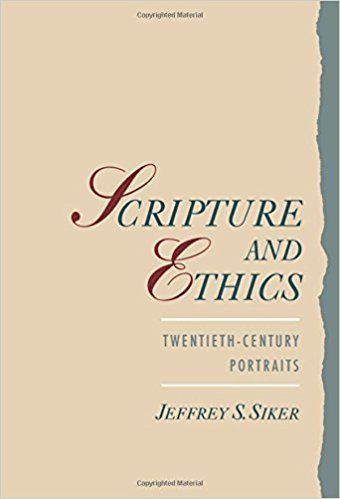
How should the Bible be used in Christian ethics? Although this question has been addressed many times, little attention has gone to how the Bible actually has functioned in constructing theological ethics. In this book, Siker describes and analyzes the Bible’s various uses in the theology and ethics of eight of the twentieth century’s most important and influential Christian theologians: Reinhold Niebuhr, H. Richard Niebuhr, Bernhard Haring, Paul Ramsey, Stanley Hauerwas, Gustavo Gutierrez, James Cone, and Rosemary Radford Ruether. Of each author Siker asks five related questions: which biblical texts does the author in fact use; in what ways are the texts used; how does the author envision the authority of the Bible; what kind of hermeneutic does the author employ; and what has each author’s approach to the Bible yielded in terms of Christian ethics? Siker ends each chapter with a critical evaluation of the various problems and prospects for the author’s use of Scripture, and concludes the study with a comparison and contrast of the authors’ respective appropriations of the Sermon on the Mount.
ما از اخلاق چه انتظاری داریم؟ این سوال شاید تاحدودی برای عموم مردم و یا متخصصان این رشته قابل پاسخ باشد؛ اینکه خوب بودن را به ما بیاموزد و در تنظیم روابط فردی م...

جشن کتاب تهران به ایستگاه سی و یکم رسیده است. حال و احوال نشر کتاب خوب نیست و باید فرهنگدوستان را به خرید و هدیه دادن کتاب ترغیب نمود. خانه اخلاقپژوهان جوان ب...

بنیاد کتابهای اخلاق اسلامی عمدتا پالایش جان از آلودگیها و آراستن آن به زیباییها است. اندیشه محوری این قبیل کتابها آن است که انسان فعلی آنی نیست که باید باشد...

-
0 Comments